
Patient Intake Automation
Overview
This Generative AI & LLM Integration Use Case demonstrates how healthcare providers can automate one of the most repetitive administrative tasks in patient management. Instead of having staff manually enter information from patient forms into healthcare systems, AI can collect, organize, and process data automatically.
Patient intake is often the first interaction between a patient and a healthcare provider. When this process is slow or dependent on manual data entry, it can create delays, increase administrative workload, and introduce errors. AI powered patient intake automation helps healthcare organizations streamline the process by capturing information directly from patients and feeding it into the appropriate systems.
The goal is to reduce manual work, improve data accuracy, and create a smoother experience for both patients and healthcare staff.
The Problem
Patient intake is a critical process in healthcare, but it is often highly manual. Patients typically complete forms containing personal information, medical history, insurance details, and appointment information. Once these forms are submitted, administrative staff frequently need to review the information and enter it into healthcare management systems.
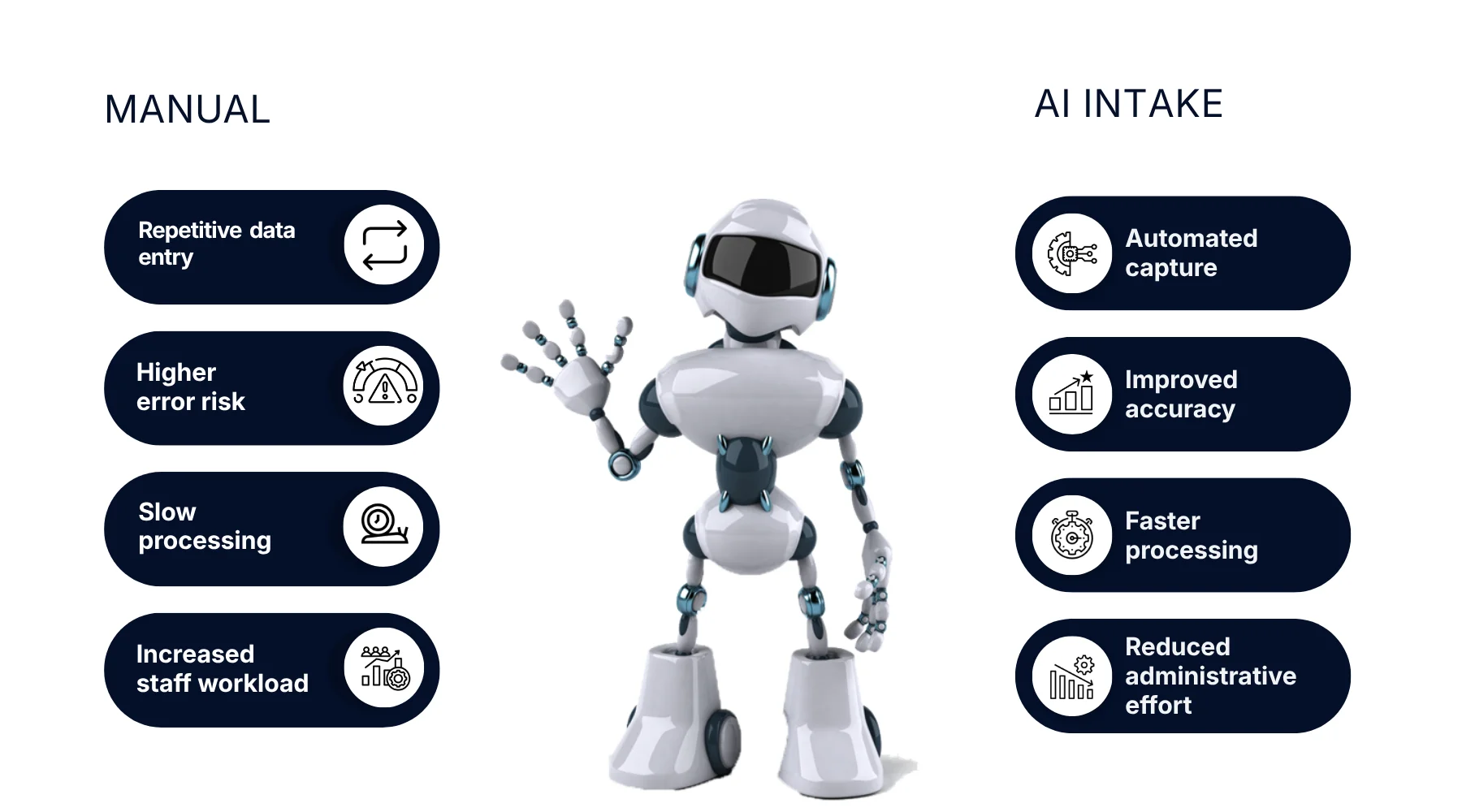
This process consumes a significant amount of time every day. Staff members may spend hours transferring information from paper forms, PDFs, emails, or online submissions into electronic health record systems. While the task may seem simple, the volume of patient information can make it a major operational burden.
Manual data entry also increases the risk of errors. Information may be entered incorrectly, important details may be missed, or records may be duplicated. Even small mistakes can create issues later, affecting scheduling, billing, treatment planning, or patient communication.
Another challenge is the impact on patient experience. Delays in processing forms can slow appointment preparation and increase waiting times. Patients expect healthcare organizations to handle information efficiently, and administrative bottlenecks can negatively affect satisfaction.
Healthcare providers must also maintain accurate and complete patient records. When intake processes rely heavily on manual work, consistency becomes difficult to maintain. Different staff members may enter information differently, creating data quality issues across the organization.
As patient volumes increase, these challenges become even more significant. More patients mean more forms, more administrative work, and more opportunities for mistakes. This can place unnecessary pressure on healthcare teams and reduce operational efficiency.
The AI Solution
Patient intake automation uses AI to collect patient information, organize it, and transfer it into healthcare systems automatically. This reduces the need for manual data entry while improving speed and accuracy.
Trigger
Staff re-enter patient form data by hand daily.
AI Action
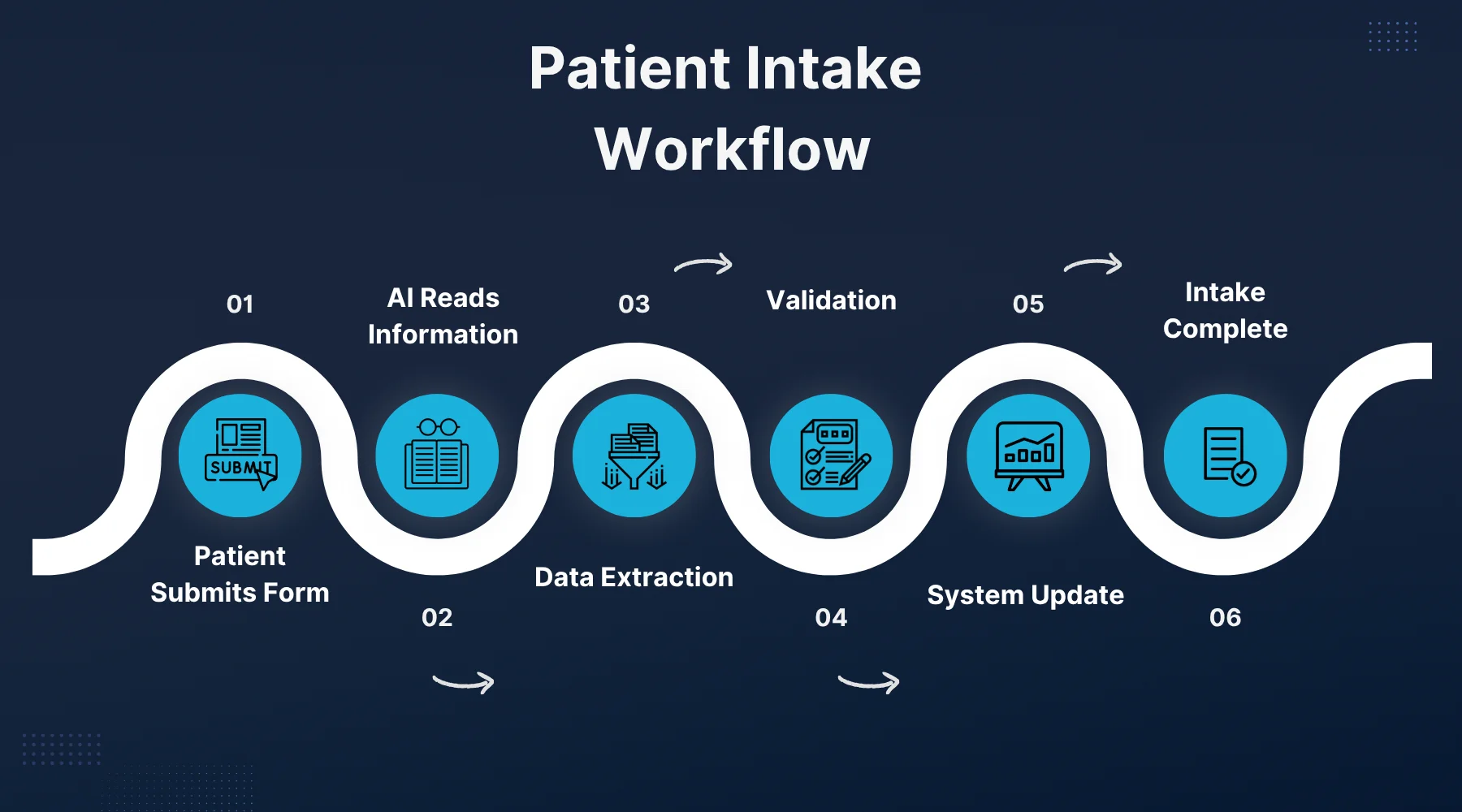
- Collect patient information: The system receives information from digital forms, uploaded documents, emails, or patient portals.
- Read and understand submitted data: The AI analyzes the content and identifies key patient details, including personal information, medical history, insurance information, and appointment requirements.
- Extract relevant fields: The system captures important data points and converts them into a structured format that healthcare systems can process.
- Validate information: The AI checks for missing fields, duplicate records, incorrect formats, or incomplete submissions before processing.
- Standardize patient data: Information is organized according to predefined healthcare data requirements to ensure consistency.
- Match existing patient records: The system searches for existing profiles to prevent duplicate entries and maintain accurate records.
- Update healthcare systems automatically: The extracted information is transferred directly into electronic health records, practice management software, or patient databases.
- Flag exceptions for review: Any unclear or incomplete information is routed to staff members for verification.
- Track processing status: The system records each action and maintains an audit trail for compliance and operational visibility.
- Confirm successful intake completion: Once all data has been processed, the system updates records and notifies the appropriate teams.
Outcome
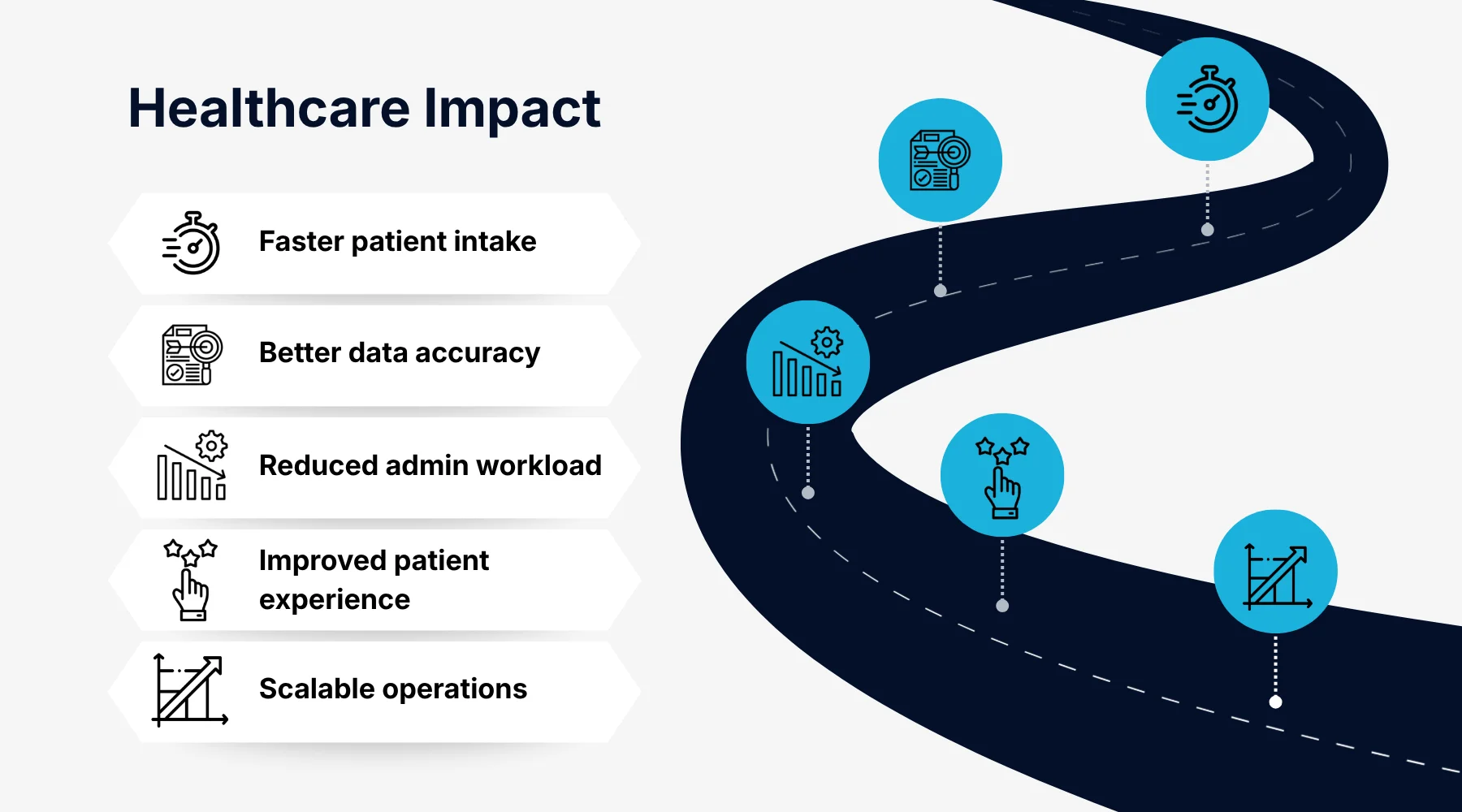
With patient intake automation in place, healthcare organizations can significantly reduce the amount of time spent on administrative data entry. Information moves directly from patient forms into healthcare systems, eliminating repetitive manual tasks and improving operational efficiency.
Data accuracy improves because information is extracted and validated automatically. This reduces the risk of human error and helps ensure that patient records remain complete and reliable. Accurate records support better patient care, billing accuracy, and regulatory compliance.
Patient experience also improves. Information is processed more quickly, reducing delays and helping healthcare providers prepare for appointments more efficiently. Patients spend less time repeating information and experience a smoother intake process.
Administrative teams benefit from reduced workload and greater productivity. Instead of spending hours entering data, staff can focus on patient support, scheduling, and other higher value activities that improve overall service quality.
Healthcare organizations also gain better visibility into intake operations. Automated tracking makes it easier to monitor processing times, identify bottlenecks, and improve workflows over time.
As patient volumes grow, the system scales without requiring additional manual effort. Healthcare providers can handle more patients while maintaining high levels of accuracy and efficiency.
Patient Intake Workflow
Manual vs AI Intake
Healthcare Impact
Why Trust This Approach
Patient intake automation is built on proven AI technologies that are already being used across healthcare and administrative environments. These systems are designed to process large volumes of information accurately while reducing the need for repetitive manual work.
The approach combines data extraction, natural language understanding, and workflow automation to ensure that patient information is handled consistently and efficiently. By reducing manual touchpoints, organizations can improve both speed and accuracy.
Transparency is also an important advantage. Every action can be tracked and reviewed, helping organizations maintain compliance and accountability. Healthcare teams can see how information was processed and identify any exceptions that require attention.
Security remains a priority throughout the process. Patient information is handled using controlled access, secure workflows, and data protection measures that support privacy and compliance requirements.
Healthcare providers that implement intake automation often experience improvements in productivity, data quality, and patient satisfaction. These outcomes demonstrate the practical value of the solution in real world healthcare environments.
Conclusion
Patient intake automation transforms one of the most time consuming administrative tasks in healthcare. By automatically collecting, processing, and updating patient information, the system reduces manual effort and improves operational efficiency.
The solution helps healthcare providers maintain accurate records, reduce processing delays, and improve the patient experience. Staff members spend less time entering data and more time supporting patients and delivering quality care.
As healthcare organizations continue to manage growing patient volumes, automation becomes increasingly important. AI powered patient intake provides a scalable and reliable solution that supports efficiency, accuracy, and long term growth.
In simple terms, it helps healthcare providers process patient information faster, reduce administrative burden, and create a smoother experience for everyone involved.