
Agentic AI Development Company in Canada
AI That Does The Work, Not Just The Talking
Agentic AI is software that gets a goal, makes a plan, and finishes the job. Python Technologies builds these systems for Canadian businesses so your team spends less time on repeat work.
into actionable step-by-step plans
CRM, ERP, and business tools
accelerate business processes
Multi-agent systems that grow
with your business needs






Our Agentic AI Services
Whether you need a single autonomous AI agent or a collaborative multi-agent ecosystem, our end-to-end Agentic AI development services cover strategy, design, development, deployment, integration, and governance.
AI Agent Development
Custom AI agents built to perform defined business jobs. An agent can understand a goal, reason through steps, call approved tools, use business data, and return a result instead of only generating a response.
Multi Agent AI
Multi-agent systems divide complex work among specialized AI agents. Agents can coordinate tasks, share context, hand work to the next agent, and use evaluation or approval steps before completion.
Enterprise Agentic AI
Enterprise agentic AI connects autonomous workflows with existing applications, data, permissions, security requirements, and operating processes. Start with a measurable use case, then scale the architecture.
AI Automation
AI automation combines intelligent decision-making with repeatable workflows. Automate document intake, lead qualification, reporting, data entry, follow-ups, and other processes while keeping exceptions visible to people.
AI Integration
Connect AI agents to the systems where work actually happens. Integrations can link CRM, ERP, databases, email, knowledge bases, APIs, internal tools, and other approved business systems.
AI Agent Governance and Observability
Autonomous systems need visibility and boundaries. Governance and observability cover permissions, audit trails, action logs, evaluations, alerts, cost monitoring, human approvals, and operational controls.
Chatbot vs Automation vs Agentic AI
The right choice depends on the task. A chatbot is primarily conversational, automation follows defined logic, while an AI agent can reason through a goal and take actions using approved tools.
Chatbot
- Conversational responses
- Mostly response generation
- Limited by its conversation design
- Optional integrations
- Conversation context
- Often needed for complex requests
- FAQs and guided conversations
Rule-based Automation
- Repeat a defined workflow
- Predefined rules and conditions
- Needs explicit rules for exceptions
- Preconfigured actions
- Workflow state
- Needed when rules or systems fail
- Predictable, repeatable processes
Agentic AI
- Achieve a goal through multiple steps
- Dynamic planning and tool selection
- Can adapt its next step within defined boundaries
- Can select approved tools and APIs as part of task
- Task, tool, and business context
- Can be required at selected risk or approval points
- Complex work with multiple decisions and actions
Find your highest-value AI opportunity
Turn Repetitive Work Into an AI-Agent Workflow
Instead of starting with a generic chatbot, identify a business process where an AI agent can create a measurable outcome. Python Technologies can map the workflow, identify the systems involved, define the guardrails, and recommend whether an agent, automation, or another AI approach is the right fit.
Types of AI Agents
The Right AI Agent For Every Business Need
Different agents are designed around different jobs. Select a type to explore the dedicated AI agent development service.
AI Customer Service Agent
Handles customer questions, order lookups, ticket workflows, knowledge retrieval, and approved service actions.
AI Sales Agent
Qualifies leads, researches prospects, updates CRM records, follows up, and helps move opportunities through sales process.
AI Voice Agent
Conducts natural voice conversations for inbound or outbound workflows, captures information, and triggers approved actions.
AI Research Agent
Collects information from approved sources, compares findings, synthesizes evidence, and prepares research outputs.
AI Workflow Agent
Coordinates multi-step business processes across forms, systems, approvals, notifications, and records.
Multi-Agent AI System
Coordinates specialized agents that collaborate on larger tasks with defined roles, handoffs, evaluation, and orchestration.
How Agentic AI Works
An agentic AI system combines a model with instructions, context, tools, memory or state, and control mechanisms. It can evaluate the task, choose the next action, inspect the result, and continue until the workflow reaches a defined outcome or requires human intervention.
Understand the goal
The agent receives the objective, relevant context, constraints, and success criteria for the task.
Plan the next actions
It breaks the objective into steps and determines which approved tools or data sources are needed.
Act and evaluate
The agent calls tools, receives results, checks them against the goal, and adjusts the next step when necessary.
Complete, escalate, and log
It finishes the task, requests approval for restricted actions, or escalates exceptions while recording what happened.
The Future of Autonomous AI Agents
AI Is Moving From Answering Questions To Completing Work
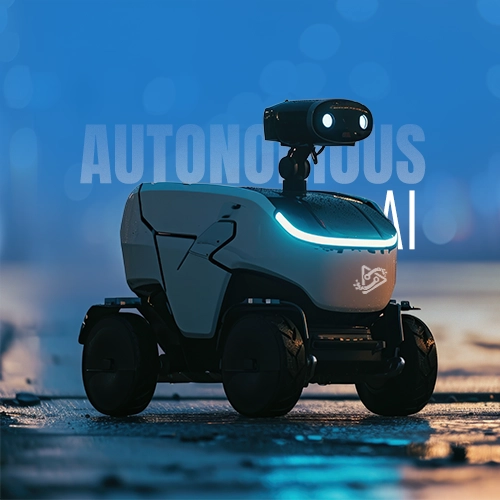
The next stage of enterprise AI is not simply a better chat interface. It is software that can coordinate information, reasoning, tools, and actions across a business process.
As AI agents become more capable, successful implementations will depend on architecture and governance as much as model quality. Businesses need clear permissions, reliable data, evaluation, observability, and human oversight for high-impact decisions.
- Agents operating across multiple business applications
- Multi-agent systems coordinating specialized tasks
- More structured evaluation, monitoring, and governance
- Human approval for sensitive or irreversible actions
The next stage of enterprise AI is not simply a better chat interface. It is software that can coordinate information, reasoning, tools, and actions across a business process.
As AI agents become more capable, successful implementations will depend on architecture and governance as much as model quality. Businesses need clear permissions, reliable data, evaluation, observability, and human oversight for high-impact decisions.
- Agents operating across multiple business applications
- Multi-agent systems coordinating specialized tasks
- More structured evaluation, monitoring, and governance
- Human approval for sensitive or irreversible actions
AI Platforms & Tools
Platforms And Tools For Agentic AI
The right stack depends on the use case, data, integrations, security requirements, latency, cost, and operating environment. A platform should serve the architecture, not dictate it.
OpenAI
Models and agent-building capabilities for reasoning, structured outputs, tool use, and multimodal applications.
Anthropic Claude
Useful for complex reasoning, long-context work, coding, and tool-connected agent workflows.
Google Gemini
Models and tooling suited to multimodal workloads and organizations already using Google Cloud services.
LangGraph
Agent orchestration for workflows that need explicit state, branching, persistence, and control over execution.
n8n
Workflow automation that can connect business applications, APIs, AI models, triggers, and human approval steps.
CrewAI
A framework for coordinating role-based AI agents when a task benefits from multiple specialized agents.
Agentic AI Use Cases
Agentic AI is most valuable when it is tied to a real business outcome. Common use cases combine reasoning with access to approved company data and systems.
Customer support
Resolve common requests, retrieve account information, create or update tickets, and escalate exceptions.
Lead qualification
Research leads, ask qualifying questions, score opportunities, update CRM records, and route qualified prospects.
Document intelligence
Extract information from documents, compare content, identify required fields, summarize findings, and route exceptions.
Internal knowledge
Search company knowledge, retrieve relevant information, synthesize answers, and support employees across internal workflows.
Healthcare workflows
Support intake, information collection, routing, reminders, and administrative workflows with appropriate controls.
Ecommerce operations
Support catalogue content, product information workflows, classification, enrichment, and publishing processes.
Agentic AI For Businesses Across Canada
Explore the regions and provinces served by Python Technologies. The implementation stays grounded in the business process, systems, data requirements, and operating context of each organization.
Agentic AI in Ontario
Toronto, Mississauga, Brampton, Markham, Cambridge, and other Ontario markets. Ontario businesses can start with a focused agent for customer service, sales, operations, or internal knowledge, then expand into connected workflows. A local Canadian delivery presence supports discovery, implementation, and ongoing optimization.
Toronto, Mississauga, Brampton, Markham, Cambridge, and other Ontario markets. Ontario businesses can start with
a focused agent for customer service, sales, operations, or internal knowledge, then expand into connected workflows. A local Canadian delivery presence supports discovery, implementation, and ongoing optimization.
Canadian delivery
PIPEDA-aware design
Eastern Time
Agent rollout
Agentic AI in Toronto and GTA
Toronto, Mississauga, Brampton, Markham, Vaughan, and surrounding markets. GTA organizations often have multiple systems and high-volume workflows. Agentic AI can connect CRM, support, sales, operations, and knowledge processes while keeping permissions and approvals explicit.
Toronto, Mississauga, Brampton, Markham, Vaughan, and surrounding markets. GTA organizations often
have multiple systems and high-volume workflows. Agentic AI can connect CRM, support, sales, operations, and knowledge processes while keeping permissions and approvals explicit.
Complex integrations
High-volume workflows
Enterprise systems
Pilot to scale
Agentic AI in Ottawa
Ottawa and surrounding technology, professional services, and public-sector markets. Ottawa organizations can benefit from controlled agent workflows where data handling, approvals, auditability, and access boundaries are central to implementation.
Ottawa and surrounding technology, professional services, and public-sector markets. Ottawa organizations can
benefit from controlled agent workflows where data handling, approvals, auditability, and access boundaries are central to implementation.
Approval gates
Audit-ready workflows
Canadian hosting options
Controlled autonomy
Agentic AI in British Columbia
Vancouver, Victoria, Surrey, Burnaby, and across British Columbia. British Columbia businesses can use AI agents for customer operations, scheduling, research, internal knowledge, and workflow coordination. Delivery can support Pacific Time operations.
Vancouver, Victoria, Surrey, Burnaby, and across British Columbia. British Columbia businesses can use
AI agents for customer operations, scheduling, research, internal knowledge, and workflow coordination. Delivery can support Pacific Time operations.
Pacific Time
Remote delivery
Workflow automation
Agent integration
Agentic AI in British Alberta
Calgary, Edmonton, Red Deer, and across Alberta. Alberta businesses can apply agentic AI to energy, logistics, professional services, field operations, customer support, and back-office workflows where information moves across multiple systems.
Calgary, Edmonton, Red Deer, and across Alberta. Alberta businesses can apply agentic AI to energy,
logistics, professional services, field operations, customer support, and back-office workflows where information moves across multiple systems.
Field operations
Operations automation
System integration
Measurable pilots
Agentic AI in Quebec
Montreal, Quebec City, Laval, Gatineau, and across Quebec. Quebec organizations may need bilingual experiences and privacy-conscious workflows. Agent architecture can support French and English interactions alongside controlled access to business systems.
Montreal, Quebec City, Laval, Gatineau, and across Quebec. Quebec organizations may need bilingual
experiences and privacy-conscious workflows. Agent architecture can support French and English interactions alongside controlled access to business systems.
French and English
Privacy-aware design
Workflow controls
Enterprise integration
Agentic AI in Manitoba
Winnipeg and across Manitoba. Manitoba businesses can use agents for customer operations, order workflows, document processing, internal knowledge, and administrative tasks that involve multiple steps.
Winnipeg and across Manitoba. Manitoba businesses can use agents for customer operations,
order workflows, document processing, internal knowledge, and administrative tasks that involve multiple steps.
Order workflows
Document processing
Back-office automation
Knowledge access
Why Python Technologies
Build Agentic AI Around the Business, Not Just the Model
Agentic AI projects involve more than choosing an AI model. The business workflow, integrations, data, permissions, evaluation, security, and user experience all affect whether an agent is useful in production.
87+ projects delivered
Python Technologies brings software delivery experience across AI, web, mobile, cloud, and custom business systems.
Canada-focused delivery
Based in Cambridge, Ontario, with delivery support across Canada and international teams for continuous development.
Business-first discovery
The starting point is the workflow and measurable outcome. The technology follows the actual problem instead of forcing every process into an agent.
Integration experience
AI agents can be connected to CRM, ERP, APIs, databases, knowledge bases, communication tools, and custom software through controlled integrations.
Security and governance
Permissions, authentication, audit trails, monitoring, and human approval can be designed into agent workflows from the beginning. Explore cybersecurity services.
Production-minded engineering
Prototypes need a path to production. Architecture, testing, observability, failure handling, cost controls, and maintainability are considered alongside the AI experience
Frequently Asked Questions
What is agentic AI?
Agentic AI is an approach where an AI system can pursue a goal through multiple steps. It can reason about the task, use approved tools, evaluate results, maintain task context, and take actions rather than only producing a conversational response.
What is an AI agent?
An AI agent is software that uses an AI model plus instructions, context, tools, and control logic to perform a task. Depending on its design, it can retrieve information, make decisions within defined limits, update systems, communicate with users, and complete workflows.
How is agentic AI different from a chatbot?
A chatbot is primarily designed to communicate with a user. An agent can go beyond conversation by planning a task, calling tools, retrieving business data, taking approved actions, and continuing through a workflow.
What is the difference between AI agents and automation?
Traditional automation usually follows predefined rules and steps. An AI agent can handle more variable tasks by interpreting the goal, choosing among approved actions, evaluating results, and adapting the next step within its guardrails.
What types of AI agents can Python Technologies develop?
Services include AI customer service agents, AI sales agents, AI voice agents, AI research agents, AI workflow agents, AI agent integrations, enterprise AI agents, multi-agent systems, and agent security and governance capabilities.
Can an AI agent connect to an existing CRM or ERP?
Yes. An agent can be connected to CRM, ERP, databases, APIs, knowledge bases, email, and other systems when appropriate integration methods and permissions are available. Access should be limited to the data and actions the agent actually needs.
How long does it take to build an AI agent?
Timeline depends on the use case, integrations, data, security requirements, testing, and production scope. A focused proof of concept can be much faster than a production enterprise system with multiple integrations and governance requirements.
How much does agentic AI development cost?
There is no single price because an AI agent can range from a focused workflow to a multi-system enterprise platform. Scope, model usage, integrations, security, testing, monitoring, and ongoing operations all affect cost. A discovery process can define the required scope before development begins.
Is agentic AI secure?
Security depends on architecture and implementation. Important controls include authentication, least-privilege access, data protection, tool permissions, logging, evaluation, monitoring, rate and cost limits, and human approval for sensitive actions.
Can humans remain in control of an AI agent?
Yes. Human-in-the-loop controls can require approval before sensitive, financial, irreversible, or otherwise high-impact actions. Agents can also be limited by permissions, business rules, spending limits, tool access, and escalation conditions.
Build Your AI Agent
Have a Workflow That Should Run Itself?
Bring the process, bottleneck, or business goal. Python Technologies can help determine whether an AI agent, AI automation, integration, or multi-agent system is the right solution, then map the path from concept to production.
- Identify the highest-value agent opportunity
- Map systems, data, tools, and approval points
- Define a practical path from pilot to production
No pressure. No long forms. Just a real conversation.