
LLM Integration Services in Canada: How to Add AI to Your Existing Software
Author: Python Technologies Date: 06/25/2026
Most Canadian businesses do not need to build AI from scratch. They already have software that works. What they need is a clean, reliable way to connect large language models to what they already have. That is what LLM integration services for Canada businesses are investing in right now. Not full rebuilds. Not experimental prototypes. Practical AI integrations that slot into existing systems and make them more capable.
This guide covers what that actually involves i.e. architecture, RAG pipelines, vector databases, enterprise compliance, cost, and the decisions that separate integrations that work in production from ones that do not.
What LLM Integration Services Actually Do
An LLM custom integration services in Canada connects a large language model to your software. The model receives input, processes it using its training and any context you provide, and returns output your application can use.
That output could be a summary, an answer to a customer question, a categorised document, a draft, a risk score, or a recommended action. The integration layer handles everything around that: getting data to the model, validating what comes back, connecting to your existing tools, and keeping the whole thing running reliably.
Types of LLM integration services Approaches
Direct API integration works well for self-contained tasks. You call the model with a prompt and use the response. Good for summarisation, classification, and drafting where the model’s general knowledge is sufficient.
RAG-based integration adds a retrieval layer. Before calling the model, your system pulls relevant content from your own data and includes it in the prompt. This lets the model answer questions about your specific business without retraining.
Agentic integration gives the model the ability to take actions, not just generate text. It can call tools, query databases, send messages, and complete multi-step tasks. This is the most complex approach and the most powerful for autonomous AI workflows.
In Python-based systems, these patterns are typically built using LangChain, LlamaIndex, or LangGraph. The backend services that connect everything together are commonly built with FastAPI, which handles the high-throughput async workloads that LLM integration demands well.
LLM Architecture Ontario — How We Design Systems That Hold Up
A production LLM architecture is not just the model. It is everything around it.
Input comes in and gets cleaned and formatted. Context is retrieved and assembled. The prompt is sent to the model. The response is validated and formatted before it reaches your users. Every request is logged for monitoring and improvement.
Choosing the Right Model
There is no single best LLM. The right choice depends on your use case, your volume, and your compliance requirements.
OpenAI GPT models are the reliable general-purpose starting point for most business integrations. Strong documentation, wide ecosystem support, and consistent performance.
Anthropic Claude handles long documents well and follows complex instructions carefully. A good fit for regulated environments and document-heavy use cases.
Open-source models via Hugging Face let you run AI on your own infrastructure. This matters when data residency is non-negotiable or when API costs at high volume make managed services impractical.
Cohere produces strong embeddings for retrieval use cases and is worth considering when your integration is RAG-heavy.
Latency and Scale for Canadian Deployments
If your LLM API endpoints are hosted in US data centres, every call adds network latency. For real-time applications like voice assistants or live chat, that gap matters.
We handled this directly on AutoCalls.ai, an AI voice platform handling real-time phone calls in 100 plus languages for 750 business users. Latency engineering there included semantic caching to avoid redundant API calls, model routing to send simple queries to faster and cheaper models, and async processing for tasks that do not need an instant response. These same strategies apply to any Canadian deployment where response speed is part of the product.
RAG Pipeline Canada — Why Retrieval Changes Everything
What a RAG Pipeline Does
A general-purpose LLM does not know your products, your policies, or your internal data. It can only respond based on its training. That gap is exactly what a RAG pipeline closes.
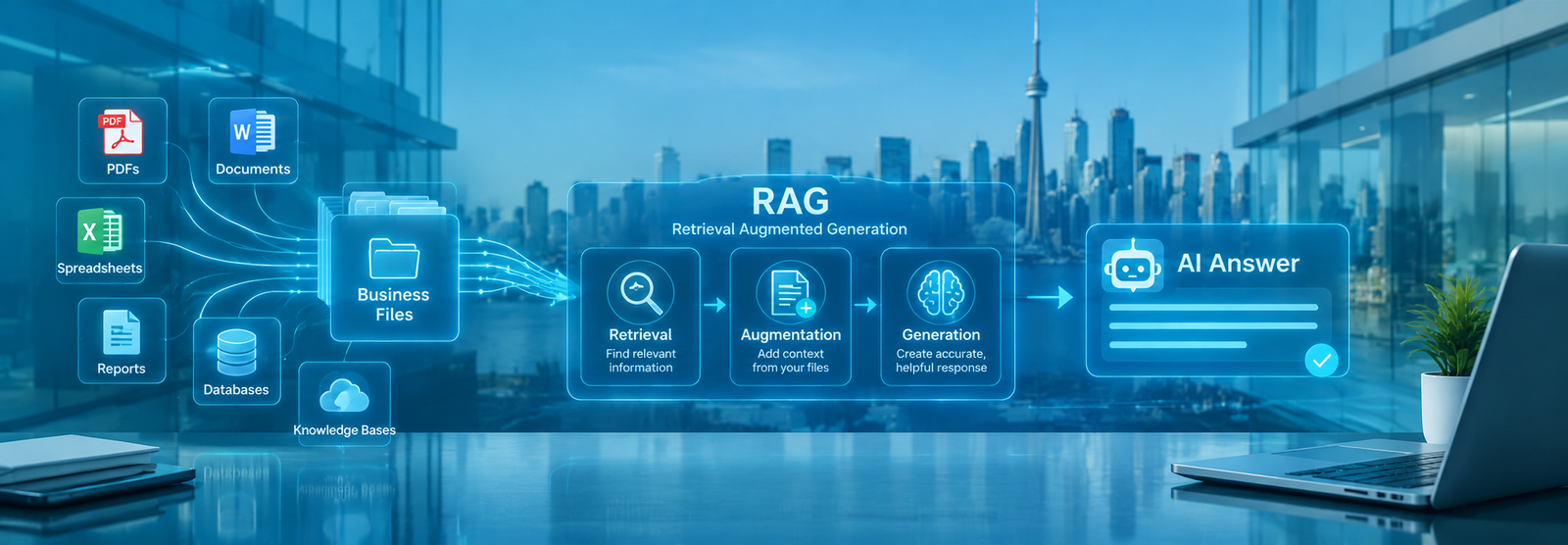
Retrieval-Augmented Generation retrieves relevant content from your own data sources and includes it in the prompt before the model responds. The result is grounded, accurate answers specific to your business, without retraining the model every time your data changes.
The pipeline works like this: documents are ingested, chunked into meaningful pieces, converted to vector embeddings, and stored in a vector database. When a query comes in, it is embedded and matched against stored content. The most relevant chunks are retrieved and assembled into the prompt. The model generates a response grounded in that content.
RAG vs Fine-Tuning
RAG is better when your data changes often, you want answers tied to specific source documents, or you need explainability. Most business use cases fit here.
Fine-tuning is better when you need the model to adopt a specific style or domain vocabulary, the task is narrow and consistent, and you are making enough API calls that retraining pays off long-term.
Many production systems combine both. A fine-tuned model handles domain language well. A RAG layer adds current business data on top.
Real Business Applications
Our work on Vikk AI, a legal assistant serving 100,000 users, involved processing and querying uploaded legal documents to produce instant summaries and relevant answers. Document ingestion, chunking, and retrieval precision were all critical to making that work accurately at scale.
Hakem AI, built on Python and AI technologies, retrieves and compares insurance data from multiple providers to generate personalised recommendations. The system needs to surface accurate, specific information on demand, not generic answers from a model’s general training.
Imprima, an AI-powered virtual data room used in M&A transactions by 600 users, indexes and retrieves sensitive documents during complex business deals. Speed and accuracy of retrieval directly affect the outcome of those transactions.
Vector Database Canada — The Infrastructure Behind Accurate Responses
A vector database stores content as mathematical embeddings, representations of meaning rather than exact text. When a query comes in, the system finds the stored content most similar in meaning and returns it. This is what makes semantic retrieval work.
Options We Work With
Pinecone is a fully managed hosted option with strong performance at scale. Good for teams that want reliability without infrastructure overhead.
Weaviate is open-source with native hybrid search, combining vector and keyword search in one system. Strong choice when retrieval precision matters.
pgvector adds vector search to PostgreSQL. If you are already running Postgres, this is the lowest-friction path to adding semantic retrieval.
FAISS from Meta is used in local and self-hosted setups. Fast and efficient for environments where managed services are not an option.
Chroma is lightweight and fast to set up. Useful for development and smaller-scale deployments. Integrates cleanly with LangChain and LlamaIndex.
Data Residency and Canadian Compliance
PIPEDA governs how personal information is handled by Canadian businesses. PHIPA applies specifically to personal health information in Ontario. Both affect where data can be stored and how it must be protected.
If your embeddings are derived from personal data, the vector database storing them must comply with Canadian data residency requirements. Options include managed services with Canadian infrastructure (AWS Canada, Azure Canada Central, Google Cloud Montreal), open-source databases deployed on Canadian cloud, and data anonymisation before embedding so stored vectors contain no personally identifiable information.
For healthcare deployments like Sensely, which serves 285,000 users with AI-powered patient engagement, and Patientory, a blockchain-powered health ERP built on Python with HIPAA-adjacent security requirements, compliance was part of the architecture from day one. Not added later.
Best LLM Integration Services for High Accuracy
Generic LLM integration services fail in predictable ways. No grounding in business data. Poor chunking that breaks meaning across retrieved chunks. Weak retrieval that misses relevant content. No output validation so errors reach users. No feedback loop so nothing improves over time.
Each of these is a solvable engineering problem. Our approach uses five layers:
Data quality first. We audit source data before building anything. Incomplete or inconsistent data produces poor AI responses regardless of the model.
Retrieval precision. We combine semantic vector search with BM25 keyword search (hybrid search) and tune chunk size, overlap, and top-k retrieval for the specific content type.
Prompt engineering. Clear instructions, relevant context, explicit constraints. Prompt chaining handles multi-step reasoning. Context window management keeps token usage efficient.
Output validation. Responses are checked against defined criteria before reaching users. Format validation, confidence scoring, and flagging for human review when needed.
Evaluation and iteration. We run accuracy benchmarks on domain-specific test sets before deployment and track performance after it. Accuracy is not a launch milestone. It is an ongoing metric.
Enterprise LLM Integration Services
Enterprise integration comes with requirements that small-scale integrations do not. Role-based AI access so users only see content they are permitted to see. AI audit logging that captures what was asked and what was returned. Scalability for thousands of concurrent users. Integration with CRMs, ERPs, data warehouses, identity providers, and legacy systems. And in regulated industries, private LLM deployment that keeps data entirely inside your own infrastructure.
Our enterprise work includes VoiceSpin (8,000 users), a multi-tenant SaaS customer communication platform where we built AI transcription, sentiment analysis, and real-time agent assist tools across a multi-channel stack. And Sensely (285,000 users), a healthcare AI platform integrating with hospital systems and insurance providers, where security, accuracy, and uptime all had compliance implications.
These projects required the same things every enterprise LLM integration requires: a clear access model, thorough logging, tested failover, and an architecture that was designed for the actual load from the start.
AI API Cost Canada — What to Budget For
LLM APIs are priced per token. Every character you send and every character you receive costs money. That cost scales with request volume, prompt length, and which model you use.
For Canadian businesses, most commercial LLM providers bill in USD, which adds currency exposure to the calculation. Enterprise pricing with committed volume discounts is available from most major providers and worth negotiating if your expected usage is high.
Managed APIs from OpenAI, Anthropic, and Cohere are the right starting point for most businesses. No infrastructure overhead, billed on usage.
Self-hosted open-source models require upfront infrastructure investment but have no ongoing per-token cost. At high enough volume, the economics favour self-hosting, and it solves data residency concerns at the same time.
To keep costs down at any scale, we apply semantic caching so repeated queries do not trigger new API calls, model routing to send simpler queries to cheaper models, and prompt optimisation to reduce unnecessary tokens per request. For high-volume clients, these strategies typically reduce AI API cost by 30 to 50 percent compared to an unoptimised baseline.
Ready to Add AI to Your Software?
Python Technologies has built LLM-powered systems serving millions of users across legal, healthcare, communications, insurance, and enterprise software. Our team handles the full stack: RAG pipelines, vector database infrastructure, LLM architecture, enterprise AI governance, and AI API cost optimisation.
The starting point is a conversation about your existing software and the specific problem you want AI to solve.
Or explore python technologies AI/ML Solutions to see how we approach AI across industries.
Frequently Asked Questions
What are LLM integration services?
LLM integration services connect large language models to your existing software. This includes building the layer between the model and your systems, handling prompt design, retrieval, output validation, and logging, and making sure the integration performs reliably in production across real user load.
How long does LLM integration take?
A single-use case integration such as a knowledge base chatbot or document summarisation feature typically takes 4 to 8 weeks. Integrations with RAG pipelines, multiple data sources, enterprise authentication, and compliance requirements run 3 to 6 months. Clear scoping at the start gives the most accurate timeline.
How much does LLM integration cost in Canada?
Simple integrations for defined single use cases start in the low thousands. Enterprise-grade builds with RAG, vector infrastructure, security controls, and ongoing support are priced higher. AI API cost Canada businesses pay on an ongoing basis depends on usage volume and model choice. We scope both before any work begins.
What is a RAG pipeline and do I need one?
A RAG pipeline retrieves content from your own data and includes it in the prompt before the model responds. You need one if you want the AI to answer questions about your specific business content, such as your policies, products, or documents. Without it, the model only uses its general training, which does not include your business information.
Can you integrate LLMs with existing Python software?
Yes. Python is our primary language and the dominant language in AI development. LangChain, LlamaIndex, LangGraph, and FastAPI are all Python-native. If your backend is Python, integration is straightforward. For other stacks, we build Python API services that connect cleanly to your existing systems.
Is our data safe with LLM integration services in Canada?
t depends on how the integration is designed. For sensitive data, options include providers with Canadian infrastructure, anonymising data before it reaches the model, deploying open-source models on Canadian cloud infrastructure, or full on-premise AI deployment. We design for PIPEDA compliance and accommodate PHIPA requirements for healthcare use cases.
What is the difference between fine-tuning and RAG?
RAG retrieves information from your data at query time and adds it to the prompt. The model itself is unchanged. Fine-tuning updates the model's weights using your data so its default behaviour is more suited to your use case. RAG works better when data changes often or when citations matter. Fine-tuning works better for narrow, consistent tasks at high volume.
Which LLM is best for enterprise software integration in Canada?
No single model is best for everything. GPT models are the reliable general-purpose option. Claude performs well on long documents and complex reasoning. Open-source models are best when data residency and cost at scale are the priority. The right choice depends on your use case, compliance needs, and volume. We evaluate all of these before recommending a model.
Categories
- Agentic AI (14)
- AI (1)
- AI & Automation (3)
- AI & Technology (1)
- AI Adoption (1)
- AI Automation (9)
- AI Business Solutions (1)
- AI Consulting (1)
- AI Costs & Pricing (1)
- AI Development (3)
- AI Framework (1)
- AI Governance & Compliance (1)
- AI in Enterprise (3)
- AI Services Canada (1)
- AI Strategy (2)
- AI Use Cases (1)
- AI/ML Services (1)
- Artificial Intelligence (7)
- Artificial Intelligence Canada (2)
- Best AI Agents in 2026 (2)
- Business Automation (2)
- Business Technology (4)
- Business Technology Canada (1)
- Canada Tech & Business (3)
- Case Studies (1)
- Cloud Computing (1)
- CRM Automation (1)
- Custom Development (2)
- Custom Software Development (2)
- Custom Software Development Company (2)
- Customer Support (2)
- DevOps (1)
- Devops & Cloud Services (1)
- DevOps Services (1)
- Digital Transformation (5)
- ERP Technology (3)
- Hiring Guide (1)
- Industry Insights (2)
- Kubernetes (1)
- LLM Integration services (1)
- Local Business Guides (1)
- Machine Learning (1)
- Ontario Tech (1)
- Productivity (1)
- Python Development (1)
- RAG AI Framework (1)
- Software Development (2)
- Software Engineering (1)
- Tech Product Pricing (1)
- Web Development (1)
Recent Posts
- All Posts
- Agentic AI
- agentic AI customer support
- AI
- AI & Automation
- AI & Technology
- AI Adoption
- AI Automation
- AI Business Solutions
- AI Consulting
- AI Costs & Pricing
- AI Development
- AI Framework
- AI Governance & Compliance
- AI in Enterprise
- AI Services Canada
- AI Strategy
- AI Use Cases
- AI/ML Services
- Artificial Intelligence
- Artificial Intelligence Canada
- Best AI Agents in 2026
- Business Automation
- Business Technology
- Business Technology Canada
- Canada Tech & Business
- Case Studies
- Cloud Computing
- CRM Automation
- Custom Development
- Custom Software Development
- Custom Software Development Company
- Customer Support
- DevOps
- Devops & Cloud Services
- DevOps Services
- Digital Transformation
- ERP Technology
- Hiring Guide
- Industry Insights
- Kubernetes
- LLM Integration services
- Local Business Guides
- Machine Learning
- Ontario Tech
- Productivity
- Python Development
- RAG AI Framework
- Software Development
- Software Engineering
- Tech Product Pricing
- Web Development
- Back
- Generative AI

About
Menu
Locations
© 2026 – Python Technologies. All Rights Reserved.