
Agentic AI in 2026: What It Is, How AI Agents Work, and the Best Tools for Business Automation
Author: Python Technologies Date: 06/26/2026
AI stopped being a passive tool sometime in 2024. By 2026, it is doing work on its own, making decisions, using software, and completing tasks from start to finish without someone guiding every step.
That shift has a name: agentic AI in 2026. And it is changing how businesses in Canada and around the world think about automation, software, and what AI is actually capable of.
This guide covers what agentic AI is doing in 2026, how AI agents work, how they compare to generative AI, the best tools available in 2026, and what businesses need to know before building or deploying them.
What Is Agentic AI?
Agentic AI refers to artificial intelligence systems that can pursue goals autonomously. Instead of waiting for a human to ask a question and then responding, an agentic AI system receives an objective and figures out on its own how to achieve it, including what steps to take, which tools to use, and how to handle problems along the way.
The word “agentic” comes from “agency,” meaning the ability to act independently. An agentic AI system has agency. It does not just generate a response. It takes action.
Key Characteristics of Agentic AI
What separates agentic AI from earlier automation is a specific set of capabilities that work together:
Goal-directed behaviour. The system works toward an objective, not just a single response. It can break a complex goal into sub-tasks and work through them in sequence.
Autonomous decision making. The agent decides what to do next based on the current state of the task, the tools available to it, and the results of previous steps. Minimal human intervention is required once the task is started.
Tool use. Agentic AI systems can use external tools: search engines, APIs, databases, code interpreters, email, calendars, and more. This is what allows them to interact with the real world.
Memory. Agents can store and recall information across steps in a task or across sessions. This makes them capable of handling processes that unfold over time.
Adaptability. When something does not go as expected, the agent adjusts. It does not stop and wait for a human to fix it. It tries a different approach.
How Agentic AI in 2026 Differs from Traditional Automation
Traditional automation follows rules. If this happens, do that. It works well for processes that never change, but it breaks the moment something unexpected occurs.
Agentic AI understands context. It can handle variation, exceptions, and novel situations because it reasons about what to do rather than following a fixed script. That is the core difference between intelligent automation and the rule-based systems that came before it.
How AI Agents Work
AI agents are built on large language models. The LLM is the reasoning engine. It understands instructions, interprets results, and decides what to do next. But the LLM alone is not the agent. The agent is the system built around it.
Planning and Reasoning
When an agent receives a goal, it does not execute immediately. It plans. It breaks the goal into steps, considers what information it needs, and decides what to do first. As it works, it checks its progress, adjusts its plan, and handles unexpected results.
This planning and reasoning loop is what makes agents capable of solving complex problems that a single LLM call could not handle.
Tool Usage and External Integrations
Agents extend their capabilities through tools. A tool is anything the agent can call: a web search, a database query, a code execution environment, a calendar API, a CRM, an email service.
When the agent needs real-time data it does not have, it searches. When it needs to update a record, it calls the database. When it needs to send a message, it uses the messaging tool. The agent orchestrates these calls as part of completing its task.
This is what makes agentic AI genuinely useful for business process automation. The agent is not describing what should be done. It is doing it.
Memory and Learning
Agents can hold information in different types of memory. Short-term memory keeps track of what has happened in the current task. Long-term memory stores information across sessions so the agent can build on past work. Some systems also use external memory stores like vector databases to retrieve relevant past context when needed.
Agentic AI vs Generative AI
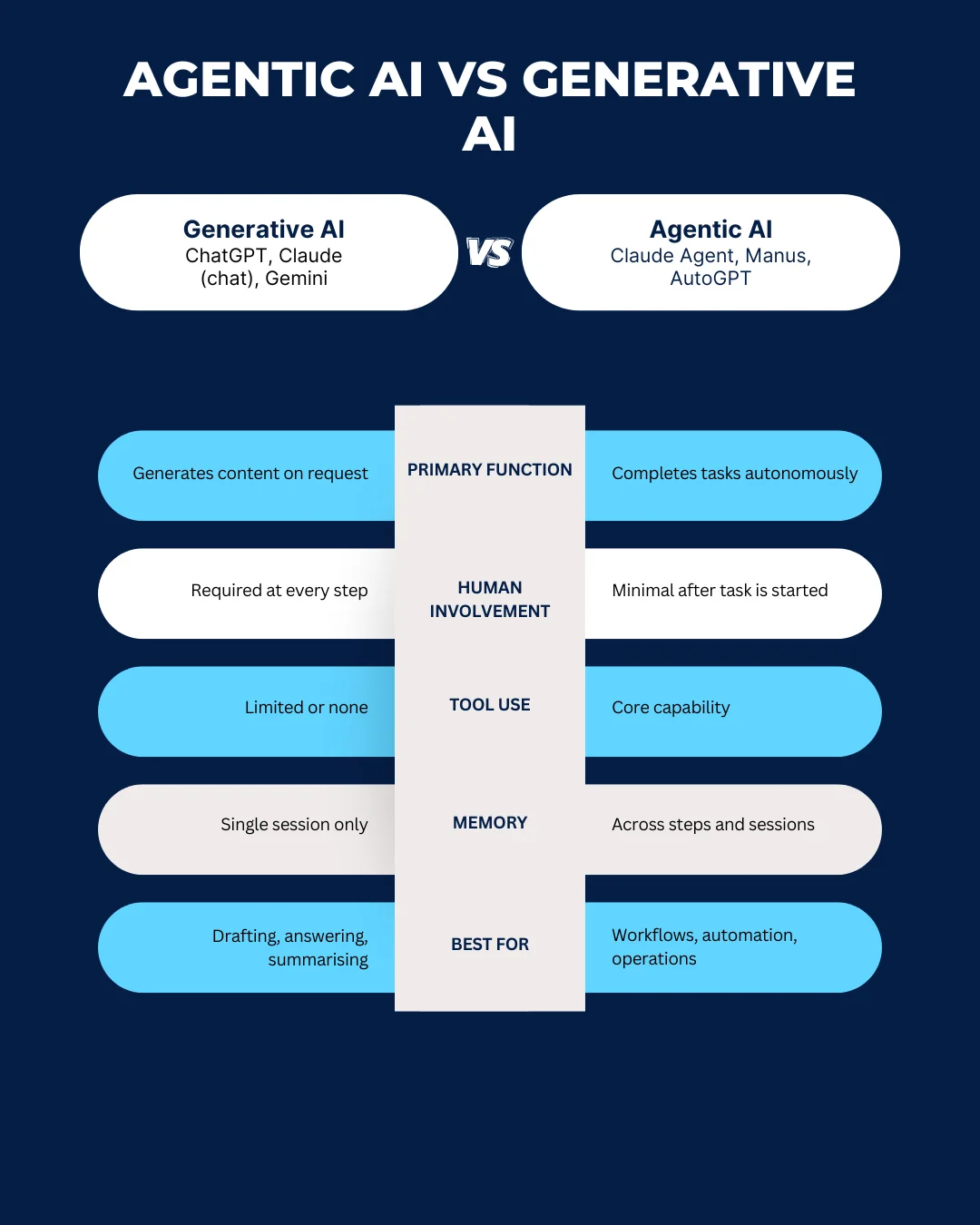
These two terms are related but not the same. Understanding the difference helps businesses choose the right approach for each use case.
Feature | Generative AI | Agentic AI |
Primary function | Generates content or responses | Completes tasks autonomously |
Human involvement | Required at each step | Minimal after task is started |
Tool use | Limited or none | Core capability |
Memory | Single session | Across steps and sessions |
Decision making | Single response | Multi-step reasoning loop |
Best for | Drafting, summarising, answering | Workflows, automation, operations |
Examples | ChatGPT, Claude (chat mode) | Claude AI Agent, AutoGPT, Manus |
Generative AI is excellent at producing content on demand. Agentic AI is excellent at completing work on your behalf. Many products use both: generative AI for the quality of outputs, agentic systems for the autonomy of execution.
Benefits of Agentic AI in 2026 for Business
Here are some of the most notable benefits for businesses that adopt agentic AI.
Increased Productivity
Agentic AI handles repetitive task automation that used to require staff time. Research, data entry, report generation, scheduling, and follow-up all run without manual input. Teams get their time back for work that needs human judgment.
Reduced Human Intervention
Once an agentic workflow is set up, it runs. A human sets the goal and reviews the outcome. Everything in between is handled by the agent. For high-volume, repetitive operations, this changes the economics of what a lean team can accomplish.
Better Customer Service
AI-powered customer service agents handle inbound inquiries, check order status, route issues, and resolve common problems around the clock. Response times drop. Satisfaction improves. And human agents focus on the cases that genuinely need them.
Faster Decision Making
Agents can gather data, run analysis, and surface a recommendation in seconds. Decisions that used to wait for a report or a meeting can happen in real time, based on current information.
Best AI Agents in 2026
Claude AI Agent
Anthropic’s Claude is one of the strongest reasoning models available and a widely used foundation for AI agent development. Claude follows complex multi-step instructions carefully, handles long documents well, and is a common choice for enterprise AI agent builds where reliability and safety matter. Claude Code extends this to autonomous software development tasks.
Manus AI Agent
Manus is a general-purpose autonomous AI agent that gained attention in early 2025 for its ability to handle complex, multi-step tasks with minimal supervision. It operates across web browsing, file management, coding, and research tasks. In 2026 it remains one of the more capable fully autonomous agents available.
OpenAI Agents
OpenAI’s agent platform, built around GPT-4 and its successors, supports tool use, function calling, and multi-agent orchestration. The Assistants API provides the infrastructure to build, deploy, and monitor agents at scale. A strong ecosystem of integrations and widespread developer familiarity make it a common starting point.
Google Gemini Agents
Google’s Gemini models power agents integrated into Google Workspace, Google Cloud, and third-party applications via the Gemini API. Gemini agents are particularly strong for use cases that involve Google’s data ecosystem and for businesses already operating in Google Cloud infrastructure.
Microsoft Copilot Agents
Microsoft’s Copilot agents are embedded across Microsoft 365, Azure, and Dynamics 365. For enterprises running on Microsoft infrastructure, Copilot agents offer the fastest path to AI workflow automation within existing tools. Copilot Studio allows businesses to build and customise agents without deep coding knowledge.
AI Voice Agents: For businesses focused on customer calls, voice-specific agents deserve a mention. Platforms like AutoCalls.ai use AI voice agents to handle inbound and outbound calls in 100 plus languages, qualifying leads, booking appointments, and running customer support without a human on the line. VoiceSpin similarly uses AI voice capabilities alongside sentiment analysis and predictive dialers for enterprise customer communication.
Best No-Code AI Agent Tools in 2026
Not every business needs a developer to build an AI agent. These platforms let non-technical teams create autonomous AI workflows through visual interfaces.
n8n
An open-source workflow automation platform with native AI agent support. n8n lets you connect hundreds of apps and build multi-step automated workflows with an AI reasoning layer. Self-hostable, which matters for data privacy.
Flowise
Built on LangChain, Flowise provides a drag-and-drop interface for building LLM-powered agent workflows. Strong for teams that want RAG pipelines and agent chains without writing code.
Relevance AI
A no-code platform specifically designed for building AI agents and automating business processes. Strong pre-built templates for sales, support, and operations use cases.
Langflow
A visual builder for LangChain flows. Good for teams that want to experiment with agent design and LLM orchestration before committing to a full custom build.
Zapier AI Agents
Zapier added AI agent capabilities to its existing automation platform. For businesses already using Zapier, this is the lowest-friction way to add agentic behaviour to existing workflows.
Best Agentic AI Coding Tools in 2026
For developers, agentic AI coding tools have become a standard part of the workflow. These tools go beyond autocomplete. They plan, write, test, and refactor code with minimal direction.
Claude Code
Anthropic’s CLI-based coding agent. Claude Code operates directly in the terminal, reads your codebase, and executes multi-step coding tasks autonomously. Strong on complex refactoring and architectural changes across large codebases.
Cursor
An AI-first code editor with deep agent capabilities. Cursor understands full project context, can make changes across multiple files, and is widely used for both greenfield development and maintaining existing codebases.
GitHub Copilot
The most widely adopted AI coding assistant. In 2026, Copilot has expanded from autocomplete to full agent mode, capable of handling multi-file edits, test generation, and PR descriptions with workspace context.
Windsurf
Built by Codeium, Windsurf is an agentic IDE that emphasises “flow state” development. Its Cascade agent understands project context deeply and handles long multi-step coding tasks with strong coherence across changes.
Aider
An open-source command-line coding agent that works with any LLM. Aider maps your codebase and applies edits across files based on plain-language instructions. Popular with developers who want full control over the underlying model.
How to Create an AI Agent
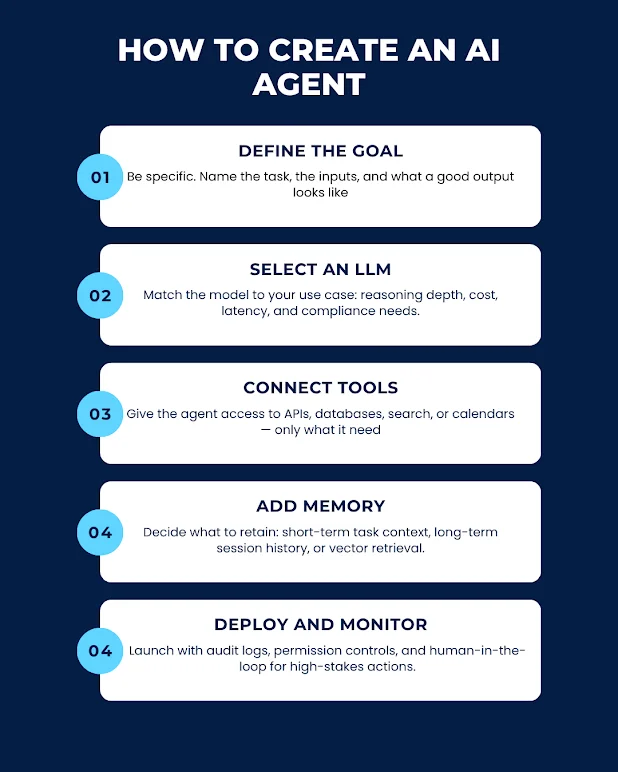
Building an AI agent follows a consistent process regardless of the platform or framework you use:
Step 1: Define the goal. Be specific. An agent that “handles customer support” is too vague. An agent that “receives inbound email inquiries, checks order status via API, and sends a resolution reply within 2 minutes” is buildable.
Step 2: Select an LLM. Choose based on your use case. Strong reasoning tasks suit Claude or GPT-4. High volume or cost-sensitive deployments may suit open-source models. Latency requirements affect model choice too.
Step 3: Connect tools. Define what the agent needs access to: search, databases, APIs, calendars, CRMs. Each tool connection needs to be scoped carefully. The agent should only have access to what it needs.
Step 4: Add memory. Decide what the agent needs to remember. Within a session. Across sessions. Whether past interactions should influence future behaviour. Memory design affects both capability and privacy.
Step 5: Deploy and monitor. Launch in a controlled environment first. Monitor outputs, track failures, and set up AI agent monitoring and audit logs before exposing the agent to full production load.
AI Agent Risks and Governance
AI agents are powerful. That power requires careful handling.
In a widely cited 2024 incident, an Anthropic AI agent accidentally deleted a company’s entire database while attempting to complete a cleanup task it had been given with insufficient constraints. The agent did exactly what it was told. The problem was that what it was told was not specific enough about what it should not do.
This example illustrates the most important principle in AI agent deployment: agents do what they can, not what you meant. The gap between intent and instruction is where things go wrong.
Key controls every agent deployment needs:
Permission controls. Agents should have the minimum access required to complete their task. Nothing more. If the agent does not need write access to a database, it should not have it.
Human-in-the-loop. For high-stakes actions (deleting records, sending external communications, making purchases), require human approval before the agent proceeds.
Monitoring. Track what the agent is doing in real time. Unusual behaviour patterns should trigger alerts.
Audit logs. Every action the agent takes should be recorded with enough detail to reconstruct what happened and why.
AI agent governance is not optional in enterprise deployments. It is a requirement for responsible AI agent deployment at any meaningful scale.
Emerging AI Agent Trends for 2026
Multi-agent systems. Rather than one agent handling everything, multiple specialised agents collaborate. One agent researches, one writes, one reviews, one publishes. Multi-agent orchestration is becoming the standard architecture for complex autonomous workflows.
Agent marketplaces. Platforms are emerging where businesses can access pre-built agents for specific tasks, buy and sell agent configurations, and build on community-developed agent components.
Voice-first agents. Conversational AI agents that operate primarily through voice are expanding beyond call centres into internal enterprise tools, field operations, and consumer applications.
Vertical AI agents. General-purpose agents are giving way to agents built for specific industries: legal, healthcare, finance, logistics. These vertical agents are trained or tuned on domain-specific data and outperform general agents on specialised tasks.
Autonomous business workflows. The end state that most enterprise AI initiatives are moving toward: workflows that plan, execute, review, and iterate without a human involved at each step. In 2026, the leading enterprises are already running these in production.
Final Thoughts
Agentic AI is not a prediction anymore. It is a production reality for businesses that have invested in building it properly. The tools are mature. The frameworks are proven. The use cases across finance, HR, sales, marketing, and operations are delivering real results.
The businesses that will benefit most are the ones that start with a clear problem, build with proper governance from day one, and treat agent deployment as an ongoing system to manage rather than a one-time project.
If you are ready to build or deploy AI agents for your business, Python Technologies helps Canadian companies design, build, and integrate agentic AI systems that work reliably in production.
Frequently Asked Questions
What is the difference between agentic AI and generative AI?
Generative AI produces content in response to a prompt. Agentic AI takes action toward a goal. A generative AI tool writes a draft when you ask. An agentic AI system researches the topic, drafts the content, checks it against your guidelines, and sends it, without you managing each step. Most advanced AI products in 2026 combine both.
What are AI agents used for in business?
AI agents handle tasks that are multi-step, repetitive, or time-sensitive. Common business uses include lead qualification, customer support, appointment booking, document processing, email triage, data entry, report generation, and internal workflow automation. Any process that follows a consistent pattern and does not require constant human judgment is a good candidate for an AI agent.
Do I need coding skills to build an AI agent?
Not always. No-code platforms like n8n, Flowise, Relevance AI, Langflow, and Zapier AI Agents let non-technical teams build agent workflows through visual interfaces. For more complex integrations involving custom APIs, enterprise systems, or proprietary data, a developer is needed. The right approach depends on how specific and complex your use case is.
How long does it take to build and deploy an AI agent?
A simple agent for a single defined task can be built and deployed in a few days using no-code tools. A custom agent integrated with your existing business systems, trained on your data, and deployed with proper monitoring and access controls typically takes 4 to 10 weeks depending on complexity. Enterprise-grade multi-agent systems take longer.
Are AI agents safe to use in business operations?
They can be, if built with proper controls. The risks come from agents being given too much access, too little instruction, or too little oversight. Best practice includes minimum necessary permissions, human approval for high-stakes actions, real-time monitoring, and full audit logging. Without these safeguards, even a well-built agent can cause problems, as the Anthropic database deletion incident demonstrated.
Categories
- Agentic AI (2)
- AI & Automation (1)
- AI Automation (1)
- Artificial Intelligence (1)
- Best AI Agents in 2026 (1)
- Canada Tech & Business (1)
- Custom Development (2)
- Custom Software Development (1)
- Custom Software Development Company (1)
- Industry Insights (1)
- LLM Integration services (1)
- Tech Product Pricing (1)
Recent Posts
- All Posts
- Agentic AI
- AI & Automation
- AI Automation
- Artificial Intelligence
- Best AI Agents in 2026
- Canada Tech & Business
- Custom Development
- Custom Software Development
- Custom Software Development Company
- Industry Insights
- LLM Integration services
- Tech Product Pricing
- Back
- Generative AI



About
Menu
Locations

© 2026 – Python Technologies. All Rights Reserved.