
AI Automation Services in Canada: What to Expect (2026)
Categories
- Agentic AI (13)
- AI (1)
- AI & Automation (3)
- AI & Technology (1)
- AI Adoption (1)
- AI Automation (9)
- AI Business Solutions (1)
- AI Consulting (1)
- AI Costs & Pricing (1)
- AI Development (1)
- AI Governance & Compliance (1)
- AI in Enterprise (3)
- AI Services Canada (1)
- AI Strategy (1)
- AI Use Cases (1)
- AI/ML Services (1)
- Artificial Intelligence (7)
- Artificial Intelligence Canada (2)
- Best AI Agents in 2026 (2)
- Business Automation (2)
- Business Technology (4)
- Business Technology Canada (1)
- Canada Tech & Business (3)
- Cloud Computing (1)
- CRM Automation (1)
- Custom Development (2)
- Custom Software Development (2)
- Custom Software Development Company (2)
- Customer Support (2)
- DevOps (1)
- Devops & Cloud Services (1)
- DevOps Services (1)
- Digital Transformation (5)
- ERP Technology (3)
- Hiring Guide (1)
- Industry Insights (2)
- Kubernetes (1)
- LLM Integration services (1)
- Local Business Guides (1)
- Ontario Tech (1)
- Productivity (1)
- Python Development (1)
- Software Development (2)
- Tech Product Pricing (1)
- Web Development (1)
Recent Posts
- All Posts
- Agentic AI
- agentic AI customer support
- AI
- AI & Automation
- AI & Technology
- AI Adoption
- AI Automation
- AI Business Solutions
- AI Consulting
- AI Costs & Pricing
- AI Development
- AI Governance & Compliance
- AI in Enterprise
- AI Services Canada
- AI Strategy
- AI Use Cases
- AI/ML Services
- Artificial Intelligence
- Artificial Intelligence Canada
- Best AI Agents in 2026
- Business Automation
- Business Technology
- Business Technology Canada
- Canada Tech & Business
- Cloud Computing
- CRM Automation
- Custom Development
- Custom Software Development
- Custom Software Development Company
- Customer Support
- DevOps
- Devops & Cloud Services
- DevOps Services
- Digital Transformation
- ERP Technology
- Hiring Guide
- Industry Insights
- Kubernetes
- LLM Integration services
- Local Business Guides
- Ontario Tech
- Productivity
- Python Development
- Software Development
- Tech Product Pricing
- Web Development
- Back
- Generative AI




Author: Python Technologies Date: 09/25/2026
Businesses across Canada are moving fast on AI automation. The ones seeing real results are not just buying a tool. They are working with an AI automation services provider that understands their workflows, their data, their compliance environment, and what a successful deployment actually looks like in production.
The challenge is that the AI automation services market in Canada is noisy. Every agency, freelancer, and software vendor is calling itself an AI company in 2026. Knowing what to look for, what services actually matter, and how the implementation process should work is what separates a smart decision from an expensive mistake.
This guide covers exactly that. What a serious AI automation company in Canada does, which services Canadian businesses are buying most, how to evaluate providers, what the build process looks like from discovery to deployment, and how to find the right fit for your business whether you are in Toronto, Vancouver, Calgary, or anywhere else across the country.
Python Technologies is a Canadian AI automation company based in Cambridge, Ontario, with 87 plus delivered projects and a track record across healthcare, legal, fintech, logistics, and enterprise communications. That context informs everything in this guide.
What Does an AI Automation Company Actually Do?
This is the first question most business buyers ask, and it deserves a direct answer.
An AI automation company designs, builds, and deploys systems that use artificial intelligence to handle business processes autonomously. Not just software that follows a fixed rule. Systems that understand context, adapt to variation, use tools to take real-world actions, and complete multi-step workflows without constant human input.
The services span a wide range depending on the provider. A strong AI automation agency in Canada handles the full lifecycle: identifying which workflows are the right candidates for automation, designing the AI architecture that fits the business, building the integrations that connect the AI to existing systems, testing for accuracy and edge cases, deploying to production, and monitoring performance after launch.
What a serious AI automation development company does not do is hand you a wrapped ChatGPT interface and call it done. The work is in the integration layer: connecting the reasoning model to your CRM, your database, your email platform, your customer communication tools, and your internal knowledge base. That integration work is where most of the value, and most of the complexity, lives.
Python Technologies builds across this full stack. From AI agents development and AI and ML services for intelligent reasoning systems to DevOps and cloud services for the infrastructure that keeps them running at scale, the capability covers everything a production AI automation deployment requires.
AI Automation Services Canadian Businesses Are Using Most
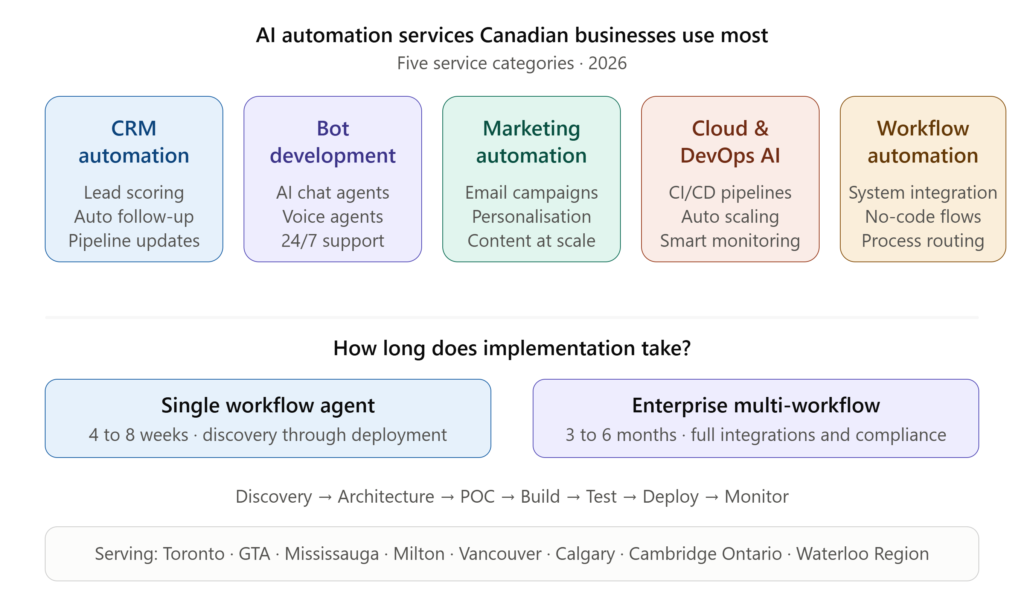
AI automation is not one thing. It is a category that covers several distinct service types, each suited to different business problems. Here are the ones Canadian businesses are investing in most heavily in 2026.
CRM Automation
CRM automation connects AI to your customer relationship management platform so that lead capture, scoring, follow-up sequencing, and pipeline updates happen automatically. A sales rep no longer has to manually log every interaction or remember to send the third follow-up email. The AI handles the operational layer while the rep focuses on the conversation.
Canadian businesses using Salesforce, HubSpot, or custom-built CRMs are integrating AI automation to qualify inbound leads before a human touches them, update deal stages based on communication signals, and trigger personalised outreach sequences at the right moment. The AI-powered lead qualification bot is a direct example of this in action, engaging every inbound lead instantly, scoring them against defined criteria, and routing qualified prospects directly to the sales team.
Bot Development and Conversational AI
Bot development is one of the most requested AI automation services across Canada right now, and the scope has expanded far beyond simple FAQ chatbots. Modern AI bots handle complex, multi-turn conversations with context and memory. They book appointments, process requests, check account information, and escalate intelligently when a human is genuinely needed.
The 24/7 AI customer support agent is the most widely deployed version of this. An AI agent handles the first layer of all inbound support, resolves common issues autonomously, and passes complex cases to human staff with a full conversation history already prepared. For businesses managing high support volumes, this one deployment can change the economics of the entire support operation.
VoiceSpin, a customer communication platform Python Technologies built serving 8,000 business users, combines AI voice bots, chatbots, and predictive dialers in one platform. That is bot development at serious enterprise scale.
AI voice agents are an extension of this. Platforms like VoiceCenta.ai deploy AI agents across phone systems, websites, and messaging platforms with multilingual support, making them particularly relevant for Canadian businesses operating in both English and French markets.
Email and Marketing Automation
AI marketing automation goes further than scheduled email sequences. It analyses audience behaviour, segments lists dynamically based on signals, generates personalised content at scale, and adjusts send timing and messaging based on what is actually working.
Migma AI, a platform Python Technologies built for AI-powered email marketing, generates fully branded, ready-to-send campaigns from simple prompts. Users get emails with logos, colors, fonts, and brand tone applied automatically, including Figma-to-email and design-to-HTML conversion. That is AI marketing automation that saves a marketing team days per campaign cycle.
For businesses building out content and outreach at scale, this kind of intelligent automation removes the bottleneck between strategy and execution.
Cloud and DevOps Automation
AI automation in cloud and DevOps services is about making infrastructure intelligent. Automated deployment pipelines, self-healing systems, intelligent monitoring that distinguishes real incidents from noise, and dynamic resource scaling that responds to actual demand rather than manual configuration.
Canadian businesses running on AWS or Azure benefit from AI-enhanced DevOps that reduces deployment time, cuts infrastructure costs through dynamic scaling, and improves reliability through automated rollback and recovery. As covered in our DevOps services in Canada guide, CI/CD pipelines built with intelligent automation consistently cut deployment time by 80 percent compared to manual processes.
AI Workflow Automation and Process Integration
AI workflow automation connects the dots between systems that previously required manual handoffs. An order placed in an e-commerce platform automatically updates inventory, triggers a fulfillment workflow, creates a shipping label, and sends a confirmation, all without human coordination at each step.
Levity, a no-code AI workflow automation platform Python Technologies built, handles exactly this kind of process integration. Teams automate repetitive document and email workflows without writing code, using custom AI models that classify information, route requests, and reduce manual operational work. It serves 350 businesses and is a live example of what accessible, production-grade AI workflow automation looks like.
Enso Bot extends this to enterprise scale, unifying business communication and automation across calls, messages, CRM data, and operational workflows in one cloud platform serving 690 users.
For businesses needing patient intake automation specifically, AI patient intake automation for healthcare covers the clinical workflow use case with PHIPA-compliant architecture built in from the start.
How to Choose the Right AI Automation Company in Canada
The market for AI automation services in Canada has grown quickly, which means the quality range is enormous. Here is how to evaluate providers before committing.
- Ask for production evidence, not demos. Any credible AI automation development company in Canada can demo a prototype. The question is whether they have deployed systems that handle real users under real load. Ask for examples with user numbers, industry context, and what happened after launch.
- Check the integration depth. The value of AI automation services is almost always in the integrations, not the AI model itself. Ask how the provider connects AI to your existing CRM, your communication tools, and your internal data. If the answer is vague, the integration work will be too.
- Evaluate compliance awareness. Canadian businesses operate under PIPEDA, and regulated industries face PHIPA, OSFI guidance, and provincial equivalents. An AI automation provider that does not raise compliance in the first conversation is not ready for serious Canadian deployments. The AI regulations in Canada after AIDA covers what actually applies in 2026 so you can test whether a provider knows the landscape.
- Understand how they handle ongoing support. AI automation systems need monitoring, updates, and maintenance after launch. Ask what the post-deployment relationship looks like. A provider that disappears after delivery is not a partner.
- Look at team depth, not just pricing. The difference between a solo AI automation specialist and a team with engineering, data, and DevOps capacity shows up in production. A cheaper quote from a single contractor often means no capacity for incident response, no redundancy in expertise, and no ability to scale the engagement as your needs grow.
The Implementation Process: From Discovery to Deployment
Understanding how a professional AI automation implementation works helps you evaluate whether a provider is doing it right.
- Discovery and workflow mapping. Every serious AI automation engagement starts here. The provider maps your current process in detail, identifies where the bottlenecks are, and determines which workflows are genuine automation candidates. Vague briefs produce expensive failures. Clear, specific scope definitions produce fast, accurate builds.
- AI strategy and architecture design. Which model is right for this use case? What tools does the agent need access to? How does the retrieval layer work? What are the compliance constraints? These decisions get made before a line of code is written. Getting them right early is what separates systems that work from systems that require complete rebuilds six months after launch.
- Proof of concept. A well-run AI automation proof of concept tests the core workflow on a subset of real data before full development begins. This validates that the approach works and surfaces edge cases early when they are cheap to fix.
- Development and integration. The AI system is built, connected to your existing tools, and tested against defined accuracy and reliability standards. Integration with CRM software, communication platforms, document systems, and internal databases happens at this stage.
- Testing and validation. Every production AI automation deployment needs output validation testing, edge case coverage, and performance testing under realistic load. This is where hallucinations get caught before they reach users.
- Deployment and monitoring. Launch happens in a controlled environment. Post-deployment monitoring tracks accuracy, response times, error rates, and user feedback. AI automation maintenance and AI automation monitoring are ongoing activities, not one-time tasks. A proper AI automation strategy defines how the system evolves after launch.
The full timeline for a single-workflow agent runs 4 to 8 weeks. Enterprise multi-workflow deployments with full integrations typically take 3 to 6 months. The AI agent development cost and timeline guide covers what drives these numbers in detail.
AI Automation Services Across Canada
Python Technologies delivers AI automation services across Canada with particular depth in Ontario and the Greater Toronto Area.
Toronto and the GTA represent Canada’s largest market for enterprise AI automation. Businesses in Toronto, Mississauga, Brampton, Oakville, Burlington, and Hamilton are deploying AI automation across customer service, sales, operations, and compliance functions. AI automation services in the GTA benefit from proximity to Canada’s largest talent concentration and the deepest pool of enterprise technology buyers.
Waterloo Region and Milton have become significant technology corridors in their own right. Python Technologies operates from Cambridge, Ontario, giving businesses in Kitchener, Waterloo, Guelph, and Milton direct access to a local AI automation team that understands the regional market.
Vancouver is Canada’s second-largest technology market and a significant hub for AI automation adoption in retail, logistics, real estate technology, and professional services. AI automation services in Vancouver follow the same architecture as national deployments but often include specific integrations with BC-based platforms and compliance awareness of BC PIPA.
Calgary is seeing strong AI automation adoption in energy, agriculture technology, and professional services. AI automation services in Calgary increasingly focus on operational workflow automation, field service management, and data processing pipelines.
Beyond these hubs, Python Technologies serves businesses nationally through remote engagement with in-person capability in Ontario when the project requires it.
Why Businesses Choose Python Technologies for AI Automation
Python Technologies is a top AI automation solutions provider in Canada with a portfolio that spans 87 plus delivered projects across healthcare, legal, fintech, enterprise communications, and logistics.
The team is led by Najab Saleem, Chief Executive Officer, with an engineering and delivery team that has built AI automation systems serving users at every scale from 250 to 180 million.
- Track record at scale. Sensely, a healthcare AI platform, serves 285,000 users with conversational AI built for patient engagement. Strava, a fitness platform, serves 180 million users with real-time GPS tracking and social features. Vikk AI, a legal assistant, serves 100,000 users with NLP-powered document analysis. These are not prototype deployments. They are live production systems.
- Full-stack capability. From custom software development for the underlying application layer to cybersecurity services for secure AI infrastructure, the team covers every layer of a complete AI automation deployment without subcontracting critical components.
- Canadian compliance by design. PIPEDA, PHIPA, OSFI guidance, and BC PIPA are built into how Python Technologies designs AI systems, not added after the fact. For regulated Canadian industries, this is the baseline expectation, not a premium feature.
- Agentic AI specialisation. As a leading agentic AI company in Canada, Python Technologies builds the multi-agent and autonomous workflow systems that go beyond basic automation. The custom AI agents for GTA businesses guide covers what this looks like in practice for local businesses.
Final Thoughts
AI automation services in Canada in 2026 cover a wide range of capabilities, from simple bot deployments to enterprise-grade multi-agent systems running core business operations. The businesses getting the most value are the ones that start with a clearly defined problem, choose a provider with genuine production experience, and treat the engagement as a long-term system to develop rather than a one-time project to complete.
Whether you need CRM automation, conversational AI, marketing automation, cloud and DevOps automation, or end-to-end workflow integration, the right AI automation agency in Canada will help you scope what fits your business before building anything.
Python Technologies delivers AI automation services across Canada from Cambridge, Ontario. If you are ready to explore what automation looks like for your specific operation, contact the team for a free consultation.
Frequently Asked Questions About AI Automation
What do AI automation services in Canada actually include?
AI automation services in Canada cover the full lifecycle of deploying AI to handle business processes: workflow discovery and mapping, AI architecture design, model selection, integration with existing tools like CRMs and communication platforms, testing, deployment, and ongoing monitoring. The specific services vary by provider. A full-service AI automation development company in Canada handles all of these. Specialists may focus on one area such as bot development or workflow automation.
How much does it cost to hire an AI automation engineer or agency in Canada?
A freelance AI automation specialist or engineer in Canada typically charges between CAD 90 and CAD 180 per hour depending on expertise and specialisation. A full AI automation agency engagement for a single-workflow deployment starts around CAD 10,000 to CAD 35,000. Enterprise multi-workflow systems run CAD 35,000 to CAD 100,000 or more. The cost and timeline guide gives a detailed breakdown by project type.
How long does AI automation implementation take?
A single, well-scoped workflow agent takes 4 to 8 weeks from discovery to deployment. More complex systems with multiple integrations, compliance controls, and enterprise governance take 3 to 6 months. The biggest driver of the timeline is how clearly the workflow is defined at the start. Clear scope means fast builds. Vague briefs mean expensive change orders.
Can AI automation integrate with our existing CRM software?
Yes. Integrating AI automation with CRM platforms including Salesforce, HubSpot, Zoho, and custom-built CRMs is a standard part of what AI automation development services cover. The AI reads from and writes to the CRM as part of completing tasks, whether that is updating lead scores, logging interactions, or triggering follow-up sequences.
Can AI automation handle patient intake, email, and phone calls?
Yes to all three. AI automation for patient intake collects symptoms, history, and scheduling information from patients before their appointment and delivers a prepared summary to the provider. AI email automation handles outreach, follow-up sequences, and inbound triage. AI phone call automation through voice agents manages inbound and outbound calls in multiple languages, handles common queries, and escalates when needed.
Should I hire an AI automation specialist directly or work with an AI automation agency?
A specialist makes sense for a narrow, well-defined single task where you have internal capacity to manage the engagement and integrate the output. An agency makes sense when the project spans multiple workflows, requires full-stack integration, involves compliance considerations, or needs ongoing support after launch. For most Canadian businesses deploying AI automation seriously, an agency with a full team produces more reliable outcomes than a single contractor.
How do I know if an AI automation company in Canada is genuinely capable?
Ask for case studies with specific user numbers and industry context. Ask whether they have deployed systems that handle regulated data. Ask what their post-launch monitoring looks like. Ask which compliance frameworks they have worked within. Credible AI automation services providers in Canada will answer all of these without hesitation.
Python Technologies is a Canadian AI software development company specializing in custom AI Software development solutions. This Blog is reviewed by Arsalan Ali, Senior SEO Specialist at Python Technologies.
About
Menu
Locations
© 2026 – Python Technologies. All Rights Reserved.