
What Is AI Automation and How Does It Work? (2026 Guide)
Categories
- Agentic AI (14)
- AI (1)
- AI & Automation (3)
- AI & Technology (1)
- AI Adoption (1)
- AI Automation (9)
- AI Business Solutions (1)
- AI Consulting (1)
- AI Costs & Pricing (1)
- AI Development (3)
- AI Framework (1)
- AI Governance & Compliance (1)
- AI in Enterprise (3)
- AI Services Canada (1)
- AI Strategy (2)
- AI Use Cases (1)
- AI/ML Services (1)
- Artificial Intelligence (7)
- Artificial Intelligence Canada (2)
- Best AI Agents in 2026 (2)
- Business Automation (2)
- Business Technology (4)
- Business Technology Canada (1)
- Canada Tech & Business (3)
- Case Studies (1)
- Cloud Computing (1)
- CRM Automation (1)
- Custom Development (2)
- Custom Software Development (2)
- Custom Software Development Company (2)
- Customer Support (2)
- DevOps (1)
- Devops & Cloud Services (1)
- DevOps Services (1)
- Digital Transformation (5)
- ERP Technology (3)
- Hiring Guide (1)
- Industry Insights (2)
- Kubernetes (1)
- LLM Integration services (1)
- Local Business Guides (1)
- Machine Learning (1)
- Ontario Tech (1)
- Productivity (1)
- Python Development (1)
- RAG AI Framework (1)
- Software Development (2)
- Software Engineering (1)
- Tech Product Pricing (1)
- Web Development (1)
Recent Posts
- All Posts
- Agentic AI
- agentic AI customer support
- AI
- AI & Automation
- AI & Technology
- AI Adoption
- AI Automation
- AI Business Solutions
- AI Consulting
- AI Costs & Pricing
- AI Development
- AI Framework
- AI Governance & Compliance
- AI in Enterprise
- AI Services Canada
- AI Strategy
- AI Use Cases
- AI/ML Services
- Artificial Intelligence
- Artificial Intelligence Canada
- Best AI Agents in 2026
- Business Automation
- Business Technology
- Business Technology Canada
- Canada Tech & Business
- Case Studies
- Cloud Computing
- CRM Automation
- Custom Development
- Custom Software Development
- Custom Software Development Company
- Customer Support
- DevOps
- Devops & Cloud Services
- DevOps Services
- Digital Transformation
- ERP Technology
- Hiring Guide
- Industry Insights
- Kubernetes
- LLM Integration services
- Local Business Guides
- Machine Learning
- Ontario Tech
- Productivity
- Python Development
- RAG AI Framework
- Software Development
- Software Engineering
- Tech Product Pricing
- Web Development
- Back
- Generative AI


Author: Python Technologies Date: 09/22/2026
AI automation is the use of artificial intelligence to complete tasks that previously required human effort, including tasks that involve judgment, variation, and unstructured data, not just tasks that follow a fixed rule. It handles work the way a capable person would, not just the way a script does. Canadian businesses across healthcare, fintech, banking, e-commerce, logistics, HR, and professional services are deploying intelligent automation right now to handle workflows that used to require entire teams.
This guide explains what AI automation actually is, how it works under the hood, how it compares to traditional automation tools, what industries are using it today, and what the real benefits and risks look like for businesses in Canada in 2026.
What Is AI Automation?
AI automation is when artificial intelligence handles a business process from start to finish without constant human involvement. The system receives an input, such as a customer message, an uploaded document, or a new sales lead, and it processes that input, makes decisions, and produces an output, whether that is a reply, a filed record, a booked appointment, or a flagged risk.
What makes it different from a calculator or a spreadsheet formula is that AI automation can handle variation. It does not need the input to be in a perfect format. It can read an unstructured email, understand what the customer is asking, check the relevant system, and send an appropriate reply, all without a human touching the process.
The foundation is usually a large language model combined with a set of tools that let the AI interact with real systems: APIs, databases, calendars, CRMs, email platforms, and document storage. Python Technologies builds these systems using frameworks like LangChain and LangGraph, deployed on cloud infrastructure that keeps them running reliably around the clock. The result is what most people mean when they talk about AI and ML services in a business context.
AI Automation vs Traditional Automation vs RPA vs Chatbots
This is where most of the confusion lives. People use these terms interchangeably, but they describe very different things with very different capabilities.
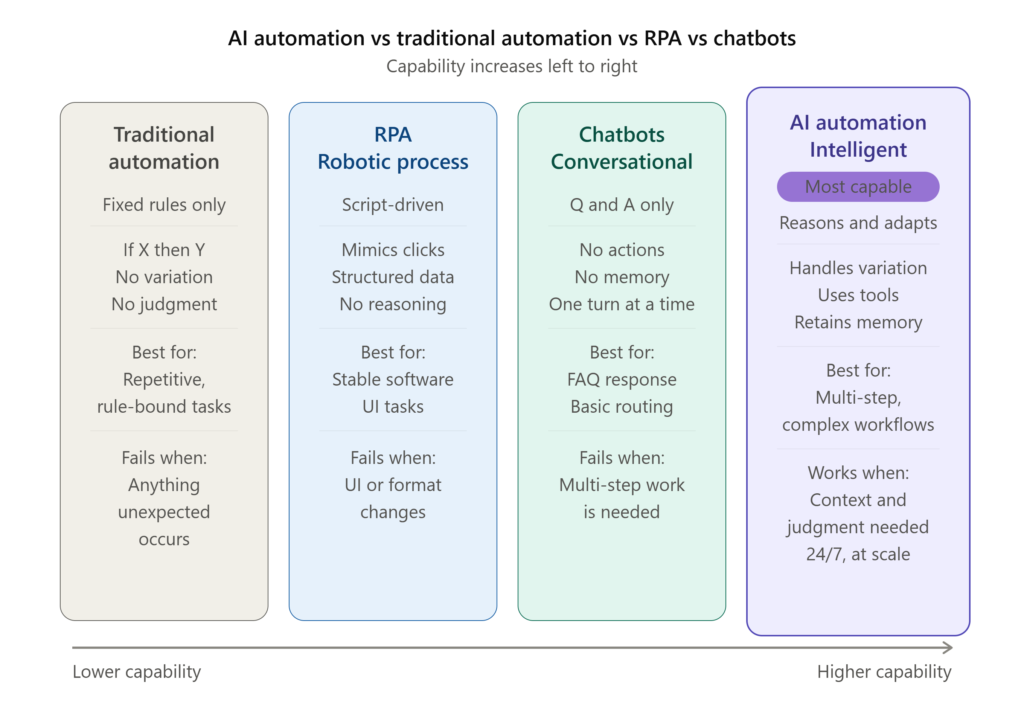
Traditional automation follows fixed rules. If a condition is met, take action. This works for perfectly consistent, never-changing processes. The moment something unexpected appears, traditional automation breaks and a human has to step in. The gap between what it can handle and what business actually throws at it is large.
Robotic Process Automon (RPAati) automates repetitive, rules-based tasks by mimicking the clicks and keystrokes a human would make in a software interface. RPA vs AI automation is a genuine distinction: RPA follows a pre-defined script, while AI automation reasons about what to do. An RPA tool filling out a form fails the moment the form layout changes. An AI automation system reading the same form understands the content regardless of formatting.
Chatbots respond to one input at a time and operate within a narrow, pre-defined question-and-answer framework. They cannot take actions outside the conversation, they cannot remember what happened two sessions ago, and they cannot handle multi-step tasks. Chatbots are a subset of what AI automation can do, not a synonym for it.
AI automation handles all of the above and more. It understands context, operates across multiple steps, uses external tools to take real-world actions, adapts to variation, and learns from feedback over time. It is not just faster than a human at a task. It is capable of tasks that no simple rule or script can handle.
The distinction between AI automation and AI agents is worth clarifying too. An AI agent is the specific software entity that executes a workflow. AI automation is the broader term for using AI to automate business processes, whether through a single agent, a pipeline, or a multi-agent system where specialised agents collaborate.
How Does AI Automation Work?
Understanding the mechanics makes the business application much clearer.
At the core of any AI automation system is a large language model. The LLM reads the input, understands its meaning, and decides what to do next. But the LLM alone cannot do much in the real world. It needs tools.
Tools are connections to external systems: a web search API, a database query function, an email sender, a calendar booking system, a document reader, or a CRM updater. When the AI needs to check a customer’s order status, it calls the database tool. When it needs to send a confirmation, it calls the email tool. When it needs to book an appointment, it calls the calendar tool.
The orchestration layer coordinates this. Intelligent process automation at this level uses frameworks like LangGraph to manage the sequence of steps, handle conditional logic, and maintain state across a multi-step workflow. If step three depends on the result of step two, the orchestration layer handles that dependency. If something goes wrong at step four, it decides whether to retry, route to a fallback, or escalate to a human.
Memory allows the system to retain context. Short-term memory keeps track of the current task. Long-term memory stores information across sessions so the AI can build on past interactions rather than starting from scratch each time.
The result is a system that can handle a customer email, check three different databases, draft a personalised reply, log the interaction in the CRM, and schedule a follow-up, all within seconds of receiving the original message.
AI Automation vs AI Agents: What Is the Difference?
This distinction trips up a lot of people, including people writing about AI professionally.
An AI agent is a specific software entity. It is the thing that runs, that has memory, that uses tools, that pursues a goal. You deploy an AI agent. You monitor it. You can point to it.
AI automation is the broader category. It describes using AI to automate business processes. An AI agent is one way to do that. A pipeline of AI-powered steps is another. A multi-agent system where several specialised agents collaborate is another still.
Think of it this way: all deployed AI agents are doing AI automation, but not all AI automation is done by a single AI agent. When a fintech company automates loan document review using AI, that is AI automation. The underlying system might use one agent or five working in sequence.
If you want to go deeper on agentic architecture specifically, agentic AI services covers the full technical picture of how autonomous agent systems are designed and deployed for enterprise use.
Industry Use Cases of AI Automation in Canada
AI automation is not a general-purpose technology in practice. It gets deployed for specific workflows in specific industries. Here is where it is actually being used today.
AI Automation in Healthcare
Healthcare in Canada is dealing with severe administrative burden. Clinical staff spend hours on intake forms, appointment scheduling, patient triage, documentation, and referral coordination. AI automation handles the administrative layer so clinicians can focus on patients.
AI patient intake automation for healthcare collects symptoms and history from patients before appointments, scores urgency, and delivers a prepared summary to the right provider. Under PHIPA in Ontario and equivalent provincial health information statutes, these systems must be built with data residency and consent requirements built in from the architecture level, not added later.
Sensely, a healthcare AI platform Python Technologies built, serves 285,000 users with a conversational AI system that guides patients through symptom assessment and connects them to appropriate care. That is real-world AI automation in healthcare at scale.
AI Automation in Fintech and Banking
Financial services were early movers on AI automation because the use cases are immediate and the ROI is measurable. Fraud detection, loan processing, compliance reporting, customer communication, and risk assessment are all areas where intelligent automation reduces cost and improves accuracy.
The Office of the Superintendent of Financial Institutions in Canada has issued guidance on model risk management that covers AI systems directly. Fintech and banking businesses deploying AI automation need systems designed to meet those standards, including model validation, explainability for AI-driven decisions, and proper audit trails.
Hakem AI, an insurance comparison platform Python Technologies built using Python and AI, analyses insurance data from multiple providers to generate personalised recommendations in real time. That is AI automation in a financial services context handling complex data comparison and output generation at a speed no human analyst could match.
AI Automation in E-Commerce
E-commerce AI automation spans the full customer lifecycle. Product description generation, personalised recommendations, inventory forecasting, customer support, and return processing are all areas where AI automation saves significant time and improves accuracy.
The AI automated product description writer is a direct example: a store with thousands of SKUs can generate SEO-ready, brand-consistent product copy for an entire catalog in hours instead of weeks. That is a direct cost saving with measurable output.
AI Automation in HR
Human resources teams handle high volumes of repetitive administrative work: screening resumes, answering employee questions about policies and benefits, scheduling interviews, and processing onboarding documents. AI automation handles the administrative layer consistently and at scale.
Automated candidate screening tools evaluate resumes against defined criteria and score candidates before a human recruiter sees them. Internal knowledge base assistants answer HR policy questions instantly without routing every query to the HR team. The AI internal knowledge base assistant is built exactly for this kind of internal employee support use case.
A critical note on AI automation in HR: human rights codes in Canada apply to AI-driven hiring tools. If an automated screening system produces discriminatory outcomes on protected grounds, the business faces liability. Responsible AI automation in HR requires regular auditing of model outputs for bias.
AI Automation in Communication and Customer Service
The 24/7 AI customer support agent is one of the highest-ROI AI automation use cases available to Canadian businesses. An AI agent handles inbound support queries, checks account information, resolves common issues, and escalates complex cases with a full conversation transcript already prepared.
Python Technologies built AutoCalls.ai, an AI voice agent platform that handles calls in over 100 languages for 750 business clients. That covers both written and voice-based AI automation in communication at serious scale.
AI Automation in Legal and Professional Services
Legal document review, contract analysis, client intake, and research are all areas where AI automation reduces the hours skilled professionals spend on work that does not require their expertise.
Vikk AI, an NLP-powered legal assistant Python Technologies built, serves 100,000 users with AI-driven document analysis and legal Q&A. Users upload documents and receive instant summaries, key clause extraction, and risk flags. That is AI automation handling a task that previously required a paralegal to do manually for every document.
AI Automation in Logistics and Supply Chain
Route optimisation, shipment tracking, carrier communication, and inventory management are all areas where AI automation reduces operational cost and improves reliability. Agents monitor shipment status across carrier APIs, proactively contact customers when delays are detected, and update internal systems without a dispatcher touching each individual case.
Vikk AI, an NLP-powered legal assistant Python Technologies built, serves 100,000 users with AI-driven document analysis and legal Q&A. Users upload documents and receive instant summaries, key clause extraction, and risk flags. That is AI automation handling a task that previously required a paralegal to do manually for every document.
Benefits of AI Automation for Canadian Businesses
The business case for what is AI automation for Canadian businesses in 2026 is no longer speculative. These are the consistent outcomes across production deployments.
- 24/7 operation without overtime. AI automation runs around the clock. For Canadian businesses serving customers across time zones, this is a direct service improvement with no additional staff cost.
- Faster response times. An AI customer support agent responds in seconds. A human agent responding in hours is a competitive disadvantage when the alternative is instant. VoiceSpin, a customer communication platform Python Technologies built serving 8,000 business users, uses AI-powered transcription, sentiment analysis, and real-time agent assist tools to reduce response time and improve accuracy simultaneously.
- Consistent output quality. AI automation applies the same logic every time. For data entry, document processing, and criteria-based decisions, this produces fewer errors than humans handling the same volume under time pressure.
- Scalability without proportional headcount growth. When business volume increases, AI automation scales instantly. No hiring cycle, no training period, no ramp-up time. The same system that handles 100 requests a day can handle 10,000 with the right infrastructure underneath it.
- Cost reduction on high-volume processes. Customer support, lead qualification, document review, and data entry all have high labour costs when done manually. AI automation handles the high-volume layer at a fraction of the per-task cost.
- Competitive positioning. The businesses deploying AI automation right now are building structural efficiency advantages that compound over time. The gap between businesses using AI automation and those not using it is measurable in conversion rates, response times, operational costs, and product delivery speed.
Risks and Challenges of AI Automation
Responsible AI automation in Canada means being honest about what can go wrong and building the controls that prevent it.
- Hallucinations and inaccurate outputs. Large language models can produce confident but incorrect outputs. Production AI automation systems need output validation layers that check responses against defined criteria before they reach users or trigger real-world actions. Deploying without this is the most common and most costly mistake.
- Data privacy and compliance. PIPEDA governs how Canadian businesses handle personal information. Any AI automation system processing personal data must be designed with consent, purpose limitation, and security requirements built in. For healthcare deployments, PHIPA creates additional obligations. Businesses handling data in British Columbia operate under BC PIPA. Quebec businesses face Law 25’s automated decision-making transparency requirements. The AI regulations landscape in Canada after AIDA covers the full compliance picture for 2026.
- Security exposure. An AI agent with access to your systems is a security surface. Every tool connection is a potential vulnerability. Access must be scoped to the minimum required for the task, and every action must be logged. Cybersecurity services should be part of any enterprise AI automation deployment from the design phase.
- Discriminatory outcomes in high-stakes decisions. Human rights codes in Canada apply to AI-driven decisions about individuals. Hiring tools, lending systems, and access-to-services platforms must be audited for discriminatory impact on protected grounds, regardless of whether discrimination was intentional.
- Integration complexity. Connecting AI automation to legacy systems, CRMs, ERPs, and communication tools requires careful engineering. Shortcuts in the integration layer produce fragile systems. Custom software development capacity is often as important as AI expertise when building production-grade automation.
- Governance gaps. Agents that take real actions need clearly defined boundaries, human approval requirements for high-stakes decisions, and full audit logging. Without governance, even technically correct automation causes business damage.
AI Automation Adoption in Canada: Where Things Stand in 2026
AI automation adoption in Canada has tripled in two years. As of the second quarter of 2026, roughly 19 percent of Canadian businesses report using AI to produce goods or deliver services, up from about 6 percent in 2024 according to Statistics Canada.
Ontario leads nationally in AI investment. The federal government’s AI for All Strategy, released June 4, 2026, targets raising Canadian AI adoption from 12 percent to 60 percent by 2034. The businesses moving now are building the operational foundations that will define their competitive position for the next decade.
The Canadian AI automation market is growing across all major sectors. Finance and insurance lead at over 40 percent adoption. Information and cultural industries follow. Professional services are close behind. Manufacturing, logistics, retail, and healthcare are all accelerating their investment.
Business process automation powered by AI is the mechanism behind these gains. The businesses that understand AI adoption trends in Canada and position themselves ahead of the adoption curve have a compounding advantage. Every month of earlier adoption means more refined systems, more historical data, and more operational efficiency embedded into the organisation before competitors catch up.
For businesses ready to start with a specific workflow, the 5 AI use cases that save time at work covers the practical starting points: customer support, lead qualification, document review, product content generation, and patient intake, all with direct ROI timelines.
AI Automation Tools and Frameworks
Understanding the technology layer helps businesses evaluate what AI automation actually involves when they are buying or building it.
- LLM reasoning engines are the models that power the reasoning in any AI automation system. Claude (Anthropic), GPT-4o (OpenAI), Gemini (Google), and open-source models via Hugging Face are the most widely deployed. Each has different strengths in terms of reasoning depth, context handling, cost per token, and compliance with data processing requirements.
- Orchestration frameworks coordinate how AI agents plan and execute multi-step workflows. LangGraph manages stateful, conditional agent workflows. CrewAI coordinates multi-agent systems where specialised agents collaborate. LangChain handles RAG pipelines, tool connections, and prompt chaining. n8n provides AI workflow automation that non-technical teams can monitor and adjust without engineering support.
- No-code AI process automation platforms like Flowise, Relevance AI, and Zapier AI Agents let businesses build simple agent workflows without writing code. These are appropriate for standard use cases where the workflow is well-defined and data handling requirements are minimal.
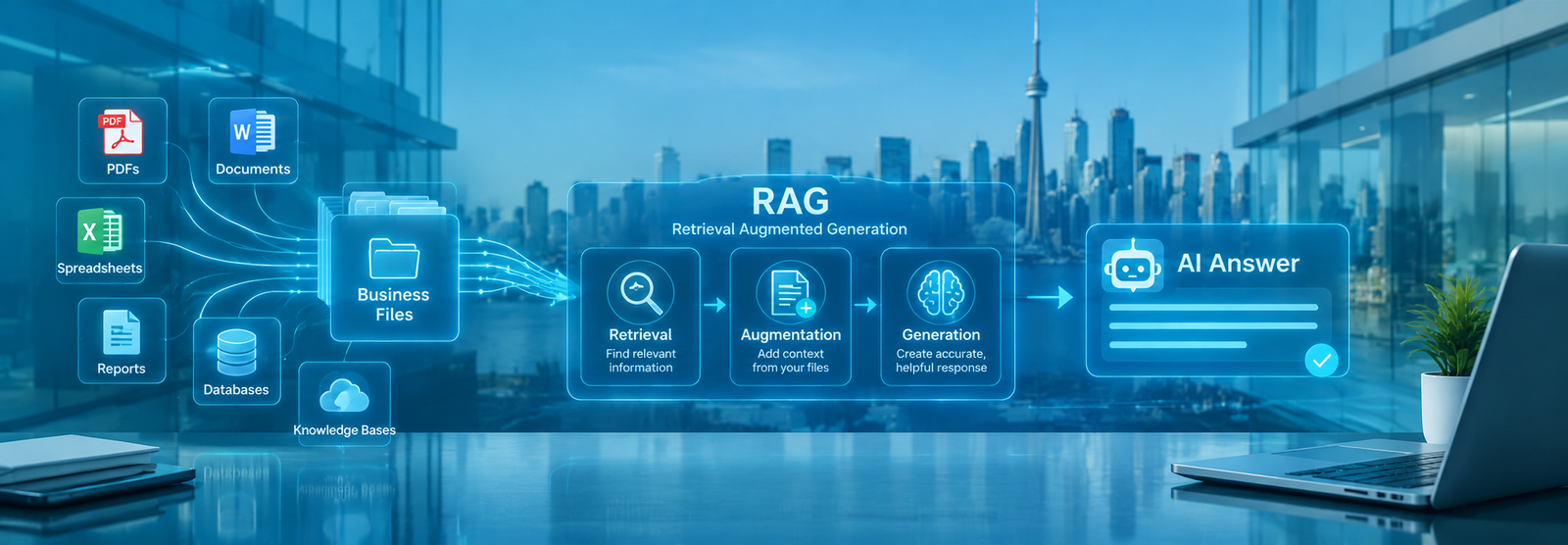
- Vector databases power the retrieval layer that allows AI automation systems to access business-specific knowledge: Pinecone, Weaviate, pgvector, and FAISS are the most widely used options. LLM integration services that connect these databases to reasoning models are a significant part of what makes business AI automation accurate rather than generic.
- Cloud infrastructure runs all of it. AWS Canada, Azure Canada Central, and Google Cloud’s Montreal region provide Canadian data residency options for businesses with PIPEDA or PHIPA compliance requirements.
- For businesses exploring AI automation in cloud and DevOps services, DevOps and cloud services covers the infrastructure layer that makes AI automation systems reliable and scalable in production.
Final Thoughts
AI automation in 2026 is not experimental. It is production technology running in Canadian healthcare clinics, fintech platforms, e-commerce stores, law firms, and enterprise operations right now.
The definition is simple: AI that handles work the way a capable person would, not just the way a script does. The applications are wide. The benefits are measurable. The risks are real but manageable with proper design.
The businesses that are building AI automation capability now are creating structural advantages that compound over time. The businesses waiting to see how it develops are watching those advantages grow.
If you are ready to identify which workflow in your business would benefit most from intelligent automation, Python Technologies offers a free consultation to help you find the right starting point and scope a practical first deployment. Contact our team to start that conversation.
Frequently Asked Questions About AI Automation
What is AI automation in simple terms, and what does it actually do?
AI automation is when artificial intelligence handles a business task from start to finish without constant human direction. Unlike basic automation that follows fixed rules, AI automation understands context, adapts to variation, and completes multi-step work across real systems. A customer emails with a billing question: AI automation reads the email, checks the account, drafts a personalised reply, logs the interaction, and schedules a follow-up, all without a human touching any step.
How is AI automation different from RPA?
Robotic Process Automation follows fixed scripts, mimicking human clicks and keystrokes in software interfaces. It breaks when anything changes. AI automation understands content and context. It can handle unstructured inputs, adapt to variation, and make decisions at each step. AI automation vs RPA is fundamentally a question of rigidity versus adaptability. RPA vs AI automation: RPA wins on simplicity for perfectly stable tasks; AI automation wins everywhere else. RPA is a good fit for perfectly stable, never-changing processes. AI automation handles everything else.
What is the difference between AI automation and a chatbot?
A chatbot responds to one question at a time within a pre-defined framework. It cannot take actions outside the conversation and has no memory across sessions. AI automation handles multi-step workflows, uses external tools to take real-world actions, retains context, and operates autonomously toward a goal. Chatbots are a narrow subset of what AI automation can do.
What industries benefit most from AI automation in Canada?
Finance and insurance, healthcare, professional services, e-commerce, logistics, and HR all see strong returns from AI automation because they share high-volume, process-driven workflows. Any industry where the same type of task is performed many times per day with variation in the inputs is a strong candidate for intelligent automation. In Canada specifically, healthcare and financial services benefit from the compliance-aware AI automation architectures that meet PHIPA and OSFI requirements.
Is AI automation safe for regulated industries like healthcare and finance?
Yes, when designed correctly. Regulated deployments require role-based access controls, audit logging for every action, output validation before results reach users or trigger downstream actions, human-in-the-loop approval for high-stakes decisions, and compliance with applicable data protection law. Built with these controls from the architecture level, AI automation operates safely in healthcare, finance, and other regulated environments.
What are the risks of AI automation for Canadian businesses?
The main risks are hallucinations producing incorrect outputs, data privacy exposure under PIPEDA and provincial equivalents, security vulnerabilities from improper access scoping, discriminatory outcomes in hiring and lending tools, integration failures when connecting to legacy systems, and governance gaps that allow agents to take unintended actions. Each of these is manageable with proper architecture, but each requires deliberate design choices rather than afterthought controls.
How long does AI automation implementation take?
A single, well-defined workflow agent takes 4 to 8 weeks from scoping to deployment. An enterprise multi-workflow system with integrations, compliance controls, and governance infrastructure takes 3 to 6 months. The clearest driver of the timeline is scope definition at the start. Vague briefs produce long, expensive projects. Clear, specific briefs produce fast, accurate ones.
Is AI automation worth it for small businesses in Canada?
Yes, often more so than for large enterprises proportionally. A small team that automates its highest-volume repetitive task gets a large percentage of its capacity back. A five-person business that removes two hours per day of manual work from every team member has the equivalent of gaining a new full-time employee. The starting cost for a well-scoped single-workflow agent is accessible for most small businesses, and the ROI timeline is short.
Python Technologies is a Canadian AI software development company specializing in custom AI Software development solutions. This Blog is reviewed by Arsalan Ali, Senior SEO Specialist at Python Technologies.
About
Menu
Locations
© 2026 – Python Technologies. All Rights Reserved.