
AI Automation Cost in Canada: Pricing, ROI and What Affects Your Budget (2026)
Categories
- Agentic AI (13)
- AI (1)
- AI & Automation (3)
- AI & Technology (1)
- AI Adoption (1)
- AI Automation (9)
- AI Business Solutions (1)
- AI Consulting (1)
- AI Costs & Pricing (1)
- AI Development (1)
- AI Governance & Compliance (1)
- AI in Enterprise (3)
- AI Services Canada (1)
- AI Strategy (1)
- AI Use Cases (1)
- AI/ML Services (1)
- Artificial Intelligence (7)
- Artificial Intelligence Canada (2)
- Best AI Agents in 2026 (2)
- Business Automation (2)
- Business Technology (4)
- Business Technology Canada (1)
- Canada Tech & Business (3)
- Cloud Computing (1)
- CRM Automation (1)
- Custom Development (2)
- Custom Software Development (2)
- Custom Software Development Company (2)
- Customer Support (2)
- DevOps (1)
- Devops & Cloud Services (1)
- DevOps Services (1)
- Digital Transformation (5)
- ERP Technology (3)
- Hiring Guide (1)
- Industry Insights (2)
- Kubernetes (1)
- LLM Integration services (1)
- Local Business Guides (1)
- Ontario Tech (1)
- Productivity (1)
- Python Development (1)
- Software Development (2)
- Tech Product Pricing (1)
- Web Development (1)
Recent Posts
- All Posts
- Agentic AI
- agentic AI customer support
- AI
- AI & Automation
- AI & Technology
- AI Adoption
- AI Automation
- AI Business Solutions
- AI Consulting
- AI Costs & Pricing
- AI Development
- AI Governance & Compliance
- AI in Enterprise
- AI Services Canada
- AI Strategy
- AI Use Cases
- AI/ML Services
- Artificial Intelligence
- Artificial Intelligence Canada
- Best AI Agents in 2026
- Business Automation
- Business Technology
- Business Technology Canada
- Canada Tech & Business
- Cloud Computing
- CRM Automation
- Custom Development
- Custom Software Development
- Custom Software Development Company
- Customer Support
- DevOps
- Devops & Cloud Services
- DevOps Services
- Digital Transformation
- ERP Technology
- Hiring Guide
- Industry Insights
- Kubernetes
- LLM Integration services
- Local Business Guides
- Ontario Tech
- Productivity
- Python Development
- Software Development
- Tech Product Pricing
- Web Development
- Back
- Generative AI




Author: Python Technologies Date: 09/28/2026
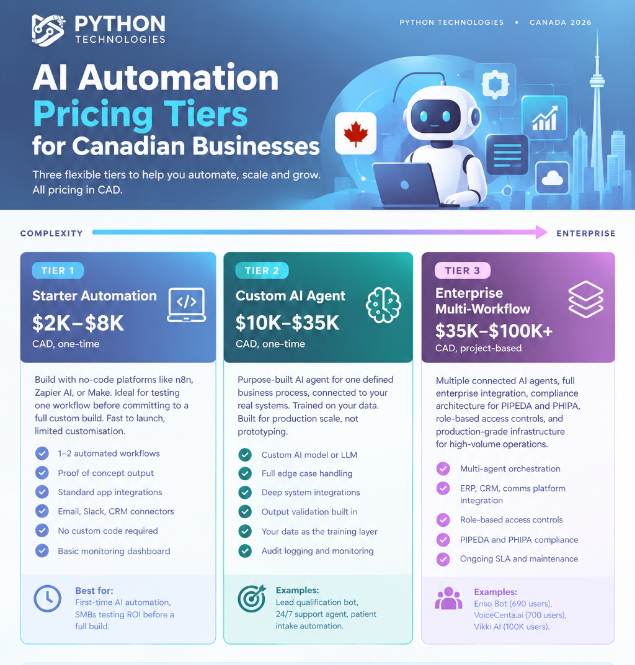
How much does AI automation cost in Canada? Most Canadian businesses pay between CAD 2,000 and CAD 8,000 for a no-code or prototype automation, CAD 10,000 to CAD 35,000 for a single custom AI workflow agent, and CAD 35,000 to CAD 100,000 or more for enterprise multi-workflow deployments. The right number depends on your workflow complexity, how many systems the AI needs to connect with, and whether you need ongoing maintenance and monitoring after launch.
That is the direct answer. The rest of this guide explains what drives each of those numbers, what AI automation hourly rates in Canada look like in 2026, how to calculate ROI before you spend anything, and what ongoing maintenance costs you should build into your budget.
How Much Does AI Automation Cost in Canada in 2026?
The AI automation market in Canada has matured enough that pricing is now reasonably predictable by project type. The biggest mistake businesses make is comparing quotes without understanding what category of project they are actually buying.
There are three meaningful tiers.
- A no-code AI automation deployment uses platforms like n8n, Zapier AI, or Make to wire together existing tools with AI logic. This is the fastest path to something working. It suits businesses that want to test a specific workflow before committing to a full custom build. Cost range: CAD 2,000 to CAD 8,000 depending on setup complexity and the number of integrations.
- A single custom AI workflow agent is a purpose-built system developed to handle one defined business process end to end. Examples include an AI-powered lead qualification bot that scores and routes every inbound lead automatically, a 24/7 AI customer support agent that handles tier-one support without human involvement, or an AI patient intake automation system that collects patient history before an appointment. Cost range: CAD 10,000 to CAD 35,000.
- An enterprise multi-workflow deployment covers multiple connected automation systems, full integration with existing enterprise software, compliance architecture for regulated industries, and production-grade infrastructure. This is what a healthcare provider, financial institution, or large SaaS company typically needs when deploying agentic AI across several departments. Agentic AI cost at this tier reflects the depth of orchestration, compliance, and infrastructure required. Cost range: CAD 35,000 to CAD 100,000 and above.
AI Automation Pricing Tiers: What You Actually Get at Each Level
No-Code and Prototype Tier: CAD 2,000 to CAD 8,000
This tier is for businesses testing AI automation for the first time or validating a workflow before investing in a full build. A consultant or AI automation specialist connects your existing tools using platforms that handle the AI logic without custom code.
What you get: one or two automated workflows, limited customisation, standard integrations with common tools like Slack, Gmail, HubSpot or Salesforce, and a working proof of concept. What you do not get: a system built for your specific data model, deep enterprise integrations, or production resilience under high load.
The AI automation case study section on the Python Technologies site shows real examples of what deployed systems look like at each stage of maturity.
Custom Single-Workflow Tier: CAD 10,000 to CAD 35,000
This is where most serious Canadian businesses start when they move from testing to production. A custom AI automation agent is built specifically for your workflow, connected to your actual systems, and validated against your real data before launch.
The Levity platform is a good reference point. It automates document and email workflows using custom AI models, runs with no code required for end users, and serves 350 businesses at production scale. A deployment of this type, built and integrated for a specific business, sits in this price tier.
What drives cost within this range: how many external systems the agent needs to connect with, whether the workflow involves structured or unstructured data, how much compliance work is required, and how complex the edge case handling needs to be.
Enterprise Multi-Workflow Tier: CAD 35,000 to CAD 100,000 Plus
Enterprise AI automation projects involve multiple interconnected agents, full integration with existing ERP, CRM, or communication platforms, role-based access controls, audit logging, and compliance with Canadian regulatory frameworks including PIPEDA and, for healthcare, PHIPA.
Enso Bot, which unifies business communication and AI workflow automation for 690 enterprise users across voice, messaging, and CRM systems, is an example of what a full enterprise deployment looks like. VoiceCenta.ai, with 700 users across multilingual voice and chat automation, is another. Building these from scratch for a specific business is what puts projects into this tier.
The AI agent development cost and timeline guide breaks down what drives timeline alongside cost, since the two are closely connected.
What Drives AI Automation Development Cost?
Understanding AI automation cost factors is more useful than knowing a number. These are the variables that move your project up or down the pricing tiers.
- Workflow complexity. A single, well-defined workflow with predictable inputs and outputs is the cheapest thing to automate. The cost increases as you add branching logic, exception handling, or multi-step reasoning. An AI agent that reads an email, extracts intent, looks up account history, drafts a personalised reply, and routes to a human if confidence is low is far more complex than one that classifies emails into folders.
- Number of integrations. Every system the AI automation agent needs to connect with adds development and testing time. Connecting to a standard CRM API is straightforward. Connecting to a custom-built internal system with poor documentation, legacy architecture, or restricted API access takes significantly longer. CRM automation, email system integration, and communication platform connections are the most common, and they each carry their own integration cost.
- Data quality and availability. AI automation systems perform as well as the data they are trained or grounded on. If your internal data is inconsistent, poorly structured, or spread across systems that do not talk to each other, there is prep work before the build can begin. This is frequently the hidden cost that surprises businesses.
- Compliance requirements. Canadian businesses in regulated industries pay more for AI automation because the compliance layer is not optional. PIPEDA applies to all personal data. PHIPA applies to health information in Ontario. OSFI guidance covers financial institutions. Building an automation system that handles regulated data correctly requires specific architecture decisions, audit logging, data residency controls, and sometimes third-party security review. The AI regulations in Canada after AIDA guide explains exactly what applies in 2026.
- Model selection. Using a managed API like OpenAI or Anthropic is faster and cheaper to start but carries per-token costs that scale with usage. Self-hosted open-source models require infrastructure investment upfront but reduce ongoing costs for high-volume deployments. The right choice depends on your usage pattern, data sensitivity, and budget structure.
- Testing and validation depth. A production AI automation system needs thorough output validation, edge case testing, and load testing before it handles real users. The more critical the workflow, the more testing is required. Cutting corners here produces systems that fail in production, which costs far more to fix than the testing would have cost upfront.
AI Automation Hourly Rates in Canada (2026)
If you are comparing AI automation agency pricing against hiring a freelance AI automation specialist or engineer directly, here is what the Canadian market looks like in 2026.
- A freelance AI automation developer in Canada typically charges CAD 90 to CAD 150 per hour depending on specialisation, years of experience, and the tools they work with. Senior specialists with production LangGraph, multi-agent, or RAG pipeline experience are at the higher end.
- An AI automation consultant focused on strategy, workflow mapping, and vendor selection charges CAD 120 to CAD 200 per hour. Consultants do not build the system but they reduce the risk that you build the wrong thing.
- An AI automation agency structures pricing differently. Most agencies quote by project scope rather than hourly rate. When agencies do quote hourly, blended rates for mixed engineering and strategy teams run CAD 130 to CAD 220 per hour for the team as a whole.
Hiring a full-time AI automation engineer directly costs CAD 110,000 to CAD 160,000 per year in Canada at a senior level, based on 2026 market data for Ontario, BC, and Alberta. This only makes sense if you have continuous, high-volume automation work that justifies dedicated headcount.
For most Canadian businesses, the cost to hire an AI automation engineer through an agency or outsourcing arrangement delivers better economics than a full-time hire for project-based work. Python Technologies offers staff augmentation services for businesses that need embedded AI engineering capacity without the overhead of a permanent hire.
AI Automation ROI: How to Calculate What It Is Worth
Before you approve any AI automation budget, you should be able to calculate the expected return. Here is a straightforward AI automation ROI calculation framework that works for most business cases.
- Step 1: Quantify the current cost of the workflow. Count how many hours per week the workflow currently consumes across all staff involved. Multiply by their fully loaded hourly cost including salary, benefits, and overhead. For a workflow that takes three staff members two hours each per day, five days a week, at an average fully loaded cost of CAD 45 per hour: 3 x 2 x 5 x 45 = CAD 1,350 per week, or approximately CAD 70,200 per year.
- Step 2: Estimate error cost. Manual processes have error rates. Each error has a cost: rework time, customer impact, potential compliance exposure. Even conservative estimates of error cost often add 15 to 30 percent to the baseline cost of the workflow.
- Step 3: Project the post-automation cost. A well-built AI automation system handling the same workflow reduces human time to oversight and exception handling only. Assume the automation handles 80 to 90 percent of volume autonomously. The remaining 10 to 20 percent needs human review. Using the same example: if the AI handles 85 percent, human involvement drops to roughly 0.45 hours per person per day, saving approximately CAD 59,500 per year.
- Step 4: Calculate AI automation payback period. Divide the total AI automation implementation cost by the annual savings. A CAD 20,000 deployment saving CAD 59,500 per year pays back in approximately four months. That is a return of nearly 300 percent in year one.
- Step 5: Add secondary benefits. AI automation return on investment compounds beyond direct labour savings. Faster response times improve customer satisfaction. Consistent outputs reduce error-driven complaints and rework. Scalability means the same system handles 10x volume without 10x cost. These are real but harder to quantify, so treat them as upside to your core calculation rather than inputs.
Vikk AI, the legal assistant platform built by Python Technologies, serves 100,000 users at a cost point that would be impossible if each query required a human. Sensely, the healthcare AI platform, serves 285,000 users with conversational AI that no human team could match at that scale and cost. These are the ROI numbers that make enterprise AI automation investment obvious in hindsight.
AI Automation Maintenance Cost: The Ongoing Budget
AI automation implementation cost is not the only number in your budget. Systems need ongoing maintenance after launch, and underestimating this is one of the most common planning mistakes.
The main components of AI automation maintenance cost are:
- Model and prompt updates. As business processes evolve, the AI needs updates to stay accurate. Prompts need tuning. Edge cases that were not anticipated in the original build need handling. Budget 5 to 15 percent of the original build cost per year for this.
- API and integration maintenance. The external systems your AI connects to change their APIs. An update to your CRM, your email platform, or any other connected system can break an integration. Monitoring and maintaining these connections is ongoing work.
- Infrastructure costs. Cloud compute, storage, API usage fees, and monitoring tools are recurring monthly costs. For a typical single-workflow deployment, infrastructure costs run CAD 200 to CAD 1,500 per month depending on usage volume and the model you are using.
- Performance monitoring. Production AI automation systems need ongoing monitoring for accuracy drift, latency issues, and unexpected failure modes. This is especially important for systems that handle customer-facing interactions, where a degrading system directly impacts customer experience.
A reasonable total ongoing budget is 15 to 25 percent of the original build cost per year, covering model maintenance, integration upkeep, infrastructure, and basic monitoring. For a CAD 25,000 deployment, plan for CAD 4,000 to CAD 6,000 per year in ongoing costs.
Python Technologies includes post-launch monitoring and support in its engagement model. DevOps and cloud services cover the infrastructure layer, and the AI team handles model and integration maintenance as part of an ongoing relationship rather than a series of separate support tickets.
AI Automation Budget Planning: A Framework for 2026
If you are planning your AI automation budget for 2026, here is a simple framework that covers the full cost picture.
- Discovery and scoping: CAD 1,500 to CAD 5,000. A proper discovery engagement maps your workflows, identifies the best automation candidates, and produces a scoped specification before any build begins. This is not optional if you want an accurate quote. It is also where the highest-ROI opportunities get identified. Some providers include this in the project cost. Others charge separately.
- Build and integration: the tier cost above. Use the three-tier model to estimate the core build cost based on your workflow complexity and the number of systems involved.
- Testing and launch: 15 to 20 percent of build cost. Proper output validation, user acceptance testing, and a controlled launch phase. Do not skip this. The cost of a failed production launch is always higher than the cost of proper pre-launch testing.
- First-year maintenance: 15 to 25 percent of build cost. As detailed above.
- Contingency: 10 to 15 percent of total. Integration surprises, data quality issues, and scope changes during development are normal. A contingency line prevents them from derailing the project.
For a single-workflow agent at CAD 20,000, a fully loaded first-year budget including discovery, build, testing, launch, and maintenance runs approximately CAD 27,000 to CAD 33,000.
Canadian businesses that want to start with AI use cases before committing to a full budget often begin with a structured discovery engagement that identifies which of their workflows has the fastest payback. The custom AI agents guide for GTA businesses covers this scoping process in detail for Ontario-based businesses.
AI Automation Costs Across Canada: Regional Context
AI automation cost Canada figures are broadly consistent across the country, but a few regional factors are worth knowing.
In Toronto and the GTA, AI automation Toronto businesses access the widest range of providers, from solo AI automation specialists to large agencies. AI automation services Canada pricing is most transparent in this market, but demand is also highest, which means the best providers have full order books. Budget-shopping in Toronto often means trading provider quality for price.
In Waterloo Region, Cambridge, and Milton, the proximity to the University of Waterloo and a strong engineering talent base means quality engineering capacity at slightly better rates than downtown Toronto. AI automation Ontario businesses in this corridor benefit from a dense network of AI engineers and lower overhead than Toronto. Python Technologies is based in Cambridge, Ontario, which gives GTA businesses direct access to senior AI automation engineering capacity without the premium pricing of a Toronto agency address.
In Vancouver, AI automation Vancouver businesses pay a slight premium for senior talent. BC PIPA compliance requirements add scope to any project involving BC resident data, which affects build cost for data-heavy deployments.
In Calgary, AI automation Calgary projects are growing fast across energy, agriculture technology, and professional services. Pricing is competitive, though the talent pool for senior AI engineering is smaller than Ontario or BC.
For businesses outside these hubs, remote engagement works well for AI automation projects. Python Technologies delivers AI automation services nationally, with on-site availability in Ontario when the project requires it.
Final Thoughts
AI automation cost in Canada in 2026 is predictable if you approach the budget correctly. The three tiers cover the full range from a first test at CAD 2,000 to a production enterprise system at CAD 100,000 plus. The key is matching the right tier to the actual scope of what you are trying to automate.
The businesses seeing the clearest ROI are the ones that start with a specific, well-defined workflow rather than a general intention to use AI. They scope properly before building. They budget realistically for maintenance. And they choose a provider with production experience rather than just a convincing pitch.
Python Technologies has delivered 87 plus AI automation projects across healthcare, legal technology, financial services, enterprise communications, and logistics. The team is based in Cambridge, Ontario and serves businesses across Canada. If you are ready to scope your AI automation project and understand what it will actually cost for your specific workflows, contact the team for a free consultation.
Frequently Asked Questions About AI Automation
How much does AI automation cost in Canada in 2026?
AI automation cost in Canada ranges from CAD 2,000 to CAD 8,000 for a no-code prototype, CAD 10,000 to CAD 35,000 for a single custom AI workflow agent, and CAD 35,000 to CAD 100,000 or more for enterprise multi-workflow systems. The exact cost depends on workflow complexity, number of integrations, compliance requirements, and whether you need ongoing maintenance after launch.
What is the AI automation developer hourly rate in Canada?
Freelance AI automation developers in Canada charge CAD 90 to CAD 150 per hour in 2026. Senior specialists with LangGraph, multi-agent, or production RAG pipeline experience charge CAD 130 to CAD 180 per hour. AI automation consultants focused on strategy charge CAD 120 to CAD 200 per hour. Agency blended rates run CAD 130 to CAD 220 per hour for mixed engineering and strategy teams.
How do I calculate AI automation ROI?
Calculate the current annual cost of the workflow being automated, including staff time, error cost, and overhead. Estimate the post-automation cost, assuming the AI handles 80 to 90 percent of volume autonomously. Subtract the ongoing cost from the current cost to get annual savings. Divide the implementation cost by annual savings to get the payback period. A CAD 20,000 deployment saving CAD 60,000 per year has a payback period of four months and a first-year ROI of approximately 200 percent.
What are the main AI automation cost factors?
The biggest drivers of AI automation development cost are workflow complexity, the number of external systems the agent needs to integrate with, data quality and availability, compliance requirements for regulated industries, and the depth of testing and validation required before launch. Projects that are well-scoped before development begins almost always come in on budget. Projects with vague briefs almost always do not.
How much does AI automation maintenance cost per year?
Budget 15 to 25 percent of your original build cost per year for maintenance. This covers model and prompt updates as your business evolves, integration maintenance when connected systems update their APIs, infrastructure costs for cloud compute and API usage, and ongoing performance monitoring. For a CAD 20,000 build, plan for CAD 3,000 to CAD 5,000 per year in maintenance.
Is AI automation worth the cost for small Canadian businesses?
Yes, if the workflow being automated is high-volume and repetitive. The economics work best when a process consumes significant staff time per week, has a measurable error rate, or is blocking growth because it cannot scale without proportional headcount increases. Small businesses with 10 to 50 staff often see the clearest ROI from AI automation because the savings represent a larger proportion of their total operating cost. The best AI automation use cases for Canadian businesses covers which workflows consistently deliver the fastest payback.
Should I hire an AI automation specialist directly or work with an agency?
Hiring a specialist directly works if you have a clearly defined, narrow project and internal capacity to manage the engagement and integrate the output into your operations. An AI automation agency makes more sense when the project spans multiple workflows, requires compliance expertise, needs full-stack integration, or will require ongoing maintenance and monitoring after launch. For most Canadian businesses handling their first serious AI automation deployment, an agency with a dedicated team reduces risk and produces better outcomes than a single contractor.
How long does AI automation implementation take?
A no-code prototype takes one to three weeks. A single custom workflow agent takes four to eight weeks from discovery through launch. Enterprise multi-workflow systems take three to six months. Timeline is driven primarily by how clearly the workflow is defined at the start and how many integrations are required. Projects with clear specifications and accessible APIs launch faster. Projects with vague briefs, poor data quality, or complex compliance requirements take longer.
Python Technologies is a Canadian AI software development company specializing in custom AI Software development solutions. This Blog is reviewed by Arsalan Ali, Senior SEO Specialist at Python Technologies.
About
Menu
Locations
© 2026 – Python Technologies. All Rights Reserved.