
Top AI development frameworks: How to choose the right one
Categories
- Agentic AI (14)
- AI (1)
- AI & Automation (3)
- AI & Technology (1)
- AI Adoption (1)
- AI Automation (9)
- AI Business Solutions (1)
- AI Consulting (1)
- AI Costs & Pricing (1)
- AI Development (3)
- AI Framework (1)
- AI Governance & Compliance (1)
- AI in Enterprise (3)
- AI Services Canada (1)
- AI Strategy (2)
- AI Use Cases (1)
- AI/ML Services (1)
- Artificial Intelligence (7)
- Artificial Intelligence Canada (2)
- Best AI Agents in 2026 (2)
- Business Automation (2)
- Business Technology (4)
- Business Technology Canada (1)
- Canada Tech & Business (3)
- Case Studies (1)
- Cloud Computing (1)
- CRM Automation (1)
- Custom Development (2)
- Custom Software Development (2)
- Custom Software Development Company (2)
- Customer Support (2)
- DevOps (1)
- Devops & Cloud Services (1)
- DevOps Services (1)
- Digital Transformation (5)
- ERP Technology (3)
- Hiring Guide (1)
- Industry Insights (2)
- Kubernetes (1)
- LLM Integration services (1)
- Local Business Guides (1)
- Machine Learning (1)
- Ontario Tech (1)
- Productivity (1)
- Python Development (1)
- RAG AI Framework (1)
- Software Development (2)
- Software Engineering (1)
- Tech Product Pricing (1)
- Web Development (1)
Recent Posts
- All Posts
- Agentic AI
- agentic AI customer support
- AI
- AI & Automation
- AI & Technology
- AI Adoption
- AI Automation
- AI Business Solutions
- AI Consulting
- AI Costs & Pricing
- AI Development
- AI Framework
- AI Governance & Compliance
- AI in Enterprise
- AI Services Canada
- AI Strategy
- AI Use Cases
- AI/ML Services
- Artificial Intelligence
- Artificial Intelligence Canada
- Best AI Agents in 2026
- Business Automation
- Business Technology
- Business Technology Canada
- Canada Tech & Business
- Case Studies
- Cloud Computing
- CRM Automation
- Custom Development
- Custom Software Development
- Custom Software Development Company
- Customer Support
- DevOps
- Devops & Cloud Services
- DevOps Services
- Digital Transformation
- ERP Technology
- Hiring Guide
- Industry Insights
- Kubernetes
- LLM Integration services
- Local Business Guides
- Machine Learning
- Ontario Tech
- Productivity
- Python Development
- RAG AI Framework
- Software Development
- Software Engineering
- Tech Product Pricing
- Web Development
- Back
- Generative AI



Author: Python Technologies Date: 10/05/2026
The right AI development frameworks decide how fast you build, how well your AI works, and how much it costs to maintain. In 2026, Canadian businesses and development teams are choosing between dozens of AI development frameworks for agents, LLMs, RAG pipelines, and multi-agent orchestration. This guide cuts through the noise and tells you exactly which framework fits which use case.
Whether you are building your first AI agent or scaling a production system with autonomous agent workflows, your choice of AI development frameworks shapes every decision that comes after it. The wrong pick costs months. The right one ships in weeks.
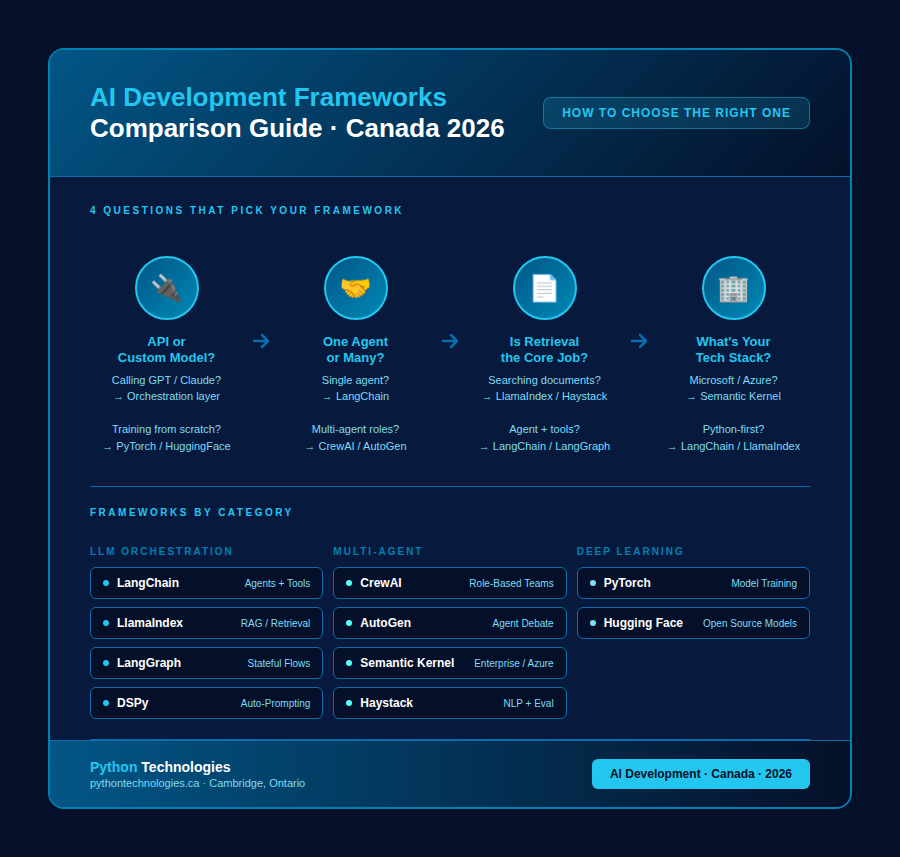
What Are AI Development Frameworks?
AI development frameworks are structured software libraries and toolkits that give developers a foundation to build AI applications faster. Instead of writing every integration from scratch, a framework handles the plumbing: connecting to LLMs, managing memory, routing agent tasks, retrieving documents, and handling retries.
The term covers a wide range of tools. Some are focused on LLM orchestration frameworks for chaining prompts and tools. Others are full agentic AI frameworks designed to coordinate multiple autonomous agents working on the same goal. Others still focus on deep learning frameworks for training models from raw data. AI application frameworks sit in the middle, providing the scaffolding for production-ready AI apps without requiring low-level model expertise. AI infrastructure frameworks handle the deployment, scaling, and monitoring layer that keeps everything running in production.
Choosing the wrong AI development frameworks means rebuilding later. Choosing the right one means shipping faster and scaling without friction. Our AI agent development cost and timeline in Canada breakdown shows that framework choice is one of the biggest drivers of project cost: the right framework can cut development time by 30 to 50 percent on a complex agentic system.
The 3 Categories of AI Development Frameworks
Before comparing specific tools, it helps to understand the three main categories. Each solves a different problem.
1. LLM Orchestration and Agent Frameworks
These are the most popular AI development frameworks for building intelligent applications today. They connect your application to one or more LLMs, manage tool calls, handle memory, and chain steps together.
Examples: LangChain, LlamaIndex, CrewAI, AutoGen, LangGraph
2. Deep Learning and Machine Learning Frameworks
These are used for training, fine-tuning, and deploying AI models. They are lower-level and more compute-intensive. Most product teams use these when they need to train a custom model rather than calling an existing LLM API.
Examples: PyTorch, TensorFlow, JAX, Hugging Face Transformers
3. Multi-Agent Orchestration Frameworks
These coordinate multiple AI agents working together. Each agent has a role, and the orchestration layer routes tasks between them. These are the backbone of enterprise AI frameworks for complex automation pipelines.
Examples: AutoGen, CrewAI, LangGraph, Semantic Kernel
Most Canadian businesses building custom agentic AI systems work with AI development frameworks from categories 1 and 3. Category 2 becomes relevant when you have proprietary data and need fine-tuning beyond what a base LLM can do. AI agent developer tools like LangSmith and Weights and Biases sit alongside these categories as observability and evaluation layers that help teams measure and improve their AI systems.
Top 10 AI Development Frameworks in 2026
1. LangChain
LangChain is the most widely used LLM orchestration framework in the world. It gives developers a modular toolkit for connecting LLMs to tools, memory systems, databases, and external APIs. Its chain-based design makes it easy to build multi-step AI workflows.
Best for: Teams building RAG systems, chatbots, and tool-using agents. Works well for any business adding AI on top of an existing knowledge base.
Why Canadian teams use it: LangChain has the largest community and the most integrations across all AI development frameworks. If you are connecting AI to a CRM, a document database, or a support ticketing system, LangChain has a connector for it. For teams building agentic AI in CRM systems, LangChain’s prebuilt memory and retrieval tools save weeks of development.
Tradeoffs: LangChain abstracts a lot, which can make debugging hard. Large-scale production systems sometimes hit performance ceilings that require dropping down to lower-level tools.
Use it when: You need to move fast, you want a broad ecosystem, and your use case fits the standard agent-plus-tools pattern.
2. LlamaIndex
LlamaIndex is the leading open source AI framework for RAG (retrieval-augmented generation) pipelines. It specializes in connecting LLMs to your private data through structured indexing, chunking, and retrieval.
Best for: Businesses with large document libraries, knowledge bases, or structured databases that need AI to search and reason over internal data.
Why Canadian teams use it: For sectors like legal, healthcare, and financial services where data is dense and structured, LlamaIndex handles ingestion, chunking, and semantic search better than any other open source AI framework. Our AI document review and summary tools built for Canadian clients use LlamaIndex as the retrieval backbone.
Tradeoffs: LlamaIndex is narrower than LangChain. It excels at data retrieval but needs to be paired with an agent framework for full agentic behavior.
Use it when: Your AI use case is primarily about searching, summarizing, or reasoning over internal documents.
3. LangGraph
LangGraph is a newer addition to the LangChain ecosystem. It uses a graph-based model to define AI agent workflows. Instead of linear chains, you define nodes (tasks) and edges (conditions that route between tasks). This makes it powerful for building stateful, multi-step agents where the path is not always linear.
Best for: Complex workflows where agents need to loop, branch, and retry based on intermediate results. Production-grade agentic systems where control flow matters.
Why teams choose it: LangGraph handles state better than standard LangChain chains. Among AI development frameworks for production-grade agentic systems, LangGraph has the most mature approach to conditional routing and human-in-the-loop approval steps.
Tradeoffs: Steeper learning curve than LangChain. Requires more upfront design work to map out the graph before you code.
Use it when: Your agent workflow is complex, non-linear, or needs to maintain and update state across many steps.
4. Microsoft Semantic Kernel
Semantic Kernel is Microsoft’s open source AI development framework. It is designed for enterprise teams, especially those already in the Microsoft ecosystem (Azure, Office 365, Teams). It supports multiple LLMs and has strong plugin architecture for connecting AI to existing enterprise services.
Best for: Enterprise teams on Azure who want to add AI capabilities to existing .NET or Python applications.
Why Canadian enterprises use it: Many Canadian organizations run on Microsoft infrastructure. Semantic Kernel integrates directly with Azure OpenAI, Azure Cognitive Search, and Microsoft 365, making it the lowest-friction path for enterprise AI adoption in those environments. For teams looking at AI automation services in Canada through a Microsoft-first lens, Semantic Kernel is the default choice.
Tradeoffs: Less flexible outside the Microsoft ecosystem. Community is smaller than LangChain.
Use it when: Your organization runs on Azure and you want enterprise-grade governance, compliance, and access control built in.
5. AutoGen (Microsoft)
AutoGen is Microsoft’s framework for building the best multi-agent AI frameworks available in 2026 for iterative agent collaboration. It allows multiple AI agents to collaborate, debate, and coordinate to complete complex tasks. Each agent has a defined role, and AutoGen manages the conversation between them.
Best for: Research automation, code generation and review pipelines, and any workflow where multiple AI perspectives improve output quality.
Why it stands out: AutoGen’s conversational agent model is one of the most powerful autonomous agent frameworks available. Two or more agents can critique each other’s work, which improves output accuracy without human review on every step.
Tradeoffs: AutoGen conversations can be verbose and expensive in token usage. Cost management requires careful system prompt design.
Use it when: Your task benefits from debate, iteration, and multiple AI agents checking each other’s work.
6. CrewAI
CrewAI is an open source agentic AI framework and one of the fastest-growing AI agent orchestration frameworks built specifically for role-based multi-agent teams. You define a “crew” of agents, each with a specific role (researcher, writer, analyst), and CrewAI coordinates their work toward a shared goal.
Best for: Content production, research pipelines, and any task that maps naturally to a team of specialists.
Why Canadian teams are adopting it: CrewAI is simpler to configure than AutoGen for straightforward multi-agent use cases. For AI automation tasks like market research, lead enrichment, or content drafting pipelines, CrewAI ships working prototypes faster than any other AI agent orchestration framework.
Tradeoffs: Less suited to highly dynamic or non-deterministic workflows. Works best when roles are clearly defined in advance.
Use it when: You want to build a team of AI agents that mirrors how a human team would divide work.
7. PyTorch
PyTorch is the dominant deep learning framework for AI research and model training, and the backbone of most fine tuning frameworks used in production today. It is used by most major AI labs and is the foundation for most open source model training runs.
Best for: Teams that need to train or fine-tune their own models using proprietary data. AI agent development frameworks like LangChain often sit on top of models that were fine-tuned using PyTorch underneath.
Why fine-tuning matters: If you have data that no public LLM has seen, fine-tuning with PyTorch can produce a highly specialized model that outperforms general-purpose LLMs on your specific task. Canadian LLM integration services teams often pair PyTorch fine-tuning with LangChain for production deployment.
Tradeoffs: Requires significant ML expertise, GPU compute, and time. Not the right choice if you are building on top of existing LLM APIs.
Use it when: You have labeled proprietary data, you need a model that a public API cannot deliver, and you have ML engineering resources.
8. Hugging Face Transformers
Hugging Face Transformers is the most widely used AI application framework for working with pretrained models. It gives you access to tens of thousands of open source models for text, image, audio, and code tasks, with a consistent API for loading, running, and fine-tuning them.
Best for: Teams that want open source model flexibility without building from scratch. Also essential for RAG frameworks that need embedding models.
Why Canadian businesses use it: Hugging Face provides both the models and the infrastructure to run them. For AI projects with data privacy requirements where you cannot send data to an external API, running a Hugging Face model on your own cloud infrastructure keeps data inside your environment.
Tradeoffs: Running models locally or on a private cloud requires more infrastructure work than calling an API.
Use it when: Data privacy matters, you want full control over your model, or you need a specialized open source model not available through commercial APIs.
9. Haystack (by deepset)
Haystack is an open source AI development framework built specifically for production NLP and search pipelines. It is especially strong for building RAG pipelines, question-answering systems, and enterprise search tools.
Best for: Enterprises that need robust document search, FAQ systems, or custom knowledge-base assistants.
Why it competes with LlamaIndex: Haystack has stronger production tooling and better support for evaluation frameworks. It includes built-in AI evaluation frameworks for measuring answer quality, which matters when you need to measure and improve output accuracy over time.
Tradeoffs: Smaller community than LangChain. Fewer integrations out of the box.
Use it when: You need enterprise-grade search with measurable quality metrics and you want an evaluation pipeline baked into the framework.
10. DSPy (by Stanford NLP)
DSPy is one of the newer generative AI frameworks and one of the most innovative AI programming frameworks available in 2026. It treats AI prompting as a programming problem rather than a writing problem. Instead of writing prompts by hand, you define what your AI system should do, and DSPy automatically optimizes the prompts using a compiler-like process.
Best for: Teams that want to remove prompt engineering as a bottleneck and build AI pipelines that self-optimize.
Why it is gaining traction in 2026: As AI systems grow more complex, hand-written AI prompt frameworks become fragile and expensive to maintain. DSPy’s approach to automated prompt optimization makes pipelines more robust across model versions and input variations.
Tradeoffs: Newer and less documented than LangChain or LlamaIndex. Requires understanding of the DSPy programming model.
Use it when: Prompt fragility is slowing your team down and you want AI pipelines that tune themselves based on examples.
How to Choose the Right AI Framework for Your Business
With ten strong options, the real question is: which AI development frameworks fit your situation? Here is a practical filter.
Ask These 4 Questions First
Are you building on top of existing LLMs or training your own model?
If you are calling GPT-4, Claude, or Gemini via API, you need an orchestration layer like LangChain, LlamaIndex, or CrewAI. If you need to train or fine-tune from scratch, you need PyTorch or Hugging Face.
Do you need one agent or multiple agents?
Single-agent workflows fit LangChain or LlamaIndex. Multi-agent workflows where different agents take different roles fit CrewAI, AutoGen, or LangGraph.
Is data retrieval the core of your AI use case?
If your AI mostly needs to search and summarize internal documents, LlamaIndex or Haystack will outperform a general-purpose agent framework for that task.
What is your team’s existing tech stack?
Microsoft shops lean toward Semantic Kernel. Python-first teams lean toward LangChain or LlamaIndex. Teams with strong ML backgrounds lean toward PyTorch.
The Decision Matrix
Use Case | Recommended Framework |
RAG pipeline over documents | LlamaIndex or Haystack |
Multi-step agent with tool use | LangChain or LangGraph |
Multi-agent role-based teams | CrewAI or AutoGen |
Enterprise on Azure | Semantic Kernel |
Model training or fine-tuning | PyTorch |
Open source model deployment | Hugging Face Transformers |
Self-optimizing pipelines | DSPy |
AI Frameworks and Canadian Businesses: What to Know
Compliance and AI Governance Frameworks
Canadian businesses operating under PIPEDA or PHIPA need to think about AI governance frameworks alongside their technical framework choice. This means data residency, audit logging, and model explainability must be considered before you pick your stack.
Frameworks like Semantic Kernel (Azure) and Haystack have stronger enterprise controls out of the box. Open source frameworks like LangChain can meet these standards but require more configuration to do it.
AI compliance frameworks for regulated Canadian industries (healthcare, finance, legal) typically require that every AI decision be traceable. Look for frameworks that log inputs, outputs, and tool calls at the step level. Our AI regulations Canada 2026 after AIDA overview explains what Canadian AI governance frameworks must account for under current and upcoming regulation.
The Canadian Market in 2026
Toronto’s developer community has the deepest LangChain and LangGraph adoption in Canada. Waterloo and the university corridor lean toward PyTorch and Hugging Face for research-adjacent work. Vancouver’s SaaS community is adopting CrewAI and AutoGen fast for multi-agent automation products.
Canadian businesses using agentic AI in ERP systems tend to require multi-agent coordination. The most common stack for this in Canada in 2026 is LangGraph for orchestration plus LlamaIndex for retrieval plus a fine-tuned Hugging Face model for domain-specific inference.
For businesses considering building AI tools on top of their existing ERP, the how to implement agentic AI in ERP guide walks through how these framework layers connect in practice.
Evaluating AI Frameworks Before You Commit
Before you commit to a framework for a production build, run a 3-step evaluation.
Step 1: Build a proof of concept in 48 hours Pick your top two frameworks and build the simplest version of your core use case in each. If you cannot get a working prototype in 48 hours, the framework may be too complex for your team’s current skill level.
Step 2: Check community health Look at GitHub stars, recent commit activity, Discord or Slack community size, and number of open issues versus closed issues. A framework that has not been updated in 3 months is a risk in 2026’s fast-moving AI landscape.
Step 3: Stress test the cost model Run your proof of concept at 10x expected volume and measure token usage and latency. Some AI development frameworks like AutoGen can generate expensive loops if not configured carefully. Know your cost per query before you scale. Also check whether the AI evaluation frameworks your team uses for quality measurement integrate with your chosen framework natively or require custom tooling.
For teams that need help evaluating frameworks for a specific project, our custom software development team at Python Technologies does framework selection as part of discovery. We have shipped 87+ projects across agent systems, RAG pipelines, and LLM integrations and know where each framework breaks down under real production load.
Open Source vs Enterprise AI Frameworks
Most of the best AI development frameworks are open source. LangChain, LlamaIndex, CrewAI, AutoGen, PyTorch, Hugging Face, and DSPy are all free to use. You pay for compute, API calls, and developer time, not the framework itself.
Enterprise AI frameworks like Semantic Kernel are also free but come with tighter integration into paid cloud platforms. The tradeoff is convenience versus control.
For most Canadian startups and mid-market businesses, open source AI frameworks are the right starting point. They give you full control over your data, your costs, and your deployment environment. Enterprise frameworks make sense when you need the compliance, support contracts, and platform integration that a paid cloud ecosystem provides.
If you want to understand what a full AI build costs beyond the framework, the AI automation cost in Canada guide breaks down development, integration, and maintenance costs for Canadian businesses.
Build AI on the Right Foundation
The AI development frameworks you choose shape everything that comes after: how fast you build, how reliable your system is, and how much it costs to run and improve.
Python Technologies builds production AI systems for Canadian businesses using the frameworks that fit the job, not the frameworks that are easiest to sell. Our team has shipped AI agents, RAG pipelines, and multi-agent systems for clients across Toronto, Waterloo, Vancouver, and the GTA using LangChain, LlamaIndex, LangGraph, and Hugging Face depending on what each project actually needed.
If you are planning an AI project and want to know which framework makes sense for your use case, talk to our team. We will scope your build honestly and tell you exactly what it takes to ship something that works.
You can also explore what agentic AI is and how it benefits businesses or see AI use cases that can save you time at work if you are still defining what to build.
Frequently Asked Questions About AI Automation
What are AI development frameworks?
AI development frameworks are software libraries that give developers the building blocks to create AI applications without writing every component from scratch. They handle LLM connections, memory management, tool use, agent coordination, and data retrieval. Examples include LangChain, LlamaIndex, CrewAI, and PyTorch. Choosing the right framework depends on your use case, team skills, and infrastructure.
Which AI framework is best for building AI agents?
For single-agent applications, LangChain is the most widely used option with the largest community. For multi-agent systems where different agents take different roles, CrewAI is the fastest to configure and AutoGen is the most powerful for iterative agent collaboration. LangGraph is best for complex workflows with non-linear control flow.
What is the difference between LangChain and LlamaIndex?
LangChain is a general-purpose LLM orchestration framework for building agents, chains, and tool-using systems. LlamaIndex is specialized for RAG: connecting LLMs to private data through indexing and retrieval. Many production systems use both: LlamaIndex for retrieval and LangChain for agent logic.
What are the best AI frameworks for Canadian enterprises in 2026?
Canadian enterprises in Microsoft environments tend to use Semantic Kernel for compliance and Azure integration. For teams building on open source stacks, LangChain and LlamaIndex dominate. For regulated industries that need explainable AI and strong audit trails, Haystack's evaluation framework makes it a strong choice.
Do I need to train my own model or can I use an existing LLM?
Most businesses in 2026 build on top of existing LLMs via API and never train from scratch. Fine-tuning with PyTorch or Hugging Face makes sense only when you have large amounts of proprietary labeled data and a specific task where a base LLM consistently underperforms. The compute and time cost of training is high, so the bar for justifying it should be too.
What are agentic AI frameworks?
Agentic AI frameworks are a subset of AI development frameworks designed specifically for autonomous agents: AI systems that can take actions, use tools, make decisions, and complete tasks without constant human input. LangChain, LangGraph, CrewAI, and AutoGen are the leading agentic AI frameworks in 2026. They differ in how they handle state, coordination between agents, and control flow.
How do I know which AI framework my development partner is using?
Ask directly in your first discovery call. A credible AI development partner will be able to explain why they chose a specific framework for your use case, what its limitations are, and how they handle framework updates over time. At Python Technologies, we select frameworks based on the use case first, not default preferences. Our agentic AI services team explains framework choices as part of every project scoping session.
What is a RAG framework and when do I need one?
A RAG (retrieval-augmented generation) framework combines a vector database with an LLM so the AI can search your documents before generating an answer. It is the right approach when your AI needs to answer questions based on internal data: policy documents, product knowledge bases, legal contracts, or historical records. LlamaIndex and Haystack are the leading RAG frameworks. You need one whenever the base LLM's knowledge is not enough and you need answers grounded in your own data.
Python Technologies is a Canadian AI software development company specializing in custom AI Software development solutions. This Blog is reviewed by Arsalan Ali, Senior SEO Specialist at Python Technologies.
About
Menu
Locations

© 2026 – Python Technologies. All Rights Reserved.