
AI Readiness Assessment: How Canadian Businesses Can Prepare for AI
Categories
- Agentic AI (13)
- AI (1)
- AI & Automation (3)
- AI & Technology (1)
- AI Adoption (1)
- AI Automation (9)
- AI Business Solutions (1)
- AI Consulting (1)
- AI Costs & Pricing (1)
- AI Development (1)
- AI Governance & Compliance (1)
- AI in Enterprise (3)
- AI Services Canada (1)
- AI Strategy (1)
- AI Use Cases (1)
- AI/ML Services (1)
- Artificial Intelligence (7)
- Artificial Intelligence Canada (2)
- Best AI Agents in 2026 (2)
- Business Automation (2)
- Business Technology (4)
- Business Technology Canada (1)
- Canada Tech & Business (3)
- Cloud Computing (1)
- CRM Automation (1)
- Custom Development (2)
- Custom Software Development (2)
- Custom Software Development Company (2)
- Customer Support (2)
- DevOps (1)
- Devops & Cloud Services (1)
- DevOps Services (1)
- Digital Transformation (5)
- ERP Technology (3)
- Hiring Guide (1)
- Industry Insights (2)
- Kubernetes (1)
- LLM Integration services (1)
- Local Business Guides (1)
- Ontario Tech (1)
- Productivity (1)
- Python Development (1)
- Software Development (2)
- Tech Product Pricing (1)
- Web Development (1)
Recent Posts
- All Posts
- Agentic AI
- agentic AI customer support
- AI
- AI & Automation
- AI & Technology
- AI Adoption
- AI Automation
- AI Business Solutions
- AI Consulting
- AI Costs & Pricing
- AI Development
- AI Governance & Compliance
- AI in Enterprise
- AI Services Canada
- AI Strategy
- AI Use Cases
- AI/ML Services
- Artificial Intelligence
- Artificial Intelligence Canada
- Best AI Agents in 2026
- Business Automation
- Business Technology
- Business Technology Canada
- Canada Tech & Business
- Cloud Computing
- CRM Automation
- Custom Development
- Custom Software Development
- Custom Software Development Company
- Customer Support
- DevOps
- Devops & Cloud Services
- DevOps Services
- Digital Transformation
- ERP Technology
- Hiring Guide
- Industry Insights
- Kubernetes
- LLM Integration services
- Local Business Guides
- Ontario Tech
- Productivity
- Python Development
- Software Development
- Tech Product Pricing
- Web Development
- Back
- Generative AI




Author: Python Technologies Date: 10/01/2026
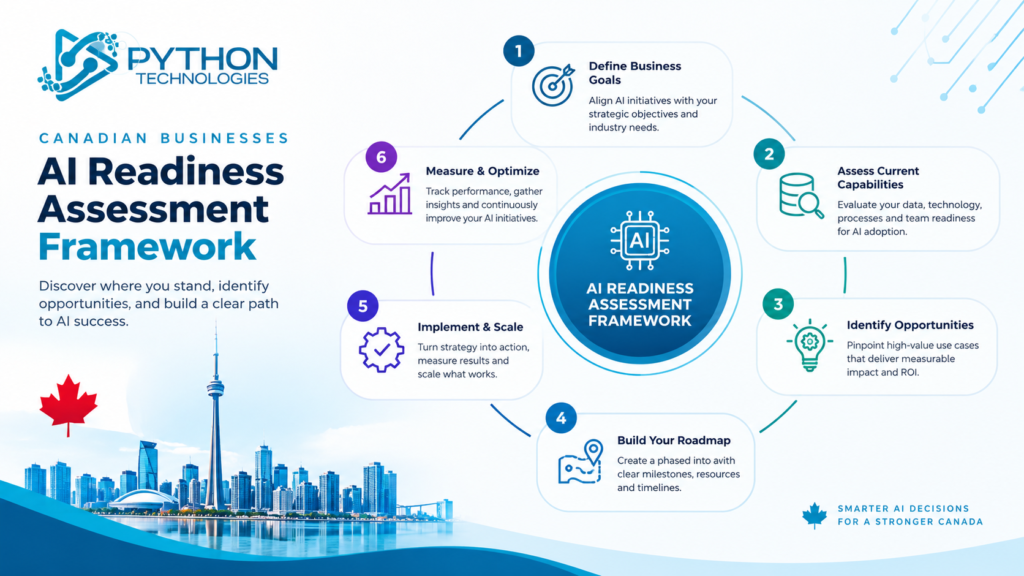
An AI readiness assessment tells you if your business is ready to build and use AI tools today. It looks at your data, your team’s skills, your tech setup, and your leadership buy-in. Most Canadian businesses that skip this step spend money on AI projects that stall or fail. The ones that run an assessment first move faster, waste less, and get better results. Whether you call it an AI risk assessment, an AI capability assessment, or a digital transformation readiness check, the goal is the same: know what you have before you spend money on what you want.
This guide walks you through a complete AI readiness framework built for Canadian companies in 2026. You will learn what to check, how to score your business, and what to fix before you start building.
What Is an AI Readiness Assessment?
An AI readiness assessment is a structured review of your business to find out if you are ready to adopt AI. It checks five key areas: data, technology, people, process, and strategy. The output is a clear picture of where you are strong and where you need to improve before you invest in AI tools or development.
Think of it as a health check for your business before a major upgrade. Just like a doctor checks your vitals before surgery, a readiness assessment checks your business vitals before you build AI. Enterprise AI readiness is not about having the most advanced tools. It is about having the right foundation.
The AI automation services in Canada market has grown fast in 2026. More businesses want to automate. But many rush into projects without checking if their foundation is solid. That leads to cost overruns, poor adoption, and tools that nobody uses.
An AI maturity assessment helps you avoid that. It puts a number or score on your current state so you know what to prioritize.
Why Canadian Businesses Need an AI Readiness Framework
Canada has a strong AI ecosystem. Toronto, Vancouver, Waterloo, and Montreal are home to world-class AI research and development. AI adoption in Canada has grown steadily, but being near AI talent does not mean your business is ready to use it.
The gap between interest in AI and actual AI readiness is large. A 2025 survey by the Business Development Bank of Canada found that over 60% of small and mid-size businesses want to use AI but fewer than 20% have a clear plan to do it.
An AI readiness framework Canada businesses can actually use closes that gap. It gives you a plan instead of a guess. It answers four questions:
- Do we have the data AI needs to work?
- Do we have the tools and infrastructure to run AI?
- Does our team know how to use and manage AI?
- Do our leaders support the change AI requires?
If any of these answers is no, you fix it before you build. That saves money and time. The AI automation cost in Canada for a full custom solution runs from CAD 10,000 to over 100,000 depending on scope. Getting the foundation right before you spend that money is smart business. This is the core of any AI adoption roadmap Canada companies should follow: assess first, then build.
The Five Pillars of AI Readiness
A solid AI maturity model for organizations covers five areas. Each one affects how well your AI project will work. Preparing business for AI means working through all five, not just the ones that feel easy.
1. Data Readiness
AI runs on data. If your data is messy, incomplete, or locked in spreadsheets, your AI will perform poorly. Data readiness checks four things:
- Volume: Do you have enough data for the AI to learn from?
- Quality: Is your data accurate, consistent, and up to date?
- Access: Can you get your data out of your systems quickly and cleanly?
- Privacy: Does your data handling meet PIPEDA and other Canadian privacy laws?
Many Canadian businesses find data readiness is their biggest gap. They have data, but it lives in silos across different systems. An agentic AI in ERP project, for example, needs clean, connected data across sales, inventory, and finance. If those systems do not talk to each other, the AI cannot work.
Score your data: Rate yourself 1 to 5 on each of the four points above. A score below 12 out of 20 means data prep should come before AI development. An AI assessment tool can help you benchmark your data quality against industry standards before you begin.
2. Technology and Infrastructure Readiness
Your current tech stack needs to support AI workloads. This means looking at your cloud setup, your APIs, your storage, and your compute power.
Key questions:
- Are your core systems cloud-based or on-premise?
- Do your apps have APIs that new tools can connect to?
- Can your infrastructure handle the compute load of running AI models?
- Do you have version control and deployment pipelines for software updates?
Most AI projects using AI strategy Canada-based firms rely on cloud platforms like AWS, Azure, or Google Cloud. If your systems are fully on-premise with no cloud access, you will need to plan a migration step before or alongside your AI build.
At Python Technologies, our DevOps and cloud services team often works alongside AI development to make sure the infrastructure is ready before a single line of AI code is written.
3. People and Skills Readiness
AI tools need people who can use them, manage them, and improve them over time. The skill gap is one of the most common blockers for Canadian businesses.
You do not need a full AI team on day one. But you do need a few things:
- At least one person who understands what AI can and cannot do
- Managers who can connect business problems to AI solutions
- Frontline staff who will actually use the AI tools in their daily work
- A partner or in-house developer who can build and maintain the system
The hire AI developers Canada market is competitive. If you cannot find senior AI talent quickly, a staff augmentation or custom software development partner can fill the gap while you build internal skills.
For businesses with limited technical staff, starting with a narrow AI use case helps. One tool, one problem, one team. Prove the value, then expand.
4. Process Readiness
AI does not replace your processes. It improves them. But your processes need to be documented and consistent before AI can improve them.
If two people on your team do the same task in completely different ways, AI will not know which way is right. You need standard operating procedures (SOPs) and clear workflow maps before you automate.
Process readiness also means asking: which processes are the right fit for AI? The best candidates for AI automation share a few traits:
- High volume and repetitive
- Rule-based or pattern-based
- Time-sensitive
- Error-prone when done manually
Customer support ticket routing, invoice processing, lead qualification, and document review are common examples. Our custom AI agents for GTA businesses guide covers the top automation use cases for SMBs in Ontario.
5. Strategy and Leadership Readiness
AI projects fail when leadership is not behind them. Strategy readiness checks whether your organization has the right mindset and plan to drive AI adoption all the way through.
Key questions:
- Has leadership committed budget and time to AI?
- Is there an executive sponsor for the AI project?
- Does the team understand why you are adopting AI (not just what you are building)?
- Is there a plan for change management and user adoption?
AI adoption strategy is not a tech decision. It is a business decision. The companies that get the most value from AI are the ones where leadership treats it as a strategic priority, not a side project for the IT team.
Step 1: Define Your AI Goal
Before you assess anything, write down the specific business problem you want AI to solve. Be specific.
Not this: “We want to use AI to grow.” This: “We want to reduce customer support response time from 24 hours to under 2 hours using an AI support agent.”
A clear goal focuses your assessment. Every answer you give in Steps 2 to 5 should connect back to whether you can hit that goal.
Step 2: Score Your Five Pillars
Use the scoring template below. Rate each area from 1 (not ready) to 5 (fully ready). Be honest. Overrating yourself just delays the work.
Pillar | Score (1-5) |
Data readiness | |
Technology readiness | |
People and skills readiness | |
Process readiness | |
Strategy and leadership readiness | |
Total (out of 25) |
Score guide:
- 20 to 25: High readiness. You can start building now.
- 13 to 19: Moderate readiness. Fix 1 to 2 gaps before you build.
- Below 13: Low readiness. Spend 3 to 6 months on foundation work first.
Step 3: Map Your Gaps
For any pillar where you scored 3 or below, list the specific gap and the action needed to fix it.
Example:
- Gap: Data is in three separate spreadsheets with no API access.
- Fix: Move data to a cloud database and set up basic API access. Timeline: 6 weeks.
Step 4: Build Your AI Transformation Roadmap
An AI transformation roadmap and AI implementation roadmap for businesses turns your gap fixes into a clear timeline. It has three phases:
- Phase 1: Foundation (weeks 1 to 12) Fix your data, infrastructure, and process gaps. Document your target workflows. Set your AI goal in writing and get leadership sign-off.
- Phase 2: Pilot (weeks 12 to 24) Build a narrow proof of concept for one use case. Measure the output. Get user feedback. The building an agentic AI support system approach works well here: start with support, prove the value, then expand.
- Phase 3: Scale (weeks 24 to 52) Roll out to more users and more use cases. Build internal skills. Measure ROI monthly.
Step 5: Choose Your Build Approach
Once your foundation is solid, you have two options for building:
- Build with a custom AI development partner Best for businesses with complex workflows, proprietary data, or deep integration needs. Python Technologies builds custom AI agents for Canadian businesses across industries. We have delivered 87+ projects including Vikk AI (100,000 users), Sensely (285,000 users), and Levity (350 businesses).
- Use a pre-built AI tool or platform Best for businesses with standard workflows and limited budgets. Tools like Zapier AI, HubSpot AI, or Microsoft Copilot work well for general productivity and CRM automation. The tradeoff is less customization and less control over your data.
Most growing Canadian businesses end up with a hybrid approach: off-the-shelf tools for general work and custom AI for the workflows that are unique to their business. Enterprise AI adoption strategy at larger companies often combines both, with a phased roadmap that expands AI coverage over 12 to 24 months.
AI Readiness Assessment by Industry
AI readiness looks different depending on your industry. Here are the key considerations for common sectors in Canada.
AI Readiness Assessment for Healthcare
Healthcare in Canada has strict rules around patient data. PHIPA in Ontario and similar provincial laws add extra compliance steps. An AI readiness assessment healthcare teams can actually use must include:
- PHIPA and PIPEDA compliance review
- De-identification of patient data for training
- Audit trails for all AI decisions
- Clinician and patient consent workflows
Our AI patient intake automation solution for healthcare providers is built with these requirements as the baseline, not an afterthought.
AI Readiness for E-commerce and Retail
E-commerce businesses often have the most ready data: purchase history, browse behavior, cart abandonment, and support tickets. Key readiness gaps here are usually in connecting platforms (Shopify + CRM + email + support) and building the right AI use cases around that connected data.
AI Readiness for Professional Services
Law firms, accounting firms, and consulting companies have rich document data but often poor data structure. AI readiness for professional services means converting unstructured documents into structured data that AI can read and reason over. AI document review and summary tools are often the first AI use case for these firms.
AI Readiness for Manufacturing and Logistics
Manufacturing businesses often have older on-premise systems. The readiness gap here is usually in infrastructure: moving data from machines and floor systems into cloud databases that AI can access. Once that pipeline is in place, AI for predictive maintenance, quality control, and demand forecasting follows naturally.
AI Readiness by Canadian Region
Toronto and GTA
Toronto is Canada’s largest AI market. Businesses in the GTA have access to a deep talent pool, strong cloud infrastructure, and a large network of AI consultants and development firms. AI strategy consulting for executives in Toronto is a competitive field, and most businesses can find a qualified partner quickly.
The main readiness challenge in Toronto is not access to AI, it is prioritization. Too many options and too many vendors make it hard to focus. AI strategy consulting Toronto firms and executives rely on most often focuses on scoping: narrowing the AI investment to the highest-value use case first. A clear AI readiness assessment gives GTA businesses a filter: is this vendor solving a problem I actually have?
Vancouver
Vancouver’s tech scene is strong in media, gaming, and SaaS. AI readiness assessment Vancouver companies run most often centers on data infrastructure: companies have product data but struggle to connect it across tools. AI agents in Canada are gaining fast adoption in Vancouver’s SaaS sector where workflow automation drives direct revenue.
Waterloo and Cambridge
Waterloo is home to some of Canada’s best engineering talent and a cluster of AI-native startups. For businesses in Waterloo, Cambridge, and Kitchener, the readiness gap is often in go-to-market strategy: how do you turn a good AI prototype into a product customers will pay for?
Python Technologies is based in Cambridge, Ontario. We work with Waterloo Region businesses on custom software development in Ontario to bridge the gap between engineering skill and commercial AI deployment.
Calgary
Calgary’s energy and agriculture sectors are increasingly interested in AI for operations and predictive analytics. AI readiness in Calgary often requires a longer foundation phase: legacy systems need modernizing before AI can plug in. But the ROI for AI in these sectors is high, which drives strong leadership buy-in.
Common AI Readiness Mistakes Canadian Businesses Make
- Starting with the tool, not the problem. The most common mistake is picking an AI platform first and then trying to find problems it solves. Always start with the business problem and work backward to the tool.
- Skipping data cleanup. Businesses rush to build AI before cleaning their data. Bad data produces bad AI outputs. Every hour spent on data quality before the build saves four hours of debugging after.
- No change management plan. AI tools fail when people do not use them. A rollout plan that includes training, communication, and user feedback loops is as important as the code itself.
- Treating AI as a one-time project. AI systems improve over time when they get feedback and new data. Treating the launch as the finish line means leaving most of the value on the table.
- Choosing the wrong vendor. Many companies selling “AI solutions” are reselling basic automation tools with an AI label. Look for vendors with real case studies, named clients, and measurable outcomes. Our top agentic AI services in Canada page lists what to look for when evaluating a partner.
Business AI Readiness Checklist
Use this quick checklist before starting any AI project.
Data
- [ ] Core business data is in a centralized system (not just spreadsheets)
- [ ] Data is consistent and regularly updated
- [ ] You can export or access data via API
- [ ] You have a data privacy policy that meets PIPEDA
Technology
- [ ] At least some systems are cloud-based
- [ ] Your key platforms have APIs
- [ ] You have a deployment process for software updates
People
- [ ] At least one person understands AI basics
- [ ] Managers can describe which workflows are candidates for AI
- [ ] You have a development partner or plan to hire AI skills
Process
- [ ] Target workflows are documented as SOPs
- [ ] The target process is repetitive and rule-based
- [ ] You can measure the current baseline (time, cost, error rate)
Strategy
- [ ] Leadership has committed budget
- [ ] There is a named executive sponsor
- [ ] The AI goal is tied to a measurable business outcome
If you check 12 or fewer of these 15 boxes, spend time on foundation work before you build.
What Comes After the Assessment?
Once you complete your AI readiness assessment, you have a clear picture and a clear path. The next step depends on your score.
High readiness (20 to 25): Move straight to scoping your first AI project. Define the use case, the data needed, the integration points, and the success metrics. Start with a discovery call with an AI development partner.
Moderate readiness (13 to 19): Fix your top two gaps first. Set a 60-day timeline. Then scope your AI project once those gaps are closed.
Low readiness (below 13): Invest in foundation work: data consolidation, infrastructure modernization, and team training. This is not a failure. Most companies are in this bucket. The ones who do this work right grow faster when they do start building.
If you want to understand the cost of building after your assessment, the AI agent development cost and timeline in Canada guide breaks down what different types of AI projects cost and how long they take.
The best AI automation use cases for Canadian businesses page can help you pick the right starting point based on your industry and team size.
Get Your AI Readiness Assessment Done Right
Running a thorough AI readiness assessment is the smartest first move any Canadian business can make before investing in AI. Skipping this step is one of the top reasons AI projects in Canada fail in the first year. It saves money, reduces risk, and gives you a real plan instead of a best guess.
Python Technologies has helped businesses across Canada scope, build, and launch AI systems that actually deliver results. From agentic AI in CRM to LLM integration services to full custom software development in Canada, our team knows what it takes to take a business from zero AI to running AI.
If you want to talk through where your business sits on the readiness scale and get a free AI readiness assessment conversation, contact our team. We offer a free first conversation to help you figure out your starting point and what makes sense to build next.
Get Your AI Readiness Assessment Done Right
Running a thorough AI readiness assessment is the smartest first move any Canadian business can make before investing in AI. Skipping this step is one of the top reasons AI projects in Canada fail in the first year. It saves money, reduces risk, and gives you a real plan instead of a best guess.
Python Technologies has helped businesses across Canada scope, build, and launch AI systems that actually deliver results. From agentic AI in CRM to LLM integration services to full custom software development in Canada, our team knows what it takes to take a business from zero AI to running AI.
If you want to talk through where your business sits on the readiness scale and get a free AI readiness assessment conversation, contact our team. We offer a free first conversation to help you figure out your starting point and what makes sense to build next.
Frequently Asked Questions About AI Automation
What is an AI readiness assessment?
An AI readiness assessment is a structured review of your business that checks five areas: data, technology, people, process, and strategy. It gives you a score that tells you how prepared you are to build and adopt AI tools. The output is a clear list of gaps and a roadmap to fix them before you invest in development.
How long does an AI readiness assessment take?
A basic assessment with your leadership team takes two to four hours. A full external assessment with a consulting partner, including data audits and technical reviews, typically takes one to three weeks. Most Canadian businesses start with the internal version and bring in a partner to validate the findings.
What is an AI maturity model?
An AI maturity model ranks organizations on a scale from Level 1 (no AI in place) to Level 5 (AI is fully embedded across the business and continuously improving). Most Canadian SMBs sit at Level 1 or Level 2 in 2026. The goal of an AI maturity assessment is to identify which level you are at and what it takes to move to the next level.
Do I need to be a tech company to use AI?
No. AI tools are being adopted across industries in Canada including healthcare, retail, manufacturing, legal services, and construction. The key is matching the right AI use case to your industry and your workflows. Non-tech companies often have an advantage because they have clear, repetitive processes that are easy to automate.
What is the difference between AI readiness and digital transformation readiness?
Digital transformation readiness is broader. It covers all technology modernization including cloud migration, software updates, and process digitization. AI readiness is a subset of that. It focuses specifically on whether your business can support AI workloads. If you are not yet digitally transformed, AI readiness work will overlap with broader digital transformation steps.
How much does an AI readiness assessment cost in Canada?
A self-directed internal assessment costs nothing but your team's time. A formal assessment with an external AI strategy consultant typically costs CAD 2,000 to 8,000 depending on the size and complexity of your business. For enterprise organizations, full AI capability assessments can cost more and take longer. Many AI development firms in Canada offer a free discovery session as an informal starting point.
Which Canadian industries have the highest AI readiness in 2026?
Financial services, SaaS, and e-commerce tend to score highest on AI readiness because they have clean digital data, modern cloud infrastructure, and teams that are already comfortable with software tools. Healthcare, manufacturing, and professional services have strong AI potential but often need more foundation work on data structure and compliance before they can build.
How do I find an AI strategy consultant in Canada?
Look for consultants or firms with verifiable case studies, named clients, and measurable results. Ask about their experience with Canadian privacy laws (PIPEDA, PHIPA) and their approach to data security. Python Technologies offers AI strategy consulting for Canadian businesses with a team based in Cambridge, Ontario and clients across Toronto, Vancouver, and the GTA.
Python Technologies is a Canadian AI software development company specializing in custom AI Software development solutions. This Blog is reviewed by Arsalan Ali, Senior SEO Specialist at Python Technologies.
About
Menu
Locations
© 2026 – Python Technologies. All Rights Reserved.