
AI Agents in Canada: 7 Ways Businesses Are Automating in 2026
Categories
- Agentic AI (14)
- AI (1)
- AI & Automation (3)
- AI & Technology (1)
- AI Adoption (1)
- AI Automation (9)
- AI Business Solutions (1)
- AI Consulting (1)
- AI Costs & Pricing (1)
- AI Development (3)
- AI Framework (1)
- AI Governance & Compliance (1)
- AI in Enterprise (3)
- AI Services Canada (1)
- AI Strategy (2)
- AI Use Cases (1)
- AI/ML Services (1)
- Artificial Intelligence (7)
- Artificial Intelligence Canada (2)
- Best AI Agents in 2026 (2)
- Business Automation (2)
- Business Technology (4)
- Business Technology Canada (1)
- Canada Tech & Business (3)
- Case Studies (1)
- Cloud Computing (1)
- CRM Automation (1)
- Custom Development (2)
- Custom Software Development (2)
- Custom Software Development Company (2)
- Customer Support (2)
- DevOps (1)
- Devops & Cloud Services (1)
- DevOps Services (1)
- Digital Transformation (5)
- ERP Technology (3)
- Hiring Guide (1)
- Industry Insights (2)
- Kubernetes (1)
- LLM Integration services (1)
- Local Business Guides (1)
- Machine Learning (1)
- Ontario Tech (1)
- Productivity (1)
- Python Development (1)
- RAG AI Framework (1)
- Software Development (2)
- Software Engineering (1)
- Tech Product Pricing (1)
- Web Development (1)
Recent Posts
- All Posts
- Agentic AI
- agentic AI customer support
- AI
- AI & Automation
- AI & Technology
- AI Adoption
- AI Automation
- AI Business Solutions
- AI Consulting
- AI Costs & Pricing
- AI Development
- AI Framework
- AI Governance & Compliance
- AI in Enterprise
- AI Services Canada
- AI Strategy
- AI Use Cases
- AI/ML Services
- Artificial Intelligence
- Artificial Intelligence Canada
- Best AI Agents in 2026
- Business Automation
- Business Technology
- Business Technology Canada
- Canada Tech & Business
- Case Studies
- Cloud Computing
- CRM Automation
- Custom Development
- Custom Software Development
- Custom Software Development Company
- Customer Support
- DevOps
- Devops & Cloud Services
- DevOps Services
- Digital Transformation
- ERP Technology
- Hiring Guide
- Industry Insights
- Kubernetes
- LLM Integration services
- Local Business Guides
- Machine Learning
- Ontario Tech
- Productivity
- Python Development
- RAG AI Framework
- Software Development
- Software Engineering
- Tech Product Pricing
- Web Development
- Back
- Generative AI


Author: Python Technologies Date: 08/10/2026
Canadian businesses spent the last few years experimenting with AI. Chatbots on websites. AI writing tools for content teams. Basic automation scripts connecting apps together. Useful, but limited.
In 2026, that experimentation has given way to something more serious. Autonomous AI agents that handle entire workflows from start to finish. Systems that do not just respond to inputs but pursue goals, use tools, make decisions, and complete work without human direction at every step.
The adoption of AI technology across Canadian enterprises has accelerated faster than most forecasts predicted. Businesses in Toronto, Vancouver, Calgary, Ottawa, and across the country are deploying AI agents that handle customer support, qualify leads, process documents, manage HR queries, and run marketing campaigns without the same headcount those tasks required before.
This guide covers what AI agents actually are, how they differ from older automation, seven specific ways Canadian businesses are using them right now, what they cost to build, and how to choose the right approach for your operation.
What Are AI Agents?
An AI agent is software that can pursue a goal autonomously. It receives an objective, breaks it into steps, uses tools to complete those steps, evaluates the results, and continues until the goal is reached or it determines it needs help.
The core components that make this possible are a large language model for reasoning, memory that retains context across the task, tools that connect the agent to external systems, and a planning layer that sequences what to do and when.
Modern agents are built on frameworks that structure this capability for production use. LangGraph manages stateful, multi-step agent workflows with conditional logic and branching. The Hermes agent model is used in open-source deployments where instruction-following accuracy and tool use precision matter. Google AI (through Vertex AI and Gemini) and OpenAI (through the Assistants API and GPT-4o) both provide hosted platforms for building and deploying agents at scale.
The best AI agents in production are not general-purpose. They are scoped to a specific domain: customer support, sales, document processing, or operations. A narrow, well-defined scope produces an agent that performs reliably. A broad, undefined scope produces one that fails unpredictably.
Our AI and ML solutions cover the full stack of how agents are designed, trained, and deployed for Canadian business environments.
How AI Agents Are Different From Traditional Automation
Traditional automation follows rules. If this condition is met, take this action. Rigid, predictable, and completely unable to handle anything outside the defined script.
Rule-based automation works for perfectly consistent processes. The moment something unexpected appears, a missing field, an ambiguous request, an edge case the script did not anticipate, the automation fails and a human has to step in.
AI agentic workflows handle variation. They reason about what to do when the expected path is not available. An AI agent receiving a support request that does not fit a known category does not fail. It reads the request, interprets the intent, checks available resources, and determines the most appropriate response. It adapts.
The practical difference shows up in process coverage. Traditional automation can handle about 60 to 70 percent of a repetitive workflow before exceptions pull it back to humans. A well-designed AI agent handles 85 to 95 percent, with clean escalation paths for the remainder.
For a concrete look at what this difference produces in real deployments, see our AI automation case study.
AI Agent Examples for Canadian Businesses
Healthcare. AI patient intake automation collects symptoms and history from patients before appointments, scores urgency, and routes cases to the right provider with a prepared summary. Clinicians see more patients. Paperwork disappears.
E-commerce. AI product description automation generates SEO-optimised product copy for entire catalogs from structured product data. What used to take a copywriting team weeks takes hours.
Financial services. AI agents process loan applications, extract data from submitted documents, cross-reference against eligibility criteria, and flag exceptions for human review. Application processing time drops from days to minutes.
Logistics. Agents monitor shipment status across carrier APIs, proactively contact customers when delays are detected, and update internal systems without a dispatcher touching each case.
Professional services. Law firms, accounting practices, and consultancies use agents for document review, research, and client intake, freeing skilled professionals for work that actually requires their expertise.
SaaS companies. Agents handle onboarding sequences, answer product questions through in-app chat, identify accounts showing signs of churn, and trigger retention workflows automatically.
7 Ways Canadian Businesses Are Using AI Agents in 2026
1. AI Customer Service Agents
Canadian retailers, telecoms, financial institutions, and healthcare providers are deploying conversational AI customer service agents that handle complex billing inquiries, technical support requests, and account management tasks around the clock without human intervention.
The difference between these agents and basic chatbots is the ability to handle multi-turn conversations with context. A customer who says “I already explained this last week” gets an agent that retrieves the prior conversation and continues from where it left off, not one that asks the same opening questions again.
Our 24/7 AI customer support agent covers how this works in production, including escalation paths for cases that genuinely need a human and how response quality is monitored over time.
2. AI Sales Agents
B2B companies across Canada are using AI sales agents to automate outbound outreach, draft personalized pitches based on prospect data, follow up with leads on defined schedules, and move opportunities down the funnel without a sales rep involved until the conversation is ready for a human.
The agent pulls data from your CRM, researches the prospect’s company, identifies the right angle based on their industry and recent activity, drafts a message that reflects that context, sends it, tracks opens and replies, and follows up based on response or silence.
For inbound leads, AI-powered lead qualification handles the initial engagement, scores the lead against your criteria, and books a call only when the prospect meets the threshold.
3. AI Marketing Agents
Marketing agents analyse local Canadian market trends, monitor competitor activity, generate and schedule content, optimise ad spend in real time, and adjust campaign targeting based on performance data.
A marketing agent running a content calendar for a Canadian B2B company can draft blog posts based on keyword research, write social copy in the brand voice, schedule posts across platforms, and report on engagement, all without a content manager coordinating each piece manually.
For more complex marketing intelligence tasks involving data analysis and audience segmentation, our AI and ML solutions cover the modelling and integration work that makes these agents accurate.
4. AI Voice Agents
Medical clinics, restaurants, logistics companies, and professional service firms across Canada are using AI voice agents to handle high-volume phone lines, schedule appointments, answer product and service questions, and manage bookings without a receptionist on every call.
Modern voice agents operate with low latency and high fidelity. A caller cannot tell whether they are speaking to a human or an agent for the first few exchanges. The agent handles the majority of calls from start to finish. Complex or sensitive cases transfer to a human with a full call transcript already prepared.
Our AI voice solutions cover deployment across phone systems, websites, and messaging platforms with multilingual support for Canada’s bilingual business environment.
5. AI Employee Support Agents
Inside large Canadian organisations, AI employee support agents handle HR inquiries, IT troubleshooting requests, and internal knowledge retrieval without routing everything through a help desk.
An employee who needs to know the parental leave policy, reset a password, find last quarter’s sales report, or understand the expenses reimbursement process gets an immediate, accurate answer from an agent that has been trained on the organisation’s internal documentation.
This frees HR and IT teams from answering the same questions repeatedly and lets employees get answers at any hour. Our AI internal knowledge base assistant covers how this is built and deployed for enterprise environments with proper access controls.
6. AI Workflow and Process Automation
Behind customer-facing agents, agentic frameworks are connecting disparate software systems that previously required manual data transfer between them. An order placed in an e-commerce platform automatically updates inventory, triggers a fulfillment workflow, creates a shipping label, and sends a confirmation email without any human touching the process.
AI coding agents are also accelerating software development workflows. Agents that review pull requests, flag style and logic issues, generate documentation, and write unit tests are becoming standard tools for Canadian engineering teams that want to ship faster without expanding the team.
For businesses that need custom integration work connecting multiple platforms, custom software development is the starting point for building the underlying infrastructure these agents operate on.
7. AI Lead Qualification and Business Operations
Operational AI agents scan incoming inquiries across email, website forms, and chat, extract structured data about the prospect, score them against qualification criteria, update the CRM automatically, and route them to the right sales rep or self-serve resource.
The same operational agent architecture applies across revenue operations: contract renewal reminders triggered by subscription data, re-engagement campaigns triggered by inactivity signals, and pipeline reporting generated from CRM data without a revenue ops analyst pulling it manually.
Canadian businesses using these agents report that their sales teams spend a higher proportion of their time on conversations that actually result in closed deals, because the operational layer that used to consume their attention is handled automatically.
Benefits of AI Agents for Canadian Businesses
The business case for AI agents in Canada in 2026 is built on consistent, measurable outcomes across deployments.
24/7 availability. Agents work around the clock without overtime costs, shift premiums, or coverage gaps. For Canadian businesses serving customers across time zones, this is a direct service quality improvement.
Cost reduction. High-volume, repetitive tasks that previously required dedicated headcount are handled by agents at a fraction of the per-task cost. Customer support agents consistently handle 70 to 85 percent of inbound volume without human involvement. Businesses can explore real-world examples through an AI automation case study to understand how AI can be applied to actual operational processes.
Rapid scalability. When volume increases, agents scale instantly. No hiring cycle, no training period, no ramp-up time. A business launching a new product or entering a new market can handle the resulting inquiry volume on the same day.
Reduced human error. For data entry, document processing, and criteria-based decision making, agents are more consistent than humans handling the same volume under time pressure. Error rates drop when the same process runs the same way every time.
Faster response times. An AI agent responds to a customer inquiry in seconds. The competitive advantage of instant response over a competitor responding in hours is measurable in conversion rates and customer satisfaction scores.
Employee focus. When agents handle routine work, human teams focus on tasks that genuinely require judgment, creativity, and relationship skills. Employee satisfaction often improves when the repetitive layer is removed.
How Much Does AI Agent Development Cost in Canada?
Cost depends on complexity, scope, and how the agent is built.
Prototype using off-the-shelf platforms (CAD $2,000 to $8,000). Using tools like n8n, Flowise, or Relevance AI, a simple single-workflow agent can be built quickly. Good for proving a concept. Not suitable for enterprise-scale deployment or complex integrations.
Custom single-workflow agent (CAD $10,000 to $35,000). A production-grade agent built for one specific workflow, such as lead qualification or customer support, with proper integrations, monitoring, and compliance controls. This is the right entry point for most Canadian SMEs.
Multi-workflow or multi-agent system (CAD $35,000 to $100,000+). Multiple agents working together across departments, connected to CRMs, ERPs, and communication platforms, with enterprise security, governance, and observability built in. This is the range for serious enterprise deployments.
Ongoing costs. LLM API usage, cloud infrastructure, and maintenance add recurring costs that vary based on usage volume. For high-volume deployments, model routing and semantic caching strategies can reduce these costs by 30 to 50 percent.
The most reliable way to get an accurate number is a scoping conversation that defines the exact use case, the integrations required, the compliance environment, and the expected volume before any development begins.
How to Choose the Right AI Agent for Your Business
The choice between off-the-shelf platforms, no-code builders, and custom development depends on three factors: how specific your workflow is, what data the agent needs to access, and what your compliance requirements are.
Use off-the-shelf or free AI agent tools when your use case is standard, your data is not sensitive, and speed to deployment matters more than a perfect fit. Free AI agents from OpenAI, Google AI, and platforms like Zapier AI Agents are good for experimentation and simple automations.
Use a no-code AI agent builder when you need more customisation than off-the-shelf provides but your team does not have engineering resources. Platforms like Flowise, Relevance AI, and Langflow give non-technical teams visual interfaces for building agent workflows.
Hire a team to build with production-grade AI agent frameworks when your workflow is specific to your business, your data includes customer or regulated information, you need integrations with your existing systems, or you are deploying at a scale where performance and reliability matter. Businesses should consider professional AI agent development services when the workflow is highly specific, the agent needs access to sensitive business information, multiple systems need to be integrated, or the deployment requires enterprise-level reliability and security.
LangGraph is our primary framework for stateful multi-step agents where the workflow has conditional branches and needs to track state across many interactions. CrewAI works well for multi-agent systems where specialised agents collaborate. LangChain handles RAG pipelines and tool use. n8n handles visual workflow orchestration for less technical teams.
An agentic AI business solutions architect evaluates your specific situation and recommends the right combination of frameworks, models, and infrastructure rather than applying a single template to every project.
AI Agents vs. Agentic AI: What's the Difference?
These two terms appear together constantly and are often used as if they mean the same thing. The distinction is useful.
An AI agent is a specific software entity. It is the thing that runs, makes decisions, uses tools, and completes a task. You deploy an AI agent. You monitor an AI agent. You can point to it.
Agentic AI is the broader architectural philosophy and the industry movement behind it. It describes the shift toward AI systems that operate with autonomy, pursue goals, and take actions in the world rather than just generating responses to prompts. Agentic AI is the paradigm. An AI agent is an instance of that paradigm.
The distinction matters when evaluating vendors and frameworks. A company selling “agentic AI” may be selling the architectural approach. A company delivering AI agents is delivering working systems. Make sure you know which one you are being quoted for.
Discussions at the agentic AI summit 2026 consistently highlighted this terminology gap as a source of confusion for enterprise buyers evaluating agentic AI solutions. The practical test is simple: can the vendor show you a deployed agent with real users and measurable outcomes?
AI agentic workflows, the automated pipelines built using agentic principles, sit between the two. They are the concrete implementation of agentic AI that produces deployed, working AI agents.
The Future of AI Agents in Canada
Canada’s AI ecosystem is positioned to be a significant global player in agentic AI deployment. Toronto, Montreal, and Vancouver are home to world-class AI research institutions, deep engineering talent, and a business community that has moved from AI curiosity to AI investment faster than most markets.
The near-term direction for AI agents in Canada points toward several clear trends.
Multi-agent collaboration will become the standard. Single agents handling isolated tasks will give way to networks of specialised agents that pass work to each other, with one agent gathering information, another analysing it, and another executing the resulting decision.
Vertical agents will outperform general ones. Agents trained on Canadian healthcare data, Canadian legal documents, or Canadian financial regulations will consistently outperform general-purpose agents on those specific tasks. Vertical specialisation is where the real competitive advantage is built.
Governance requirements will be formalised. Canadian regulatory frameworks around AI are developing. Businesses that build governance, audit logging, and human oversight into their agent systems now will face a smoother compliance path as regulation catches up with adoption.
AI agents will handle increasingly consequential decisions. The scope of what agents are trusted to do autonomously will expand. Contract approvals, procurement decisions, and strategic recommendations are already in scope for some deployments. The governance layer that supports this is what separates responsible deployment from risk.
For Canadian businesses ready to build, our AI agent development services cover the full scope from strategy to production deployment.
Final Thoughts
AI agents in Canada have moved from pilot projects to production deployments. The seven use cases in this guide are not predictions. They are running systems with real users and real business outcomes.
The businesses that build AI agent capability now are not just saving time on today’s workflows. They are building the operational foundation that will run their business more efficiently for the next decade.
The right starting point is a single, well-defined workflow where the volume is high and the process is clear. Build it. Measure it. Expand from there.
If you want to explore which AI agent use case fits your business and what building it would involve, contact the Python Technologies team. We are an AI agent development company based in Cambridge, Ontario, with a track record of building autonomous AI systems that work at production scale.
Frequently Asked Questions
What are AI agents and how do they work?
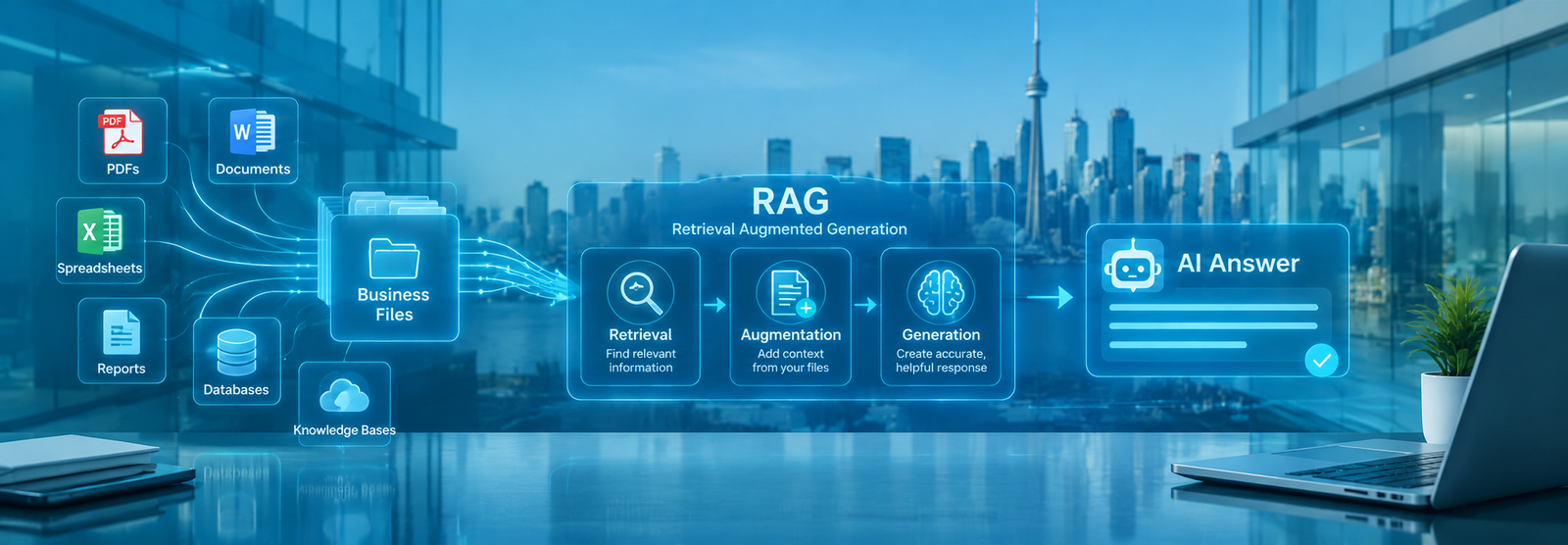
An AI agent is software that pursues a goal autonomously. It receives an objective, breaks it into steps, calls tools like APIs, databases, or search engines at each step, evaluates the results, and continues until the goal is complete. The reasoning is handled by a large language model. The coordination is handled by an orchestration framework. The tools connect it to the real world. Together, these components produce a system that acts, not just answers.
How do you build an AI agent?
The build process follows five steps. First, define the specific business goal the agent will pursue. Vague goals produce unreliable agents. Second, choose a base model suited to the reasoning requirements of the task. Third, select an agentic framework: LangGraph for stateful multi-step workflows, CrewAI for multi-agent systems, LangChain for RAG and tool use. Fourth, connect external data repositories and tool APIs the agent needs to do its job. Fifth, build safety guardrails: access controls, output validation, human-in-the-loop approval for high-stakes actions, and audit logging.
What are some examples of AI agents?
Real deployed examples include: AutoCalls.ai, an AI voice agent platform handling calls in 100 plus languages for 750 business clients. Vikk AI, a legal assistant serving 100,000 users with document analysis and legal Q&A. Sensely, a healthcare AI agent serving 285,000 users with patient intake and care navigation. VoiceSpin, a customer communication platform with AI transcription and agent assist tools serving 8,000 business users. Each is a live system with real users and measurable outcomes.
How much does an AI agent cost in Canada?
A prototype using off-the-shelf tools costs CAD $2,000 to $8,000. A production-grade custom single-workflow agent costs CAD $10,000 to $35,000. An enterprise multi-agent system with full integrations and compliance controls costs CAD $35,000 to $100,000 or more. Ongoing API and infrastructure costs vary by volume and can be reduced significantly through optimisation strategies. A scoping conversation produces the most accurate estimate for your specific situation.
What is the difference between an AI agent and a chatbot?
A chatbot answers one question at a time and waits for the next input. It cannot take action outside the conversation. An AI agent pursues a goal across multiple steps, uses tools to interact with external systems, remembers what it has done, and makes decisions along the way. A chatbot describes what to do. An agent does it.
Why should I hire an AI agent development company?
Building a production-grade AI agent involves engineering challenges that go beyond calling an API. Fine-tuning model behaviour for a specific domain requires expertise. Managing latency so agents respond fast enough for real-world use requires infrastructure knowledge. State management across complex multi-step workflows requires careful design. Enterprise data security requires a compliance-aware architecture. A specialised development company handles all of these correctly from the start, which produces higher ROI and lower risk than a general development team learning these challenges on your project.
About
Menu
Locations
© 2026 – Python Technologies. All Rights Reserved.