
Chatbot vs AI Agent: When to Upgrade From a Chatbot to an Agentic AI Assistant
Categories
- Agentic AI (14)
- AI (1)
- AI & Automation (3)
- AI & Technology (1)
- AI Adoption (1)
- AI Automation (9)
- AI Business Solutions (1)
- AI Consulting (1)
- AI Costs & Pricing (1)
- AI Development (3)
- AI Framework (1)
- AI Governance & Compliance (1)
- AI in Enterprise (3)
- AI Services Canada (1)
- AI Strategy (2)
- AI Use Cases (1)
- AI/ML Services (1)
- Artificial Intelligence (7)
- Artificial Intelligence Canada (2)
- Best AI Agents in 2026 (2)
- Business Automation (2)
- Business Technology (4)
- Business Technology Canada (1)
- Canada Tech & Business (3)
- Case Studies (1)
- Cloud Computing (1)
- CRM Automation (1)
- Custom Development (2)
- Custom Software Development (2)
- Custom Software Development Company (2)
- Customer Support (2)
- DevOps (1)
- Devops & Cloud Services (1)
- DevOps Services (1)
- Digital Transformation (5)
- ERP Technology (3)
- Hiring Guide (1)
- Industry Insights (2)
- Kubernetes (1)
- LLM Integration services (1)
- Local Business Guides (1)
- Machine Learning (1)
- Ontario Tech (1)
- Productivity (1)
- Python Development (1)
- RAG AI Framework (1)
- Software Development (2)
- Software Engineering (1)
- Tech Product Pricing (1)
- Web Development (1)
Recent Posts
- All Posts
- Agentic AI
- agentic AI customer support
- AI
- AI & Automation
- AI & Technology
- AI Adoption
- AI Automation
- AI Business Solutions
- AI Consulting
- AI Costs & Pricing
- AI Development
- AI Framework
- AI Governance & Compliance
- AI in Enterprise
- AI Services Canada
- AI Strategy
- AI Use Cases
- AI/ML Services
- Artificial Intelligence
- Artificial Intelligence Canada
- Best AI Agents in 2026
- Business Automation
- Business Technology
- Business Technology Canada
- Canada Tech & Business
- Case Studies
- Cloud Computing
- CRM Automation
- Custom Development
- Custom Software Development
- Custom Software Development Company
- Customer Support
- DevOps
- Devops & Cloud Services
- DevOps Services
- Digital Transformation
- ERP Technology
- Hiring Guide
- Industry Insights
- Kubernetes
- LLM Integration services
- Local Business Guides
- Machine Learning
- Ontario Tech
- Productivity
- Python Development
- RAG AI Framework
- Software Development
- Software Engineering
- Tech Product Pricing
- Web Development
- Back
- Generative AI


Author: Python Technologies Date: 08/18/2026
When to Upgrade From a Chatbot to an Agentic AI Assistant
Businesses have moved far beyond the basic chatbot that answers frequently asked questions. Modern customers and employees increasingly expect AI systems to understand context, access information, connect with business software, and help complete tasks rather than simply provide a text response.
This shift is changing the chatbot vs AI agent conversation. A traditional chatbot may be perfectly suitable when the goal is answering predictable questions through conversational AI and simple conversational interfaces. However, organizations dealing with complex workflows may need an AI system capable of reasoning, using tools, retrieving real-time information, and taking action.
The progression can be viewed as:
Chatbot → AI Assistant → Agentic AI Assistant → Autonomous AI Agent
A chatbot primarily responds. An AI assistant can provide more personalized assistance and perform selected tasks. An agentic AI assistant goes further by combining natural-language interaction with reasoning, planning, memory, tool use, and workflow execution.
This distinction is particularly important for AI agents for business. A customer service system, sales assistant, operations assistant, or employee productivity system may need to interact with CRM platforms, databases, APIs, knowledge bases, calendars, ticketing systems, and other applications.
For organizations evaluating AI automation, the question is no longer simply whether to use AI. The more useful question is whether the existing chatbot can accomplish what users actually need.
If customers repeatedly ask for actions instead of answers, employees need help completing multi-step workflows, or an AI system must interact with multiple business applications, it may be time to consider agentic AI solutions.
What Is an Agentic AI Assistant?
An agentic AI assistant is an AI-powered system designed to understand a user’s goal, reason about the required steps, access relevant information, use connected tools, execute actions, and provide a result.
Unlike a conventional chatbot that may follow predefined conversation paths, an agentic system can dynamically determine how to approach a task.
For example, consider a customer asking:
“Can you check my order, find out why it is delayed, contact the shipping system, and tell me when it should arrive?”
A basic chatbot might explain the shipping policy or provide a tracking link. An advanced AI assistant could retrieve the order information. An agentic AI assistant could potentially retrieve the order, check external data, identify the issue, interact with connected systems, and return an updated answer.

What Is an AI Assistant?
An AI assistant is software that helps users perform information-based or productivity-oriented tasks through natural-language interaction.
Common types of AI assistants include customer service assistants, employee assistants, sales assistants, scheduling assistants, research assistants, coding assistants, and personal productivity assistants.
Important virtual assistant features can include:
- Natural-language conversations
- Knowledge retrieval
- Context awareness
- Personalized responses
- Scheduling
- Email assistance
- Task management
- Document analysis
- Data retrieval
- Application integration
An AI assistant for business can therefore be more useful than a simple question-and-answer chatbot because it can support employees and customers across broader workflows.
Modern generative AI assistants can also produce text, summarize information, analyze documents, generate recommendations, and interact with users conversationally.
What Is an AI Agent?
An AI agent is an AI system capable of pursuing a defined objective by deciding which actions, tools, information sources, or workflows are needed to accomplish that objective.
In practical business applications, AI agents for business may connect an LLM to databases, APIs, CRM platforms, business applications, knowledge bases, and automation systems.
An agent can therefore move from:
“Here is the information you requested.”
to:
“I found the information, performed the required actions, verified the result, and completed the task.”
This is the foundation of AI agent automation, AI agent workflows, and autonomous AI agents for business.
What Makes an Agentic AI Assistant Different?
The key difference is the ability to move from conversation toward action.
An agentic AI assistant can combine:
- Context awareness
- Memory
- Reasoning
- Tool usage
- Multi-step planning
- API integrations
- Workflow execution
- Task completion
- Human-in-the-loop controls
AI agents with memory can retain relevant information across interactions, while AI agents with reasoning can evaluate the current situation and determine appropriate next steps.
A tool-using AI agent may call a CRM API, retrieve a customer’s order, update a support ticket, search a knowledge base, or initiate another approved business process.
The result is an AI system designed around objectives and tasks rather than conversations alone.
Chatbot vs AI Assistant vs Agentic AI Assistant
Understanding the chatbot vs AI assistant distinction is important before deciding whether an organization actually needs an AI agent.
Capability | Traditional Chatbot | AI Assistant | Agentic AI Assistant |
Answer questions | Yes | Yes | Yes |
Context awareness | Limited | Strong | Advanced |
Memory | Limited | Yes | Yes |
Reasoning | Limited | Moderate | Advanced |
Multi-step tasks | Limited | Some | Yes |
API integrations | Limited | Yes | Yes |
Tool usage | Limited | Yes | Advanced |
Workflow automation | Basic | Moderate | Advanced |
Autonomous decisions | No | Limited | Yes |
Task completion | Limited | Yes | Yes |
Human-in-the-loop | Usually | Often | Configurable |
The AI chatbot vs AI agent distinction becomes especially clear when the system must perform actions. Traditional chatbots generally focus on conversations and predefined responses. AI assistants can provide more sophisticated assistance, while agentic systems can coordinate multiple actions to achieve an objective.
Therefore, chatbot vs agentic AI is not simply a question of which technology is newer. It is a question of capability, complexity, risk, and business requirements.
How Is an Agentic AI Assistant Different From a Chatbot?
Intent Recognition vs Context Awareness
Traditional chatbots often rely heavily on intent recognition. They identify what the user is asking and map the request to an appropriate response or workflow.
An advanced agentic AI assistant can combine intent recognition with context awareness.
Instead of treating every message as an isolated question, it can consider previous interactions, available information, the user’s objective, business rules, and the current state of a workflow.
This enables more personalized responses and more meaningful task execution.
Answering Questions vs Completing Tasks
One of the biggest differences between a chatbot and an agent is task completion.
A chatbot might respond:
“Your order is delayed.”
An agentic system could potentially check the order, retrieve shipment information, identify the delay, update a support record, and provide the customer with the next step.
This is where multi-step tasks, AI task automation, and AI agent workflows become important.

Static Responses vs Autonomous Decision-Making
Traditional chatbots commonly operate within predefined rules or response structures.
Agentic systems can evaluate available information and determine which action should happen next within defined permissions.
This capability supports autonomous decision-making and AI decision-making systems while still allowing organizations to introduce appropriate controls.
For high-impact operations, autonomy does not necessarily mean removing humans. A human-in-the-loop design can require approval before sensitive actions are executed.
Limited Integrations vs Tool Integration
A chatbot may provide a link to another system. An agent can potentially interact with that system directly.
With tool integration, API integrations, and function calling AI, an agent can be connected to:
- CRM systems
- Databases
- ERP platforms
- Ticketing software
- Calendars
- Payment systems
- Knowledge bases
- Internal applications
This is one of the most important differences between traditional chatbot automation and agentic automation.
How Does an Agentic AI Assistant Work?
An agentic system generally combines an LLM with business data, memory, tools, workflows, and control mechanisms.
A simplified workflow looks like this:
User Request → Understand → Reason → Plan → Retrieve Information → Use Tools → Execute → Verify → Respond
Step 1 — Understand the User's Request
The system first interprets the request using natural-language understanding and intent recognition.
It can consider the conversation’s context rather than simply matching the latest message to a predefined intent.
This combination of intent recognition, context awareness, and conversational interfaces provides the foundation for more useful interactions.
Step 2 — Reason About the Task
The system evaluates what needs to happen.
For a complex request, it may determine:
- What information is required?
- Which systems contain that information?
- Which tools should be used?
- What order should actions follow?
- Which actions require approval?
This is where reasoning capabilities and AI agents with reasoning become important.
Step 3 — Create a Plan
Complex requests may require several actions.
For example:
Customer request → Check account → Retrieve order → Check inventory → Contact shipping system → Update customer
This creates an AI agent workflow rather than a single chatbot response.
Step 4 — Use Tools and APIs
The agent can use approved tools to interact with external systems.
Tool-using AI agents can invoke functions and APIs to retrieve or modify information.
Examples include:
- CRM lookups
- Database queries
- Calendar operations
- Ticket updates
- Inventory checks
- Email operations
- Internal software functions
This is where function calling AI, API integrations, and tool integration become central to agentic systems.
Step 5 — Access Business Knowledge
Business AI needs access to accurate organizational information.
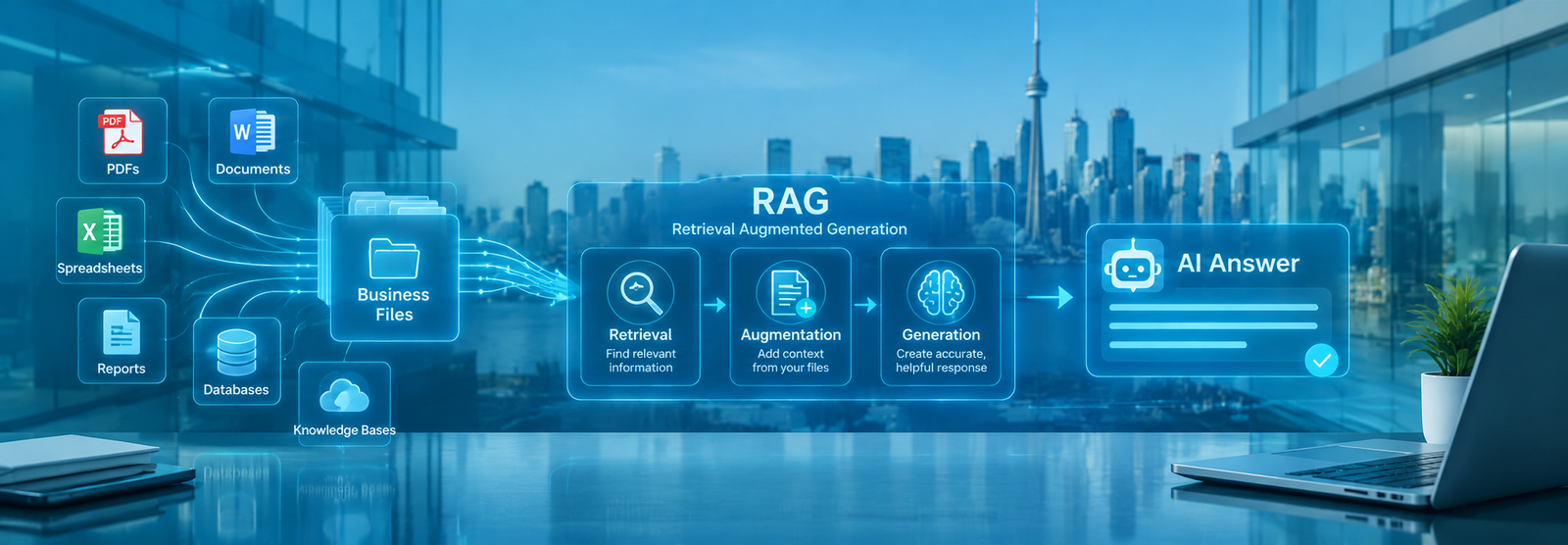
A system can use knowledge bases, retrieval augmented generation (RAG), and real-time data sources to retrieve relevant information before generating an answer or taking action.
RAG AI assistants are particularly useful when responses need to be grounded in internal documents, policies, product information, procedures, or other changing knowledge.
Step 6 — Complete and Verify the Task
After performing the required actions, the system can verify whether the workflow succeeded.
For sensitive operations, organizations can introduce a human-in-the-loop approval step.
This creates a balance between autonomous task execution and operational control.
How LLMs Power Agentic AI Assistants
Large language models provide much of the language understanding and generation capability behind modern AI assistants and agents.
Large Language Models
Large language models, or LLMs, process natural-language input and generate responses based on patterns learned during training and the context provided at runtime.
An LLM can serve as the reasoning and language layer inside:
- LLM-powered assistants
- LLM AI agents
- LLM chatbots
- Generative AI assistants
However, an LLM alone is not necessarily an agent. Agentic behavior generally requires additional components such as tools, memory, workflows, retrieval, planning, and execution mechanisms.
For organizations exploring these architectures, LLM integration services can connect language models with applications, data sources, and business workflows. More broadly, generative AI and LLM integration services can support applications that require LLM-based functionality.
RAG and Knowledge Bases
Retrieval augmented generation allows an AI system to retrieve relevant information before generating a response.
Instead of relying exclusively on the model’s existing knowledge, a RAG system can retrieve information from organizational knowledge bases and other approved sources.
This can improve responses involving:
- Internal policies
- Product documentation
- Customer records
- Procedures
- Technical documentation
- Business knowledge
Function Calling and APIs
Function calling enables an LLM-powered system to request specific actions from connected software.
For example, an AI assistant might determine that it needs to:
Check CRM → Retrieve customer record → Update ticket → Schedule follow-up
The LLM determines the appropriate tool or function, while the connected application performs the actual operation.
Memory and Context
Memory allows AI systems to maintain relevant information across interactions.
Combined with context awareness, memory can help assistants provide more personalized responses and support longer-running workflows.
10 Signs Your Business Needs an Agentic AI Assistant
Not every company needs to replace its chatbot. However, certain patterns indicate that a conventional chatbot may no longer be enough.
1. Your Chatbot Only Answers FAQs
If your chatbot primarily answers repetitive questions but cannot perform useful actions, you may be encountering common chatbot limitations for businesses.
FAQs remain one of the strongest applications of chatbots in business. The issue arises when customers expect the system to do more than provide information.
2. Customers Keep Asking for Human Help
If users repeatedly move from the chatbot to a human because the system cannot complete requests, customer support automation may need a more capable architecture.
AI customer service agents can potentially handle more complex requests by retrieving customer information, using connected tools, and following business workflows.
3. Customers Want Tasks Completed
Customers increasingly expect digital systems to solve problems rather than simply explain them.
If users ask the AI to update information, schedule appointments, check orders, initiate processes, or perform other actions, an agent architecture may be more appropriate.
Behind every reliable agentic AI system is infrastructure built to support real-time retrieval, tool calls, and scaling under load.
4. Your AI Cannot Access Your CRM
A chatbot that cannot access relevant customer information has limited ability to provide personalized assistance.
CRM integration, APIs, and tool integration allow an AI system to retrieve and work with business information under controlled permissions.
5. Your Workflows Require Multiple Steps
If a request requires several dependent actions, basic chatbot automation can become difficult to maintain.
Multi-step tasks, AI workflow automation, and AI agent workflow automation are better suited to workflows involving planning and execution.
6. Your Customers Need Personalized Responses
Generic answers may not be enough when users expect assistance based on their account, history, preferences, or current situation.
Memory and context awareness can support more personalized interactions.
7. Employees Spend Too Much Time on Repetitive Tasks
Employees may spend significant time copying information between systems, preparing reports, processing requests, updating records, or searching documentation.
This is a strong opportunity for understanding how AI assistants automate business tasks and applying AI automation for businesses to improve productivity and operational efficiency.
8. Your Business Needs Real-Time Information
Static knowledge is insufficient for workflows involving current inventory, order status, customer records, appointments, pricing, or operational information.
Access to real-time data, knowledge bases, and RAG AI assistants can make AI applications more useful in these environments.
9. You Need AI to Make Decisions Within Rules
Some workflows require an AI system to evaluate information and determine the next action.
Agentic systems can support autonomous decision-making within predefined business rules, permissions, and escalation policies.
Human approval can remain part of the workflow where necessary.
10. Your Business Needs Cross-System Automation
The strongest indication may be the need to coordinate several systems.
For example:
CRM + email + calendar + database + ticketing system + internal application
This type of AI-powered workflow can benefit from AI agent orchestration and, for larger workflows, multi-agent AI systems.
When Should a Business Upgrade From a Chatbot?
The decision should be based on the tasks the AI needs to perform, not simply the popularity of agentic AI.
Upgrade When Your AI Needs to Take Action
If the system needs to execute actions instead of simply answer questions, consider when to use an AI agent.
Examples include:
- Updating customer records
- Scheduling appointments
- Processing requests
- Creating tickets
- Retrieving account information
- Starting workflows
- Sending approved communications
Upgrade When You Need Workflow Automation
Chatbot automation vs agentic automation becomes particularly important when a workflow contains multiple dependent steps.
Basic AI chatbot automation works well for straightforward interactions. AI agent automation is more suitable when the system must determine and execute several actions.
Upgrade When You Need Business System Integrations
If the AI needs information or functionality from CRM, ERP, databases, calendars, APIs, or internal applications, integrations become essential.
Upgrade When You Need Autonomous Task Execution
When users provide a goal and expect the system to complete the workflow, autonomous AI agents for business may provide a better architecture than a conventional chatbot.
Agentic AI Assistant Use Cases for Business
An agentic AI assistant can be adapted to many business functions.
Customer Support
Customer service is one of the clearest use cases.
An AI customer service agent can potentially:
- Understand customer requests
- Retrieve account information
- Search a knowledge base
- Check order status
- Create support tickets
- Escalate complex cases
- Provide personalized responses
- Follow up on unresolved issues
These capabilities demonstrate how AI agents improve customer service beyond simple chatbot conversations.
For businesses considering round-the-clock support automation, a 24/7 AI customer support agent can serve as an example of how AI can be designed around continuous customer assistance. The shift toward more autonomous support is also explored in how agentic AI is changing customer support.
AI Sales Assistant
An AI sales assistant can help sales teams qualify leads, retrieve account information, prepare follow-ups, summarize conversations, and support sales workflows.
An AI agent for sales can potentially connect CRM data, communication systems, lead databases, and scheduling tools.
For example, an AI-powered lead qualification system can evaluate incoming leads against defined criteria before routing them to the appropriate sales representative. A practical example is an AI-powered lead qualification workflow.
AI Marketing Assistant
An AI marketing assistant can support content workflows, audience research, campaign analysis, reporting, customer segmentation, and repetitive marketing operations.
An AI agent for marketing can connect multiple tools and automate parts of a campaign workflow while keeping humans responsible for strategic decisions and approvals.
Build an Agentic AI Support System With Python Technologies
AI Operations Assistant
An AI agent for operations can coordinate repetitive processes involving internal applications, documents, databases, scheduling, notifications, and reporting.
This is particularly useful where business process automation requires several systems to work together.
AI Coding Assistant
An AI coding assistant can help developers write code, explain existing code, identify bugs, generate tests, analyze repositories, and support development workflows.
An agentic AI coding assistant can go beyond code suggestions by working through a defined development task, using tools, inspecting files, running tests, identifying failures, and iterating on the implementation under appropriate controls.
AI Personal Assistant
The personal-assistant category includes many AI use cases.
An AI personal assistant can help with:
- Scheduling
- Email management
- Task management
- Research
- Reminders
- Daily planning
- Productivity
- Work organization
Search interest also includes terms such as AI personal assistant agents, AI agent personal assistant, ai agents personal assistant, ai agent assist, ai agent for personal assistant, and best AI agent for personal assistant.
The important distinction is that an AI personal assistant describes a use case, while an agentic architecture describes how the system can reason about goals and execute tasks.
Agentic AI Assistant vs AI Personal Assistant
An AI personal assistant is designed around an individual’s needs. An agentic AI assistant describes a more capable architecture that can be used for personal or business workflows.
For example, a personal assistant might help manage:
- Calendar events
- Emails
- Tasks
- Reminders
- Research
- Meetings
- Daily planning
An autonomous personal AI assistant could potentially coordinate several of these tasks rather than simply providing information.
This makes concepts such as AI assistant for daily tasks, AI agent for productivity, and AI productivity assistant increasingly relevant.
For professionals, an AI assistant for work can also become an interface to workplace applications, helping manage schedules, information, documents, communication, and tasks.
Agentic AI Assistant vs Virtual Assistant
The terms virtual assistant and AI assistant are sometimes used interchangeably, but they can represent different technologies.
A traditional virtual assistant may be a human providing administrative services. An AI-powered virtual assistant uses software to perform assistance tasks.
The progression can be understood as:
Human Virtual Assistant → AI Virtual Assistant → AI Assistant → Agentic AI Assistant
A traditional virtual assistant may rely on human judgment. An AI assistant uses software to respond and perform supported functions. An agentic AI assistant can introduce planning, reasoning, tool usage, memory, and autonomous workflow execution.
This makes the AI assistant vs virtual assistant and AI agent vs virtual assistant distinctions important when evaluating automation opportunities.
ChatGPT vs Gemini vs AI Assistants vs AI Agents
AI products and AI architectures should not be treated as exactly the same thing.
ChatGPT vs AI Assistant
ChatGPT vs AI assistant is partly a comparison between a general-purpose AI product and an application designed around specific assistance tasks.
A business AI assistant may be built around a particular company’s workflows, data, permissions, integrations, and processes.
ChatGPT vs AI Agent
ChatGPT vs AI agent is another distinction worth making.
A conversational AI product can be used as part of an AI agent architecture, but an AI agent generally includes additional components for tools, workflows, memory, retrieval, and execution.
Gemini vs ChatGPT
When people compare ChatGPT and Gemini, the comparison usually concerns AI products and their capabilities.
The more important architectural question for businesses is whether either model can be incorporated into the required AI application, workflow, tool ecosystem, and governance model.
Therefore, Gemini vs ChatGPT is different from Gemini vs AI assistant.
AI Agent vs Generative AI
Generative AI focuses on generating content such as text, images, code, audio, or other outputs.
An AI agent can use generative AI as part of a larger system that reasons about tasks and takes actions.
That means:
Generative AI = content generation capability
AI agent = goal-oriented system capable of taking actions
Agentic AI = approach centered around autonomous or semi-autonomous task execution
This also explains the difference between generative AI vs conversational AI, AI vs generative AI, and AI agent vs generative AI.
Agentic AI Automation vs Chatbot Automation
Traditional chatbot automation can be represented as:
User → Question → Answer
Agentic automation can be represented as:
User → Goal → Reason → Plan → Tools → Actions → Verification → Result
This difference changes what businesses can automate.
Chatbot Automation
A chatbot is well suited for:
- FAQs
- Basic support
- Simple navigation
- Product information
- Basic lead capture
- Standard responses
Agentic Automation
Agentic systems are better suited to:
- Multi-step workflows
- Cross-system operations
- Personalized assistance
- Tool use
- Workflow orchestration
- Task completion
- Business process automation
The goal isn’t to make every chatbot autonomous. The goal is to use the right architecture for the required workflow.
Benefits of an Agentic AI Assistant for Business
Improved Customer Experience
Customers can receive more personalized responses and potentially complete tasks without moving between multiple systems.
Greater Productivity
An AI agent for productivity can reduce repetitive work by helping employees perform routine tasks, retrieve information, and coordinate workflows.
Operational Efficiency
Automating repetitive multi-step processes can reduce manual effort and improve operational efficiency.
Scalability
AI agents can support increasing volumes of requests without requiring every interaction to be handled manually.
Faster Task Completion
Instead of providing instructions, an AI assistant can potentially complete approved tasks directly.
More Personalized Interactions
Memory, context awareness, CRM integration, and real-time information can help create more relevant customer and employee experiences.
These are among the major benefits of agentic AI for business and the broader benefits of AI assistants for business.
When You Should NOT Upgrade to an Agentic AI Assistant
An agentic architecture is not automatically better for every business.
A chatbot may remain the better choice when:
- Customers primarily need FAQs.
- Questions are predictable.
- Workflows are extremely simple.
- No external systems need to be accessed.
- There is little value in autonomous execution.
- The cost of additional complexity is not justified.
- Business risk makes greater autonomy inappropriate.
For example, a website that only needs to answer opening-hours, pricing, shipping, and basic product questions may not need a complex AI agent.
In these situations, AI automation vs chatbot should be evaluated based on actual business value.
The right question is not:
“Can an agent do this?”
It is:
“Does the additional capability create enough value to justify the additional complexity?”
Types of Agentic AI Assistants
Different businesses can deploy specialized assistants around different workflows.
Customer Service Agents
Designed for support, ticketing, customer records, knowledge retrieval, and issue resolution.
Sales Agents
Designed for lead qualification, CRM updates, follow-ups, scheduling, and sales support.
Marketing Agents
Designed for campaign workflows, content operations, reporting, research, and marketing automation.
Operations Agents
Designed for internal processes, approvals, reporting, data processing, and business workflows.
Coding Agents
Designed for software development, testing, debugging, repository analysis, and development automation.
Personal AI Assistants
Designed for scheduling, email management, task management, research, productivity, and personal workflows.
For larger organizations, enterprise AI assistants and enterprise AI agents can be designed around organizational security, access control, governance, compliance, and system integrations.
Single-Agent vs Multi-Agent AI Systems
A single-agent architecture uses one primary agent to coordinate a workflow.
For example:
Customer request → One AI agent → CRM + knowledge base + ticketing system
A multi-agent AI system uses several specialized agents.
For example:
Customer request → Supervisor Agent → Support Agent + CRM Agent + Knowledge Agent + Scheduling Agent
The supervisor can coordinate specialized agents through AI agent orchestration.
Multi-agent systems can be useful when workflows become sufficiently complex to justify separating responsibilities.
Organizations evaluating this architecture should also consider AI agent frameworks, workflow management, permissions, monitoring, and failure handling.
For businesses exploring orchestration approaches, agentic AI tools for business process automation can provide useful context on the technology landscape.
How to Build an Agentic AI Assistant for Your Business
Building an agentic system should start with the business workflow rather than the AI model.
Define the Business Goal
Identify exactly what the assistant needs to accomplish.
For example:
“Reduce customer support resolution time”
is more useful than:
“We need an AI agent.”
Identify Workflows
Document the current process and identify repetitive steps, decisions, system interactions, and human approvals.
Choose the LLM
Select an appropriate large language model based on requirements such as reasoning, latency, cost, context, reliability, and integration requirements.
Connect Business Data
Identify the information the assistant needs to access.
Add RAG
Use retrieval augmented generation where the assistant needs access to business-specific knowledge.
Add APIs and Tools
Connect CRM, ERP, databases, calendars, ticketing systems, internal applications, and other tools.
Add Memory
Determine which information should be remembered and for how long.
Add Human-in-the-Loop Controls
Define actions that require human approval before execution.
Test and Monitor
Test normal scenarios, edge cases, incorrect requests, failed API calls, security boundaries, and escalation conditions.
Deploy and Optimize
Start with a controlled workflow, monitor performance, and gradually expand the assistant’s responsibilities.
Custom Agentic AI Assistant Development Services
Businesses that need more than an off-the-shelf chatbot may require AI agent development services tailored to their workflows.
Custom AI assistant development can include:
- AI assistants
- AI agents
- Custom chatbots
- RAG systems
- LLM integrations
- API integrations
- Workflow automation
- CRM integrations
- Memory systems
- Agent orchestration
- Human approval workflows
AI chatbot development remains appropriate for simpler conversational applications, while custom AI assistant development and custom AI agent development become more relevant when applications need deeper integrations and autonomous workflows.
For organizations exploring these options, agentic AI services in Canada can support business-focused agentic AI implementations. Businesses targeting regional automation requirements can also explore AI agents in Canada and solutions involving custom AI agents for GTA businesses.
How Much Does an Agentic AI Assistant Cost?
The cost of an agentic AI assistant depends heavily on its complexity.
Important cost factors include:
- LLM/API usage
- Development
- Number of integrations
- RAG implementation
- Databases
- Memory
- Security
- Monitoring
- Workflow complexity
- Number of agents
- Human oversight
- Hosting and infrastructure
A basic assistant connected to one knowledge base can be significantly simpler than an enterprise AI agent coordinating CRM, ERP, support, payment, scheduling, and internal systems.
The underlying software architecture therefore matters as much as the AI model itself.
For organizations evaluating broader application development requirements, custom software development services in Canada can provide context on how custom software projects are planned and delivered. Businesses can also evaluate custom software development as part of a larger AI-enabled application strategy.
Step-by-Step: How to Upgrade From a Chatbot to an Agentic AI Assistant
Step 1: Audit Your Existing Chatbot
Identify what the chatbot currently handles successfully and where users abandon the interaction.
Step 2: Identify Repetitive Tasks
Find tasks employees or support teams repeatedly perform manually.
Step 3: Identify Multi-Step Workflows
Document workflows involving several actions or systems.
Step 4: Identify Required APIs
Determine which systems the AI needs to access.
Step 5: Connect Business Knowledge
Organize documents, policies, product information, and other relevant knowledge.
Step 6: Add RAG
Use retrieval augmented generation when the system needs grounded access to business information.
Step 7: Add Tools and Function Calling
Allow the AI to interact with approved APIs and applications.
Step 8: Add Memory
Introduce memory where it provides genuine value for ongoing workflows or personalization.
Step 9: Establish Human-in-the-Loop Controls
Define which actions can be automated and which require approval.
Step 10: Test Before Full Deployment
Test the system against real-world scenarios, failures, edge cases, permissions, and escalation requirements.
Step 11: Monitor Results
Track task completion, accuracy, customer experience, escalation rates, productivity, and operational outcomes.
Step 12: Expand the Agent’s Responsibilities
Once the initial workflow performs reliably, gradually introduce additional tools and tasks.
This approach allows businesses to move from a chatbot toward an AI agent without attempting to automate every process at once.
Agentic AI Assistant Decision Framework
Business Requirement | Recommended Solution |
Basic FAQs | Chatbot |
Simple customer questions | Chatbot |
Knowledge retrieval | AI Assistant |
Personalized answers | AI Assistant |
Employee productivity | AI Assistant |
Scheduling | AI Assistant |
Email management | AI Assistant |
Multi-step workflows | Agentic AI Assistant |
CRM actions | Agentic AI Assistant |
API-based actions | Agentic AI Assistant |
Autonomous task completion | AI Agent |
Complex business automation | Agentic AI |
Multiple specialized workflows | Multi-Agent AI |
This framework highlights an important point: not every chatbot needs to become an AI agent.
The upgrade makes sense when the required business outcome exceeds the capabilities of the existing conversational system.
The Future of Agentic AI Assistants
The development of agentic AI is part of broader AI technology trends involving generative AI, automation, AI agents, LLM applications, and increasingly autonomous software systems.
Future AI assistants are likely to become more capable of maintaining context, using tools, accessing real-time information, coordinating workflows, and working with other specialized agents.
Generative AI trends are also moving toward applications that do more than generate content. Instead, generative models can become components within systems that retrieve information, reason about objectives, call tools, and execute workflows.
The emergence of AI agents with memory, reasoning capabilities, multi-agent AI systems, and AI agent orchestration may therefore change how businesses approach software automation.
Organizations considering adoption can explore agentic AI in 2026 for a broader view of current business automation applications. For foundational concepts, what is agentic AI, its benefits and future explains the technology and its potential applications. Businesses evaluating the broader market can also review AI adoption in Canada and how organizations are approaching AI implementation.
Conclusion — Is It Time to Upgrade to an Agentic AI Assistant?
A chatbot is still a useful technology. If customers primarily need answers to frequently asked questions, product information, basic navigation, or simple support, upgrading may provide little additional value.
The situation changes when users expect the AI to do more.
If an AI system needs to understand context, remember relevant information, access business systems, retrieve real-time data, or help employees complete tasks, an AI assistant may be the appropriate next step.
If the system needs to reason, plan, use tools, interact with APIs, coordinate multiple steps, and autonomously complete approved workflows, an agentic AI assistant can provide a significantly more capable architecture.
The most effective upgrade strategy is therefore not to replace a chatbot simply because agentic AI is a growing trend. Instead, identify the limitations of the current system, map the workflows users actually need, and introduce agentic capabilities where they create measurable business value.
For organizations ready to move from conversational automation toward autonomous workflows, agentic AI services in Canada can help translate specific business requirements into AI assistant and agent-based solutions.
Future AI assistants are likely to become more capable of maintaining context, using tools, accessing real-time information, coordinating workflows, and working with other specialized agents.
Generative AI trends are also moving toward applications that do more than generate content. Instead, generative models can become components within systems that retrieve information, reason about objectives, call tools, and execute workflows.
The emergence of AI agents with memory, reasoning capabilities, multi-agent AI systems, and AI agent orchestration may therefore change how businesses approach software automation.
Organizations considering adoption can explore agentic AI in 2026 for a broader view of current business automation applications. For foundational concepts, what is agentic AI, its benefits and future explains the technology and its potential applications. Businesses evaluating the broader market can also review AI adoption in Canada and how organizations are approaching AI implementation.
Frequently Asked Questions
What is an agentic AI assistant?
An agentic AI assistant is an AI-powered assistant that can understand goals, reason about tasks, access information, use connected tools, execute actions, and complete multi-step workflows with varying levels of autonomy.
What is the difference between a chatbot and an AI agent?
A chatbot primarily focuses on conversation and responses. An AI agent is designed to pursue an objective by using reasoning, tools, data, and actions to complete tasks.
When should a business upgrade from a chatbot?
A business should consider upgrading when its chatbot needs to do more than answer questions, particularly when users need personalized information, multi-step task completion, system integrations, real-time data, or workflow automation.
What are the signs you need an AI assistant?
Common signs include repetitive employee tasks, frequent customer escalations, demand for personalized assistance, disconnected business systems, and users asking the AI to perform tasks rather than simply answer questions.
What is the difference between conversational AI and agentic AI?
Conversational AI focuses primarily on interaction through natural language. Agentic AI adds capabilities such as planning, reasoning, tool use, memory, and task execution.
How do AI agents work?
AI agents typically combine an LLM with context, reasoning, tools, APIs, data retrieval, memory, workflows, and execution mechanisms to achieve a defined objective.
How do AI assistants work?
AI assistants receive user requests, interpret the intent, retrieve relevant information, generate responses, and may perform supported tasks through connected applications.
Can an AI agent replace a chatbot?
An AI agent can perform many chatbot functions while adding task execution and automation capabilities. However, a simple chatbot may remain more appropriate when the business only needs basic FAQ or informational functionality.
What are the benefits of agentic AI for business?
Benefits can include greater productivity, operational efficiency, scalability, improved customer experience, personalized interactions, faster task completion, and broader workflow automation.
What is the difference between AI and machine learning?
Artificial intelligence is the broader field of creating systems capable of performing tasks associated with intelligence. Machine learning is a major approach within AI that enables systems to learn patterns from data.
What is the difference between AI and generative AI?
AI is the broader category. Generative AI refers to AI systems designed to generate new content such as text, images, audio, video, or code.
What is the best AI personal assistant?
The best AI personal assistant depends on the user's requirements, including scheduling, email management, task automation, integrations, privacy, memory, platform compatibility, and the level of autonomy required. The best AI agent for personal assistant use cases is therefore not necessarily the same for every user.
About
Menu
Locations

© 2026 – Python Technologies. All Rights Reserved.